From my friend Cary Perkins who found this gem:
Charles Sanders Peirce quote of the day: In the late 1800s, Peirce makes a prediction: "The twentieth-century, in its latter half, shall surely see the deluge-tempest burst upon the social order, -- to clear upon a world as deep in ruin as that greed-philosophy has plunged it into guilt…. You might pronounce the Wall Street sharp to be a good angel, who takes money from heedless persons not likely to guard it properly, who wrecks feeble enterprises better stopped, and who administers wholesome lessons to unwary scientific men, by passing worthless checks among them… (357)." Peirce’s prediction – projecting a century into the future – is remarkable but all the worse for its uncanny accuracy.
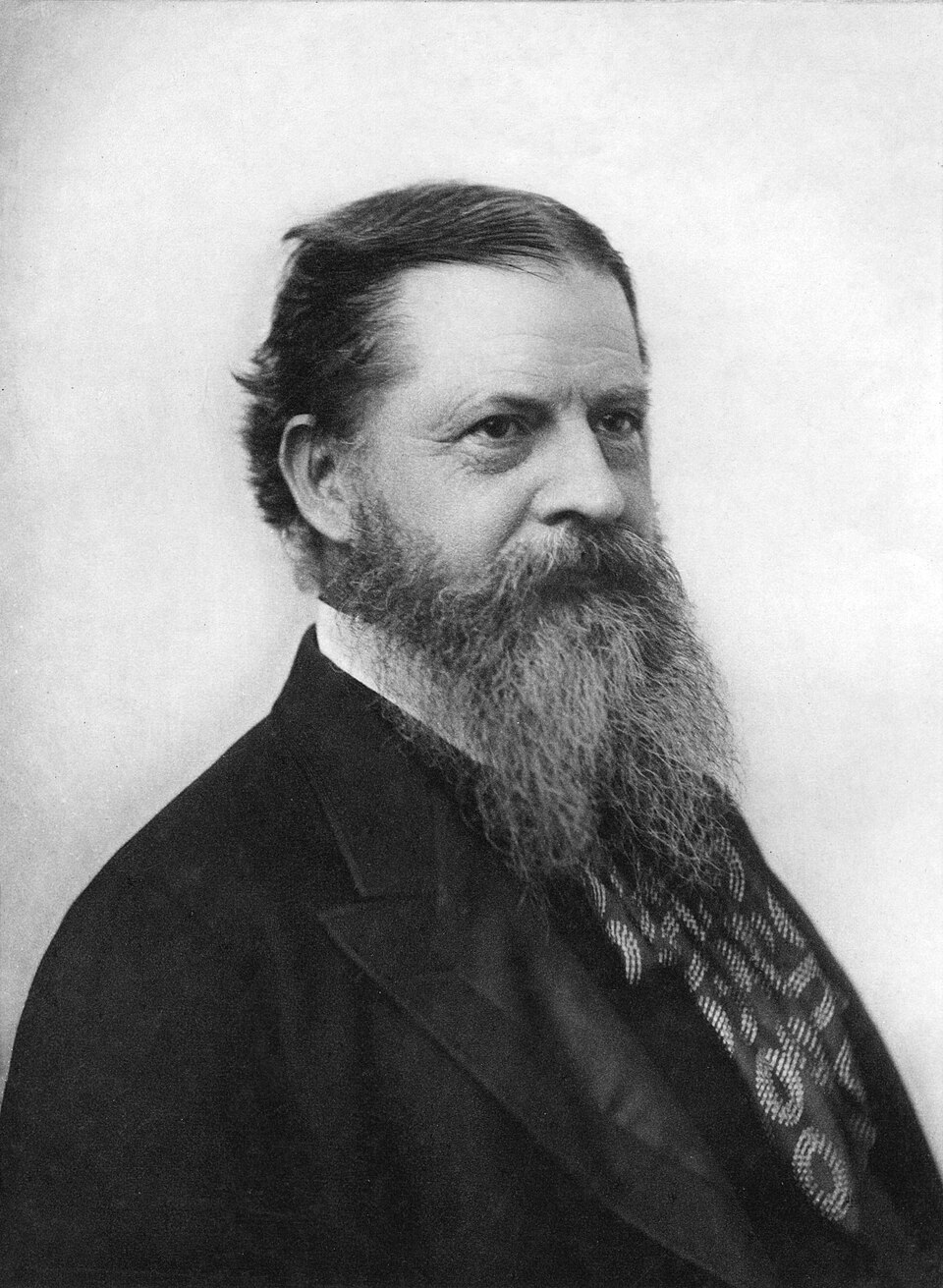
Charles Sanders Peirce in an 1891 portrait by Napoleon Sarony. Public domain image via Wikimedia Commons and the New York Public Library.
Who was Charles Sanders Peirce?
Charles Sanders Peirce was one of the most original American thinkers of the nineteenth century: a logician, mathematician, scientist, philosopher, and founder of pragmatism. He worked for decades as a scientist, including extensive work connected to measurement, geodesy, logic, and the philosophy of inquiry. That matters here because his warning about the coming century was not just a literary flourish. It came from someone who spent his life thinking about evidence, habits, systems, signs, probability, and how communities arrive at truth.
The quoted passage comes from Peirce's 1893 essay Evolutionary Love, published in The Monist. In that essay, Peirce was arguing against a view of progress based almost entirely on competition, selfishness, and economic struggle. He described that attitude as a kind of greed philosophy and contrasted it with his own idea that growth, inquiry, and social development require continuity, sympathy, and cooperative correction over time.
That is why the Wall Street language feels so striking today. Peirce was not simply predicting one market crash or one scandal. He was warning that a society which turns greed into a principle can eventually damage its own moral and social foundations. The line seems especially sharp when read after the twentieth century's financial panics, corporate frauds, speculative bubbles, and the long political argument over whether markets alone can produce a healthy society.
Peirce's broader philosophy also helps explain the force of the prediction. His pragmatism was not the modern slogan that whatever works is true. It was a theory of inquiry: ideas have meaning in their practical consequences, and truth is approached through a disciplined community of investigation over time. A society organized around clever private gain, deception, and short-term extraction would therefore be hostile to the very habits that make truth-seeking and democratic life possible.
In that sense, the passage still reads less like a prophecy than a diagnosis. Peirce saw that the celebration of the sharp operator, the financier who "teaches lessons" by ruining others, could be dressed up as efficiency or moral discipline. But he also saw the danger: when exploitation is treated as wisdom, the social order eventually pays the bill.
Sources and notes: Biographical context is drawn from the Stanford Encyclopedia of Philosophy entry on Charles Sanders Peirce. The quoted passage is from Peirce's 1893 essay "Evolutionary Love". The portrait is a public-domain 1891 image from Wikimedia Commons, sourced to the New York Public Library.