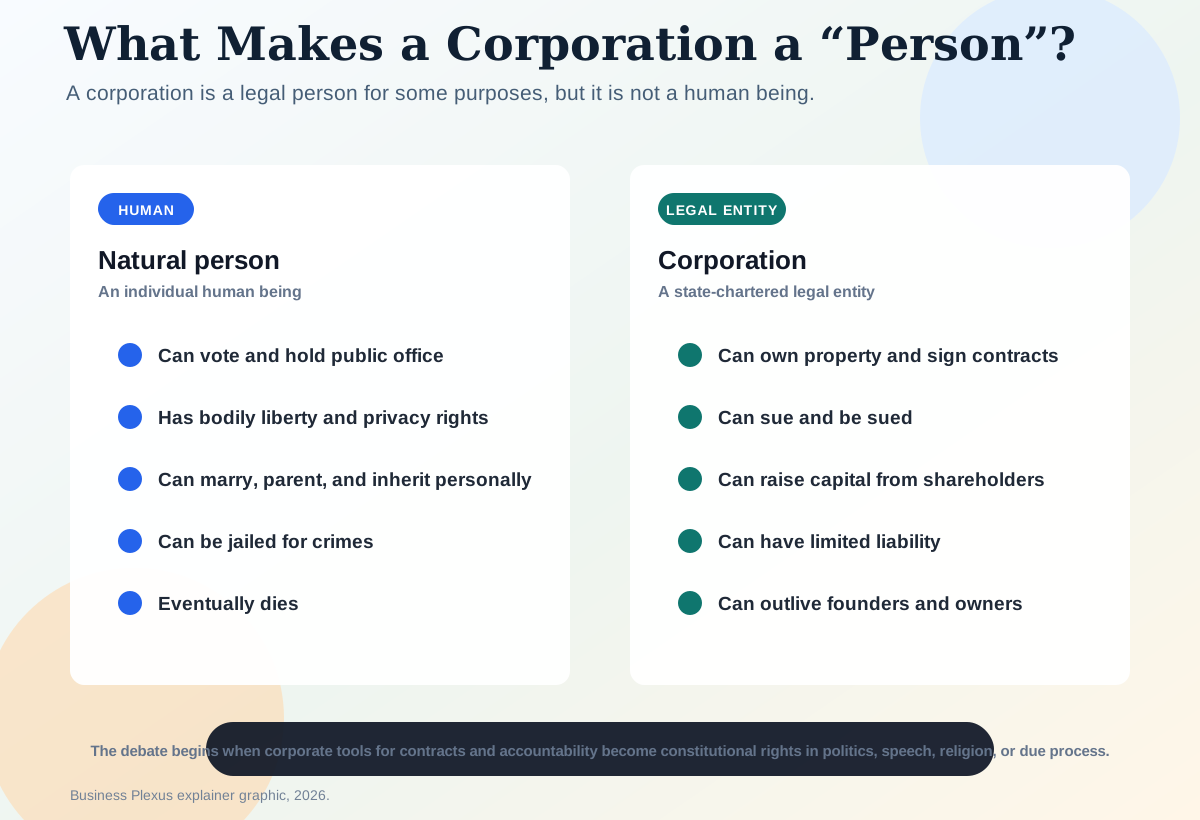
A corporation is one of the most powerful inventions in economic history. It is not a building, a logo, or even the people who work for it. A corporation is a legal entity created by law. It can own property, sign contracts, borrow money, hire employees, sue, be sued, pay taxes, and continue existing even when founders, managers, and shareholders come and go.
That may sound technical, but it matters. The corporation is one of the main tools modern societies use to organize capital, risk, labor, property, and responsibility. It lets thousands or millions of people invest in a common enterprise without each investor personally running the business or becoming personally liable for every corporate debt.
The basic idea: a legal person, not a human person
Lawyers often describe a corporation as a legal person or artificial person. That does not mean a corporation is human. It means the law gives the organization a separate identity so it can act in the legal system. Without that separate identity, every contract, lawsuit, loan, lease, or property title would have to run through individual owners.
This legal personality solves practical problems. If a company sells a defective product, customers need an entity to sue. If a business borrows money, lenders need a borrower. If a company owns a factory, land records need an owner. The corporation supplies that stable identity.
A short history of the corporation
The corporate form is older than the modern stock market. Early corporations included towns, universities, churches, guild-like bodies, and public-purpose institutions. They were not necessarily business companies. They were legal bodies that could hold property and survive changes in membership.
Business corporations became more important as trade grew. Joint-stock companies made it possible to pool money from many investors for ventures too large or risky for one merchant or family. The Dutch and English East India companies are famous examples of chartered companies that combined private investment with state power, global trade, and colonial ambition.
In the United States, corporations were originally more tightly chartered by states. Over time, incorporation became easier and more general. Instead of receiving a special legislative charter for a specific public purpose, businesses could incorporate under general corporation laws. That shift helped create the modern corporation as a routine business form.
Why limited liability changed everything
One of the corporation's biggest features is limited liability. In ordinary circumstances, shareholders can lose the money they invested, but they do not personally owe the corporation's debts. If a shareholder buys $1,000 of stock, the usual maximum loss is that $1,000, not the company's entire unpaid loan balance.
Limited liability encourages investment because it caps risk. It also separates ownership from management. Shareholders can invest, boards can govern, executives can manage, and employees can work inside a single enterprise. That structure makes large companies possible, but it also creates accountability questions: if no single owner is personally responsible, who should bear the cost when a corporation harms workers, consumers, competitors, or communities?
Individual rights versus corporate rights
A human being has rights because human dignity, liberty, conscience, and bodily autonomy matter. A corporation has rights because the legal system needs an entity capable of owning property, making contracts, going to court, and protecting the rights of the people associated with it. Those are related ideas, but they are not the same.
People can vote, marry, have children, serve on juries, be imprisoned, and die. Corporations cannot do those things. Corporations can own assets, issue stock, enter contracts, merge, dissolve, and exist indefinitely. A corporation can be fined, regulated, taxed, or dissolved, but it cannot be jailed in the human sense.
Corporate personhood in American law
The American debate often turns on the phrase corporate personhood. At its narrowest, corporate personhood is practical: corporations can sue and be sued, own property, and enter contracts. At its broadest, it raises constitutional questions about whether corporations can claim protections that sound like human rights.
Several Supreme Court cases shaped that debate. In Trustees of Dartmouth College v. Woodward in 1819, the Court treated a corporate charter as a protected contract. In Santa Clara County v. Southern Pacific Railroad in 1886, the Court accepted that corporations could receive equal-protection treatment under the Fourteenth Amendment. In Citizens United v. FEC in 2010, the Court held that corporate independent political expenditures are protected by the First Amendment. In Burwell v. Hobby Lobby in 2014, the Court held that closely held for-profit corporations could claim protection under the Religious Freedom Restoration Act.
Those cases do not mean corporations have every right that people have. They mean courts have sometimes extended particular legal or constitutional protections to corporations because corporations are associations of people, property-holding entities, speakers, employers, publishers, or contracting parties. The controversy is about where to draw the line.
The case for corporate rights
There is a practical case for many corporate rights. If a newspaper corporation has no speech rights, press freedom becomes weaker. If a business has no property rights, the government could seize assets arbitrarily. If a corporation cannot go to court, customers, employees, and shareholders may also lose an important path to accountability.
Corporate rights can therefore protect real people. A corporation may be an artificial person, but employees, customers, investors, creditors, and communities all interact through it. The legal fiction exists because it helps the law deal with organized activity.
The case for limits
The danger is that corporate rights can become stronger than human rights in practice. Corporations can accumulate capital, lobby continuously, hire lawyers, influence regulation, and survive for generations. A human person has one vote and one lifetime. A large corporation can have vast resources, international reach, and no natural lifespan.
That is why many people are uncomfortable when corporations claim rights in areas like elections, religion, privacy, or political influence. The problem is not that corporations have legal personality. The problem is deciding when that legal personality should help society hold organizations accountable, and when it lets organizations overpower the human beings the law is supposed to serve.
So what is a corporation?
A corporation is a tool. It is a legal container for ownership, risk, contracts, assets, labor, and responsibility. It can be used to build useful products, create jobs, raise capital, and organize complex projects. It can also be used to distance decision-makers from harm, concentrate power, and turn social costs into someone else's problem.
The best way to understand a corporation is to hold two truths at once. A corporation is not a person in the human sense. But it is treated as a person for specific legal purposes because society needs a way to make organizations act, own, promise, pay, and answer for what they do.
Sources and notes: General definitions from Britannica and Cornell's Legal Information Institute entries on corporations, limited liability, and companies. Historical background from Britannica's discussion of business organization and limited liability. Key corporate-rights cases include Dartmouth College v. Woodward, Santa Clara County v. Southern Pacific Railroad, Citizens United v. FEC, and Burwell v. Hobby Lobby.