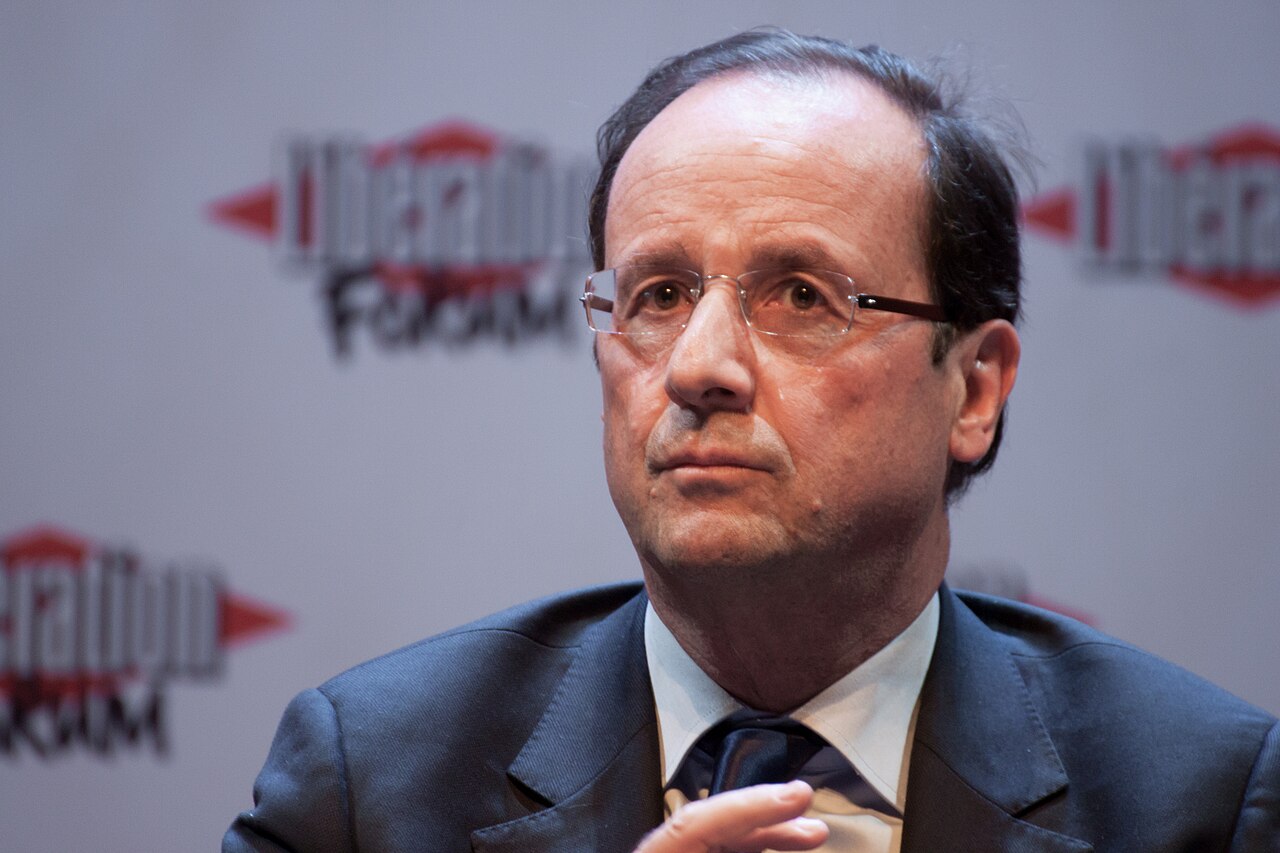
François Hollande at Forum Libération de Grenoble in January 2012. Photo by Matthieu Riegler, CC BY 3.0, via Wikimedia Commons.
Francois Hollande's victory in the French presidential election is not only part of a sea change in European politics, marked by continent-wide disillusionment with austerity, but also represents a return to socialism, which remains the intellectually and culturally dominant ideology in France. The public turned against the incumbent Nicolas Sarkozy partly because of his association with the prevailing climate of budgetary discipline within the EU and failure to reinvigorate the economy, but the extent of his unpopularity lies in his betrayal of the core values of French socialism.
History weighs heavily against the French right, especially in the current climate, and the French Revolution has lost none of its symbolic value. Left Front presidential candidate Jean-Luc Melenchon led a march on the Bastille as part of his campaign and even the placid Hollande was prepared to invoke the revolutionary spirit. Louis XVI's execution serves as a continual reminder of the French government's duty to its people. The "president of the rich" had to go.
Sarkozy's economic liberalism was the antithesis of French socialism, and not just because itresulted in rising inequality and unemployment. It also threatened the welfare state, held by many to be sacrosanct, and drove a wedge between the government and the people. Pension reforms, tax increases and reductions in welfare spending shifted the burden of fiscal responsibiliy to those who could least afford it, raising the question of who is serving who.
Strict demands on the state can only be supported by solidarity among the people, and French socialism has always had a communal spirit. Throughout his presidential campaign, Hollande presented himself as Mr Normal, steering clear of the divisive rhetoric of his right-wing opponents and differentiating himself from the prickly Sarkozy. This unity provides a partial solution to the identity crisis which has marred the French Socialist Party since its modernisation under Francois Mitterrand.
Responding to the crisis of liberalism and problems caused by austerity, the French left has revitalised itself along traditional lines. Hollande has little romantic idealism, but his policies suggest that he will seek to place the government once again in the service of the people, returning to the principle at the heart of French socialism which causes it to be valued so highly by the nation.
What happened after the anti-austerity vote?
Looking back, Hollande's 2012 victory was both a French political event and a European signal. He defeated Nicolas Sarkozy in the second round with 51.64% of the vote to Sarkozy's 48.36%, and he did so at a moment when the eurozone crisis had turned austerity into the central political question across the continent. In his victory remarks, Hollande framed the result as a mandate to give Europe a growth dimension and to argue that austerity was not inevitable.
That was the appeal of the campaign: not a promise to abandon fiscal responsibility entirely, but a claim that budget discipline without jobs, growth, and social protection would break the political compact. In France, that compact has always been unusually tied to the state. The welfare state is not merely a set of programs; it is part of the republican promise that citizenship should mean more than exposure to market forces.
The difficult part was that Hollande inherited the same constraints he had campaigned against. France still had deficit targets, weak growth, pressure from European partners, and financial markets watching the credibility of the new government. Within weeks, the anti-austerity language had to meet the arithmetic of budgets. The result was a presidency that tried to protect parts of the social model while still making tax and spending choices that many voters experienced as austerity by another name.
That tension helps explain why the 2012 moment was so revealing. French voters were not simply choosing bigger government in the abstract. They were rejecting the idea that the cost of the financial crisis should fall mainly on workers, pensioners, public services, and the unemployed. Hollande's campaign worked because it spoke to a moral expectation: the state should ask sacrifice in a way that feels reciprocal and fair.
In the longer run, the story became more complicated. Hollande struggled with unemployment, weak approval ratings, and divisions inside the Socialist Party. By 2017, the old party system was badly weakened, and Emmanuel Macron won the presidency by moving outside the traditional Socialist-versus-Gaullist structure. Even so, the basic question raised in 2012 remains alive in France and Europe: how much market discipline can a democracy absorb before voters demand a different balance between growth, solidarity, and social protection?
Sources and notes: Election figures are from official and contemporary summaries of the 2012 French presidential result. Background on Hollande's anti-austerity campaign and the European growth debate is drawn from Brookings, The Guardian, and contemporary coverage of the 2012 election. Image source: Wikimedia Commons.