Samsung's July 7, 2026 earnings guidance should have been enough to make chip investors cheer. The company estimated second-quarter consolidated sales of about 171 trillion Korean won and operating profit of about 89.4 trillion won, nearly nineteen times the year-earlier operating profit. Instead, Samsung shares fell sharply in Seoul and pulled other memory and semiconductor names lower.
That reaction does not mean AI chip demand has disappeared. It means the semiconductor market has become more complicated than the simple phrase "AI chips are hot." Some chips are genuinely scarce. Some are selling well but already priced for perfection. Some are recovering slowly. Some are still stuck in ordinary consumer or industrial cycles.
The better question is not whether semiconductors are doing well. The better question is: which semiconductors?
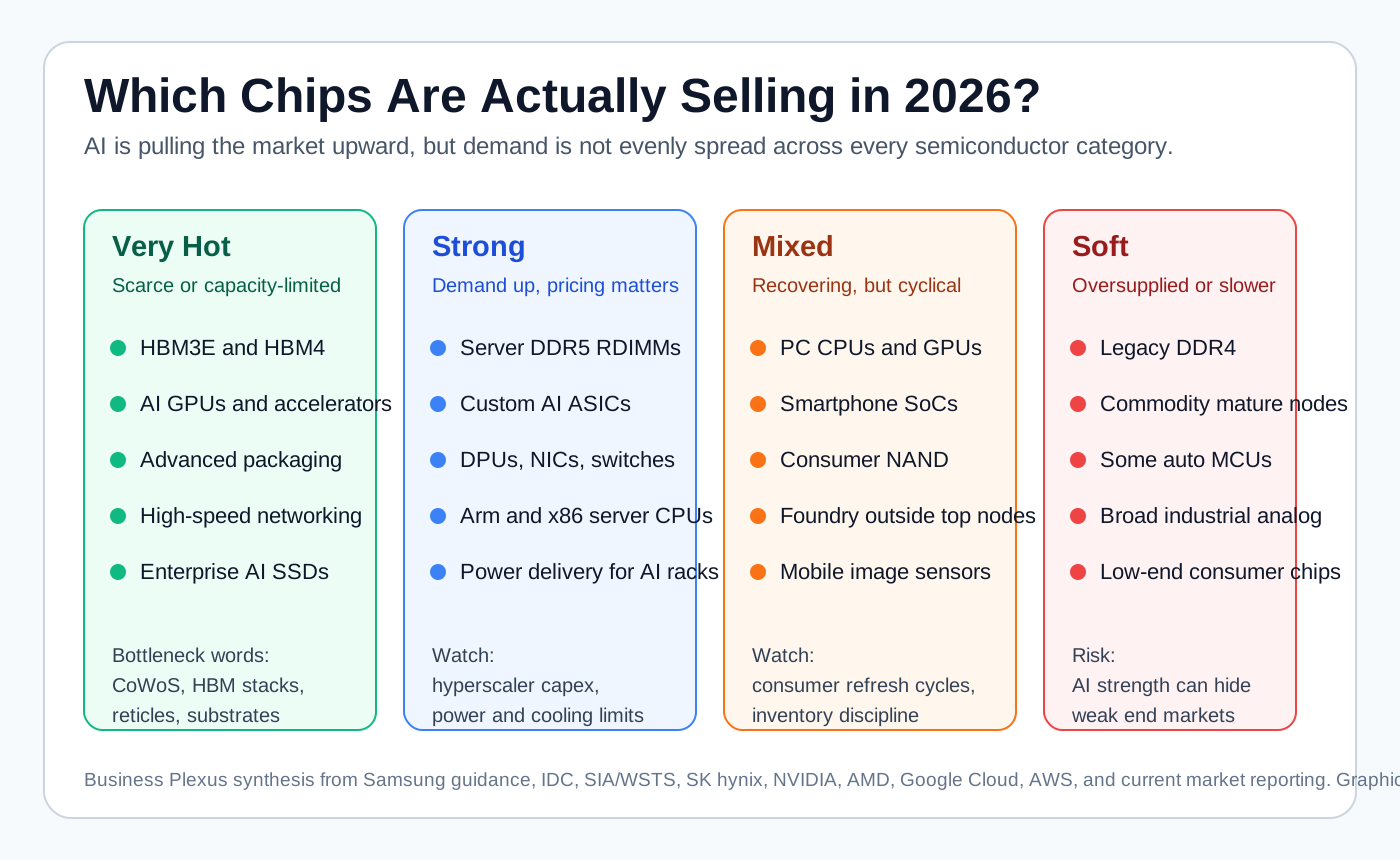
Business Plexus graphic summarizing 2026 chip demand by category.
Quick demand map
| Chip category | Important names and keywords | Demand right now | Outlook |
|---|---|---|---|
| High-bandwidth memory | HBM3E, HBM4, 12-high HBM, 16-high HBM, TSV stacking, interposers, SK hynix, Samsung, Micron | Very strong | The most important memory bottleneck for AI accelerators. HBM remains one of the clearest winners, though investors are watching for oversupply after capacity catches up. |
| AI accelerators | NVIDIA Blackwell, Blackwell Ultra, Rubin, AMD Instinct MI350, MI355X, MI400, Google TPU Ironwood, AWS Trainium3, custom ASICs | Very strong | Demand is still intense, but the bar for stocks is high. Buyers care about full rack performance, software, networking, power, cooling, and cost per token. |
| Server memory | DDR5 RDIMM, MRDIMM, CXL memory, LPDDR5X server modules, SOCAMM, high-capacity DIMMs | Strong | AI servers use HBM near the accelerator, but they also need large pools of system memory. DDR5 server memory is benefiting from the same data center buildout. |
| NAND and enterprise SSDs | eSSD, PCIe 5.0 SSD, PCIe 6.0 SSD, QLC NAND, TLC NAND, checkpoint storage, AI dataset storage | Strong | Enterprise storage is stronger than consumer storage because AI training, inference, retrieval, and checkpointing consume huge storage capacity and bandwidth. |
| Networking and data movement | InfiniBand, Ethernet AI fabrics, Spectrum-X, Spectrum-6, ConnectX, DPUs, SmartNICs, optical DSPs, co-packaged optics | Strong | The AI cluster is becoming the product. That makes networking chips, switches, NICs, DPUs, retimers, and optical interconnect chips more important. |
| Advanced packaging | CoWoS, SoIC, 2.5D packaging, chiplets, interposers, substrates, hybrid bonding, fan-out packaging | Capacity-limited | Packaging is not always called a chip category, but it is one of the biggest bottlenecks. AI accelerators cannot ship without enough advanced packaging capacity. |
| PC and smartphone chips | Apple M-series, Apple A-series, Qualcomm Snapdragon, MediaTek Dimensity, Intel Core, AMD Ryzen, mobile NPUs | Mixed | AI PCs and AI phones help, but consumer replacement cycles are slower than the data center cycle. Good products do not automatically mean explosive unit growth. |
| Automotive, industrial, analog, and power | MCUs, MOSFETs, IGBTs, SiC, GaN, PMICs, sensors, motor-control chips, battery-management ICs | Mixed to soft | These chips remain essential, but many mature-node and industrial categories are still digesting inventory. SiC and GaN have better long-term stories than generic mature-node parts. |
Why Samsung could report huge profits and still sell off
Samsung's result is a clean example of the difference between business strength and stock-market expectations. Samsung's official guidance put second-quarter operating profit at approximately 89.4 trillion won, compared with 4.68 trillion won in the same quarter of 2025. That is a spectacular operating improvement.
But the market had already moved. By the time the guidance arrived, investors had spent months buying the AI memory story. Business Insider reported that Samsung fell as much as 10% and closed down 7%, while SK Hynix also declined, because investors wanted more than a strong quarter. They wanted evidence that memory pricing power can last and that today's shortage will not become tomorrow's overcapacity problem.
That is the central tension in chips right now. The demand is real, but in some categories the stocks are priced as if the demand curve will stay perfect.
HBM is the hottest memory market
High-bandwidth memory is the most important memory product in the AI boom. HBM sits beside the accelerator package rather than out on a normal memory module. It uses stacked DRAM dies connected through through-silicon vias, or TSVs, and delivers enormous bandwidth to GPUs and AI ASICs.
The key names are HBM3E and HBM4. HBM3E is the current workhorse for many AI systems. HBM4 is the next major step, widening the interface and increasing bandwidth for future accelerators. NVIDIA says its Rubin GPU uses HBM4 and is designed around AI factory workloads where memory bandwidth, interconnect, power, and cooling all matter together. AMD's Instinct MI350 series uses HBM3E, with the MI355X configuration offering up to 288GB of HBM3E and up to 8TB/s of memory bandwidth.
The suppliers are SK hynix, Samsung, and Micron. SK hynix has been the clearest HBM leader, especially in HBM3E. Samsung wants to close the gap, and Micron has become more important as customers try to diversify supply. This is why memory stocks have been treated almost like AI infrastructure stocks.
HBM is selling well because it is not easily substituted. If an AI accelerator design depends on HBM capacity and bandwidth, a buyer cannot simply replace it with cheap commodity DRAM. The risk is later, not now: if every supplier expands aggressively, the shortage premium can eventually fade.
AI accelerators are still the center of gravity
AI accelerators are the chips most people mean when they say "AI chips." The obvious name is NVIDIA, with Hopper, Blackwell, Blackwell Ultra, and Rubin. But the field is broader than NVIDIA GPUs. AMD is competing with the Instinct MI300 family and MI350 series, with MI400 expected to be its next big data-center step. Google has its TPU line, including Ironwood. Amazon has Trainium, including Trainium3 UltraServers. Microsoft, Meta, Tesla, Broadcom customers, and other hyperscalers are also pushing custom ASICs.
That last phrase matters: custom ASICs. An application-specific integrated circuit is a chip designed for a narrower workload than a general-purpose GPU. Hyperscalers use ASICs because they want better cost, power efficiency, and supply control for their own AI workloads. AWS says Trainium3 UltraServers scale to 144 Trainium chips with 20.7TB of HBM3e and 706TB/s of aggregate memory bandwidth. Google says Ironwood TPUs are designed for the age of inference, with 192GB of HBM per chip and 7.37TB/s of HBM bandwidth per chip.
So yes, high-end AI accelerators are still selling. The market concern is not that nobody needs them. The concern is whether buyers can keep increasing capital spending fast enough to justify the valuations of every company attached to the trade.
Server DRAM is benefiting from the same AI buildout
HBM gets the attention, but ordinary server memory is also important. AI servers still need CPUs, system memory, storage, networking, and control-plane resources. Large inference systems need room for retrieval-augmented generation, caching, routing, orchestration, and preprocessing. Training systems need memory for data pipelines and host-side coordination.
That supports DDR5 server RDIMMs, high-capacity memory modules, MRDIMMs, CXL memory products, and newer module concepts such as SOCAMM. NVIDIA's Vera CPU discussion, for example, points to LPDDR5X-based SOCAMM memory as part of the platform architecture. The broad point is that AI does not only buy one expensive accelerator. It buys a whole rack of memory and data-movement silicon.
This is also why conventional DRAM pricing has been strong. Reuters-carried reporting noted that DRAM and NAND average selling prices rose sharply in the second quarter, while rapid HBM production tightened supply of conventional memory products used in smartphones, PCs, and servers.
NAND is stronger in data centers than in consumer gadgets
NAND flash has two different stories. Consumer NAND, such as the flash inside phones, laptops, USB drives, and low-end SSDs, remains tied to ordinary consumer electronics demand. Enterprise NAND is different. AI systems need storage for training datasets, model checkpoints, logs, vector databases, inference caches, and retrieval systems.
That makes enterprise SSDs, or eSSDs, one of the better parts of the NAND market. The keywords to watch are PCIe 5.0 SSD, PCIe 6.0 SSD, QLC NAND, TLC NAND, high-throughput read performance, endurance, and data-center SSD power efficiency. IDC forecasts NAND Flash revenue to reach $174.1 billion in 2026, up sharply from 2025, with AI infrastructure a major driver.
The subtle point is that not all NAND benefits equally. A hyperscaler buying high-performance enterprise SSDs for AI infrastructure is not the same as a weak consumer buying cycle for bargain laptops.
Networking chips are becoming more important
AI clusters are limited not only by compute. They are limited by moving data between accelerators. That makes networking chips a major part of the AI buildout. Look for terms like InfiniBand, Ethernet AI fabric, RDMA, RoCE, SmartNIC, DPU, optical DSP, retimer, switch ASIC, Spectrum-X, ConnectX, BlueField, co-packaged optics, and 800G or 1.6T networking.
NVIDIA's Vera Rubin platform is a good example of the direction. It is not just a GPU. NVIDIA describes a platform with a Vera CPU, Rubin GPU, NVLink 6 switch, ConnectX-9, BlueField-4 DPU, and Spectrum-6 Ethernet switch. The product is increasingly the rack or cluster, not the lone chip.
That is why Broadcom, Marvell, NVIDIA networking, optical component suppliers, PCB/substrate companies, and advanced packaging providers all matter in the AI chip conversation. If the network cannot keep the accelerators busy, expensive GPUs sit idle.
PC and smartphone chips are more mixed
Consumer chips are improving, but they are not the same market as AI data-center chips. Apple M-series chips, Apple A-series chips, Qualcomm Snapdragon platforms, MediaTek Dimensity chips, Intel Core processors, AMD Ryzen processors, mobile NPUs, and discrete PC GPUs all have AI-related marketing now. Some of that is real. On-device inference, image generation, transcription, translation, and local assistants can use neural processing units and unified memory.
But consumer demand is still tied to replacement cycles. A better NPU does not automatically make everyone replace a phone or laptop immediately. That is why we recently wrote about the Mac mini becoming an AI workhorse: local AI demand can create surprising pockets of hardware strength, but it does not mean every consumer chip category is in shortage.
The outlook for PC and smartphone chips is therefore mixed. Premium devices, AI PCs, developer machines, and high-end phones can do well. Low-end consumer electronics are more exposed to household budgets and inventory discipline.
Automotive, analog, industrial, and power chips are not one market
Automotive and industrial chips were the stars of the shortage era after 2020. Microcontrollers, analog chips, sensors, power management ICs, MOSFETs, IGBTs, and battery-management chips became painfully scarce. That has changed. Many mature-node categories have been digesting inventory, and industrial demand has been uneven.
That does not mean these chips are unimportant. Cars, factories, robots, energy systems, and power electronics still need them. But "important" is not the same as "shortage-priced." Automotive MCUs and broad industrial analog chips can be essential while still facing slower orders if customers already overbought.
The better long-term stories are more specific: silicon carbide (SiC) for electric vehicles and high-voltage power systems, gallium nitride (GaN) for efficient power conversion, advanced power delivery for AI racks, high-voltage data-center power systems, and chips used in grid and battery infrastructure. These are not as glamorous as HBM or GPUs, but power is becoming one of the constraints on AI deployment.
Foundry is split between advanced nodes and everything else
The foundry market is also bifurcated. Advanced-node capacity at the very top of the market remains strategically important. TSMC's leading nodes, advanced packaging, and AI customer relationships are central to the current cycle. Samsung Foundry and Intel Foundry are trying to win more leading-edge business, but the market is not rewarding all foundry capacity equally.
Older mature-node capacity is a different story. Some mature-node chips are critical, but capacity additions after the shortage years created pockets of oversupply. A 28nm microcontroller, a display driver, or a commodity power-management chip does not behave like an HBM stack or AI accelerator.
That is one reason the chip market can look contradictory. The industry can be in a supercycle at the top while some mature-node factories are still fighting pricing pressure.
So is the selloff about high-end chips?
Partly, but not in the way it may look at first. The July 7 selloff was not a signal that customers suddenly stopped buying HBM, AI accelerators, or data-center memory. The strongest evidence points the other way. IDC forecasts total semiconductor revenue of $1.29 trillion in 2026, with data-center semiconductors at $477.1 billion and DRAM revenue nearly tripling. SIA reported that April 2026 global semiconductor sales were up 93.9% year over year and endorsed a WSTS forecast for 2026 sales of $1.5 trillion.
The selloff is more about valuation, pricing durability, and the fear of a future supply response. Investors are asking whether the best part of the memory price move is already known. They are also asking whether hyperscalers can keep spending hundreds of billions of dollars on AI data centers without eventually slowing down to prove return on investment.
In plain English: the chips are selling, but the stocks have been priced as though the chips will keep selling at exceptional margins for a long time.
What to watch next
The first thing to watch is HBM allocation. If SK hynix, Samsung, and Micron remain sold out on HBM3E and HBM4 for key customers, the AI memory story stays strong. If customers begin pushing back on price or if new capacity arrives faster than expected, the tone changes.
The second thing is hyperscaler capital expenditure. Microsoft, Alphabet, Amazon, Meta, Oracle, CoreWeave, xAI, OpenAI infrastructure partners, and other AI buyers are effectively setting the demand curve for advanced chips. If capex keeps rising, AI accelerators, HBM, enterprise SSDs, networking, and advanced packaging remain supported.
The third thing is inference economics. Training created the first wave of demand. Inference, reasoning models, agents, long-context workloads, retrieval systems, and real-time AI services are supposed to create the next one. If those workloads monetize, demand broadens. If they disappoint, investors will start questioning the size of the buildout.
The fourth thing is the non-AI chip market. A healthy semiconductor cycle should eventually include autos, industrial, PCs, phones, analog, power, and mature-node products. Right now, AI is doing a lot of the lifting.
The most realistic outlook is a split market. HBM, AI accelerators, server memory, enterprise SSDs, networking chips, and advanced packaging remain the strongest categories. PC and smartphone chips are selective. Automotive, analog, industrial, and mature-node chips are more uneven. That is why a company can report record profit and still fall: investors are no longer asking whether the AI boom is real. They are asking who keeps the pricing power when the boom becomes normal.
Sources and further reading: Samsung's Q2 2026 earnings guidance; Business Insider and MarketWatch on the July 7 selloff; IDC's 2026 semiconductor forecast; SIA/WSTS April 2026 sales and forecast update; SIA and Deloitte on chips inside AI data-center racks; SK hynix's 2026 HBM-led memory outlook; NVIDIA's Vera Rubin platform overview; AMD's Instinct MI350 series specifications; Google Cloud's Ironwood TPU announcement and technical stack discussion; AWS's Trainium3 UltraServer information; and Reuters-carried reporting via WTAQ on DRAM and NAND pricing.