China is often described as a country of savers, while the United States is described as a country of borrowers. There is truth in that stereotype, but it is no longer enough to explain what is happening in either economy.
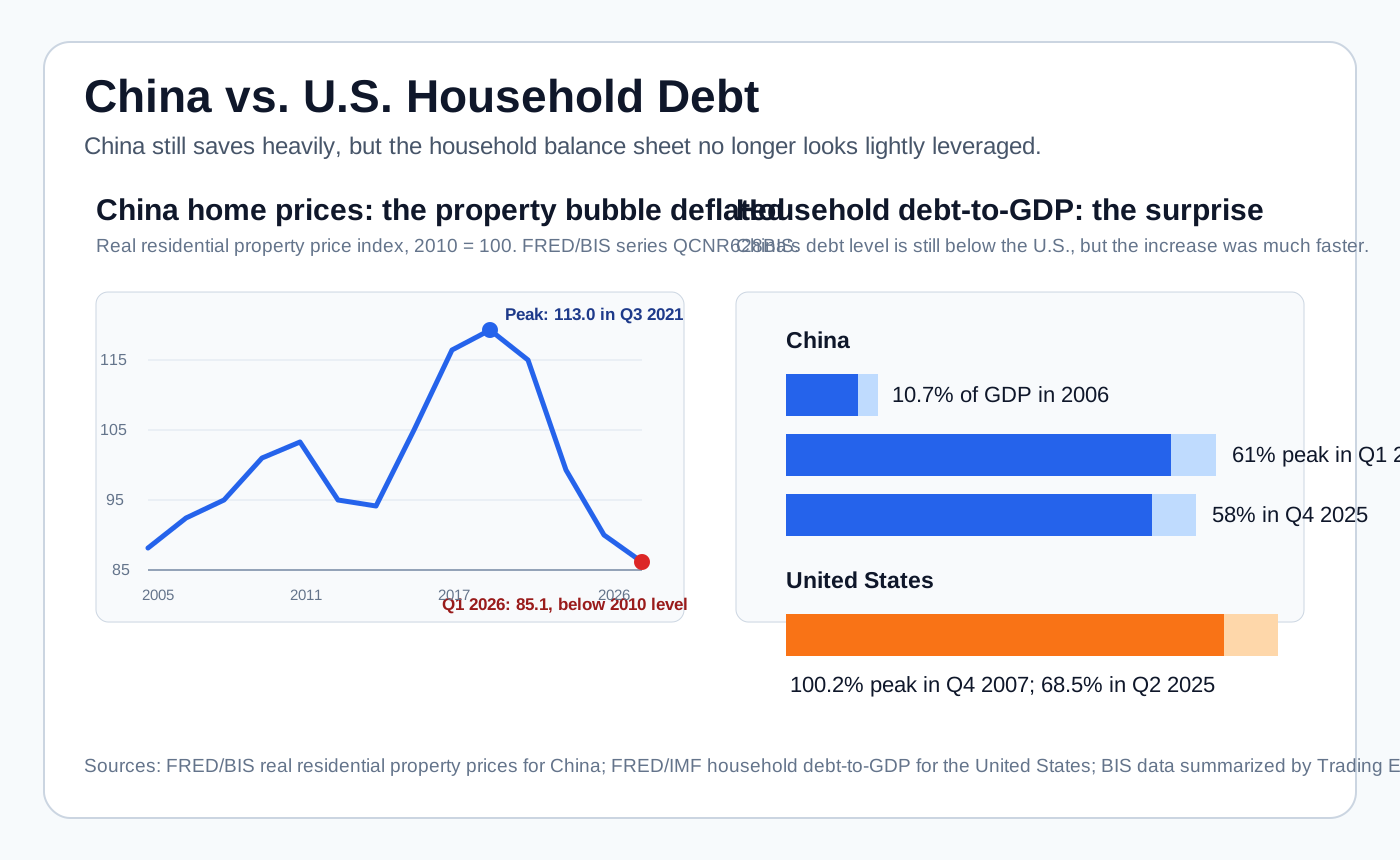
The striking chart circulating from FRED and the Bank for International Settlements shows China's real residential property prices falling to their lowest level in the series. The index peaked around 113 in 2021 and fell to 85.1 by the first quarter of 2026, below its 2010 level. That is a huge property deflation.
The deeper question is what that means for household balance sheets. If Chinese households were simply sitting on cash, a property downturn would be painful but manageable. But China's households are no longer lightly indebted. They borrowed heavily during the housing boom, and much of that borrowing was tied to apartments whose prices are now falling.
Business Plexus graphic based on FRED, BIS, IMF, and Trading Economics data.
The old China savings story is incomplete
Chinese households still save a lot for structural reasons. The social safety net is thinner than in many advanced economies. Education costs, medical costs, retirement worries, housing costs, and uncertainty about future income all encourage precautionary saving. Families also tend to think about savings across generations: parents help children buy homes, children support aging parents, and apartments have been treated as both shelter and a family financial asset.
But high saving does not mean low debt. A household can save aggressively and still borrow heavily to buy property. That is roughly what happened in China. During the long housing boom, apartments became the main store of wealth for many families. Mortgage debt rose. Developers relied on presales. Local governments relied on land sales. Banks relied on property-related collateral. The result was a system where household saving and household leverage grew side by side.
That is why the current property slump matters. It is not just a decline in asset prices. It is a decline in the asset that many households thought was their safest long-term savings vehicle.
China's household debt rose very fast
According to BIS-based data summarized by Trading Economics, China's household debt-to-GDP ratio was only about 10.7% in 2006. It climbed to an all-time high of about 61% in the first quarter of 2024 and was still around 58% in the fourth quarter of 2025.
That is still below the U.S. ratio, but the direction is the important part. China went from very low household leverage to a level that is much closer to rich-country norms in less than two decades. That shift happened before China reached U.S. income levels, which makes the debt burden more sensitive to weak employment, falling home prices, and weaker income expectations.
The comparison is even sharper because the U.S. moved the other way after the housing crisis. FRED's household debt-to-GDP series for the United States peaked at about 100.2% in the fourth quarter of 2007. By the second quarter of 2025, it had fallen to about 68.5% of GDP. In other words, the U.S. household sector spent many years deleveraging after 2008, while China's household sector was still levering up through the property boom.
The U.S. is still indebted, but the structure is different
American households carry a lot of debt in absolute terms. The New York Fed's Household Debt and Credit Report put total U.S. household debt at $18.8 trillion in the first quarter of 2026. Mortgages are the largest piece, followed by student loans, auto loans, credit cards, and other consumer debt.
But relative to GDP, U.S. households are not as stretched as they were before the 2008 financial crisis. That does not mean everything is healthy. Credit-card balances, auto-loan stress, and high mortgage rates still matter. The Federal Reserve's June 2026 debt-service release is also worth watching because higher rates make each dollar of household debt more expensive to carry.
The difference is that the U.S. household-debt story today is less about a property bubble still deflating and more about affordability, rates, and uneven stress across lower-income borrowers. China is dealing with the aftereffects of a much broader property-led balance-sheet shock.
Did China deflate the bubble without a recession?
The Reddit headline gives China a lot of credit: the People's Bank of China managed to deflate a massive, leveraged housing bubble without a single quarter of economic contraction. Technically, that is mostly the official macro story. China has continued to report positive real GDP growth even as property prices, developer balance sheets, land sales, and consumer confidence weakened.
But that does not mean the process has been painless or that the real economy kept all its momentum. A country can avoid an official recession while still experiencing a property depression, weak household confidence, deflationary pressure, falling local-government land revenue, and slower private-sector hiring. The absence of a negative GDP quarter is not the same thing as a clean escape.
The property downturn has also changed household psychology. When home prices were rising, buying property felt like disciplined saving. When home prices are falling, the same mortgage can feel like a drag on future consumption. That is the important shift.
The wealth effect cuts both ways
In the United States, the housing bust after 2006 damaged household wealth, reduced credit access, and forced years of deleveraging. China is facing a different version of that problem. Its financial system is organized differently, its capital controls are different, and its government can direct banks and local governments in ways the U.S. cannot. But the household logic is familiar: when the asset you borrowed to buy starts falling, families become more cautious.
That caution can show up as higher saving, weaker consumption, less willingness to take risk, and more pressure on policymakers to support households directly. It can also make stimulus less effective. If households are worried about jobs, home values, and unfinished apartments, they may save tax cuts or subsidies rather than spend them.
This connects directly to our earlier article on China's housing crisis and whether it is getting worse. The household-debt question is one reason the property slump matters beyond developers. It affects consumption, confidence, local government finance, and the way Chinese families think about the future.
So are Chinese households still better savers?
Yes, but not in the simple old way. Chinese households still save more than American households for cultural, institutional, and precautionary reasons. But the idea that Chinese families are simply sitting on safe cash while Americans borrow recklessly is outdated.
A large share of Chinese household wealth was effectively saved into property. That worked while prices rose. It becomes much more complicated when real residential prices fall below 2010 levels and debt remains attached to the household.
Meanwhile, American households are still heavily indebted in dollar terms, but they have already lived through a post-2008 deleveraging cycle. U.S. household debt-to-GDP is far below its housing-bubble peak. China is closer to the uncomfortable middle stage: household debt has already risen, property values are falling, and consumer confidence is fragile.
The real comparison
The cleanest comparison is this: the U.S. had its household-debt crisis first, then spent years reducing household debt relative to GDP. China built household leverage later, then hit a property downturn before its households became as wealthy as American households.
That does not make China the same as the United States in 2008. China's banks, capital controls, state direction, savings behavior, and policy tools are different. But it does mean the old savings stereotype needs revision. Chinese households may still save more, but they are also carrying much more debt than they used to, and the asset behind much of that debt has been falling.
The question for China is not whether households know how to save. They do. The question is whether a household sector that saved through property can keep supporting the economy when property no longer feels like a one-way store of wealth.
Sources and further reading: FRED's Real Residential Property Prices for China series, sourced from the Bank for International Settlements; FRED's Household Debt to GDP for the United States series, sourced from the IMF; Trading Economics summary of BIS China household debt-to-GDP data; the New York Fed's Household Debt and Credit Report; the Federal Reserve's Household Debt Service Ratio release; and the Business Plexus article on China's housing crisis, local debt, and population shift.