I find it interesting how for many years small businesses claimed their biggest problem was high taxes, but now that we have lowered taxes (under Reagan and then Bush 2) the biggest problem reported is Poor Sales.

That shift says a lot about the limits of the usual tax argument. For years we were told that lower taxes would unlock growth and solve the biggest problems for small businesses. But once taxes were lower, many small businesses were still pointing to poor sales as the real issue.
That makes sense. A business can only hire, expand, and invest when customers are actually buying. If demand is weak, lower taxes may help at the margins, but they do not magically create customers. Sometimes the problem is not that businesses are being held back from producing more. It is that ordinary people do not have enough money or confidence to spend.
What the old data was really saying
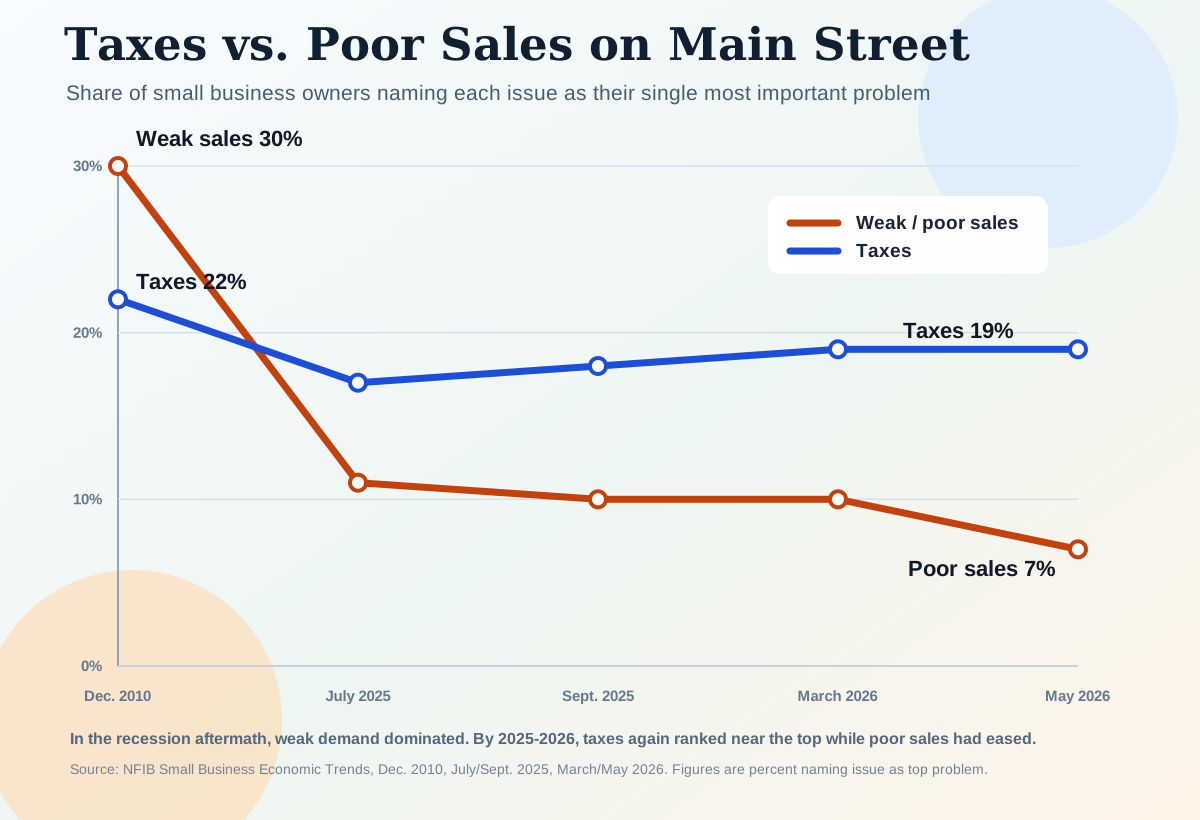
The original point was written in the long aftermath of the financial crisis. In December 2010, the NFIB Small Business Economic Trends report said 30% of owners named weak sales as their top business problem, compared with 22% naming taxes. That was not a small-business sector begging first for another tax cut. It was a small-business sector saying customers were missing.
That distinction matters. A tax cut can improve after-tax profit for a business that already has customers. It can also leave more cash inside the business. But it does not automatically create demand. A restaurant with empty tables, a contractor with no calls, or a retailer with slow foot traffic needs customers before a tax change can do much.
The 2026 update: taxes are back, but the lesson remains
Recent NFIB surveys show a different picture. By 2025 and 2026, taxes had moved back near the top of the list, while poor sales had fallen sharply as a share of owners' top concern. NFIB's May 2026 report said 19% of owners named taxes as their single most important problem, while poor sales fell to 7%.
That does not prove taxes never matter. Of course they matter. Taxes affect cash flow, pricing, hiring plans, owner income, and the ability to reinvest. But the return of taxes as a top issue actually supports the deeper point: when sales are weak, demand dominates the conversation. When sales are less weak, owners have more room to worry about taxes, labor, inflation, insurance, financing, and regulation.
NFIB has made a similar point in recent reports, noting that taxes ranking as the top issue can be a sign that other problems, such as labor quality, inflation, and poor sales, are not currently as severe. In other words, a tax complaint may sometimes be a sign of normal business frustration rather than economic emergency.
Why poor sales are different from high taxes
Poor sales are a demand problem. They say customers are not spending enough, not confident enough, or not finding enough value at current prices. High taxes are a cost and policy problem. They say the government is taking a share of income, payroll, property, sales, or profits that owners believe is too high.
Those problems require different answers. If poor sales are the problem, the economy needs stronger household income, steadier jobs, better consumer confidence, and enough broad demand to keep cash registers ringing. If taxes are the problem, the debate is about rates, deductions, compliance complexity, and whether the tax code is fair to small firms compared with large businesses.
Small businesses can survive taxes when customers are steady. They cannot survive forever without sales. That is why the recession-era data was so revealing: the problem was not mainly that owners were desperate to produce more and being stopped by Washington. It was that consumers had pulled back after a housing crash, job losses, and a credit shock.
The politics of small-business complaints
Small businesses are often used as symbols in political arguments. One side says taxes and regulation are the main problem. Another side says weak demand and inequality are the main problem. Real business owners usually live with all of it at once. A small employer can be hurt by taxes, hurt by slow sales, hurt by insurance costs, hurt by rent, hurt by inflation, and hurt by a shortage of qualified workers.
The mistake is pretending one explanation works in every period. In 2010 and 2011, weak sales were the heart of the pain. In 2025 and 2026, tax uncertainty, inflation, labor costs, insurance, and regulation are more prominent. The lesson is not that taxes are irrelevant. The lesson is that demand matters more than slogans.
What helps small businesses most?
The best small-business policy depends on the moment. In a demand crisis, direct support for household incomes, employment, and credit can help customers return. In a period of inflation, businesses need stable costs, predictable supply chains, and enough pricing power to protect margins. In a period of tax uncertainty, clear rules and simple compliance can matter as much as the headline tax rate.
Small business owners are practical. They do not hire because a politician tells them to. They hire when they need help serving customers. They do not expand because a tax talking point sounds good. They expand when demand, margins, financing, and confidence line up. The biggest problem reported by small businesses therefore tells us something important about the economy underneath the politics.
Sources and notes: Recession-era data from NFIB Small Business Economic Trends, December 2010, which reported weak sales at 30% and taxes at 22% as top business problems. Recent data from NFIB's July 2025, September 2025, March 2026, and May 2026 reports. Figures are rounded or reported as published by NFIB.