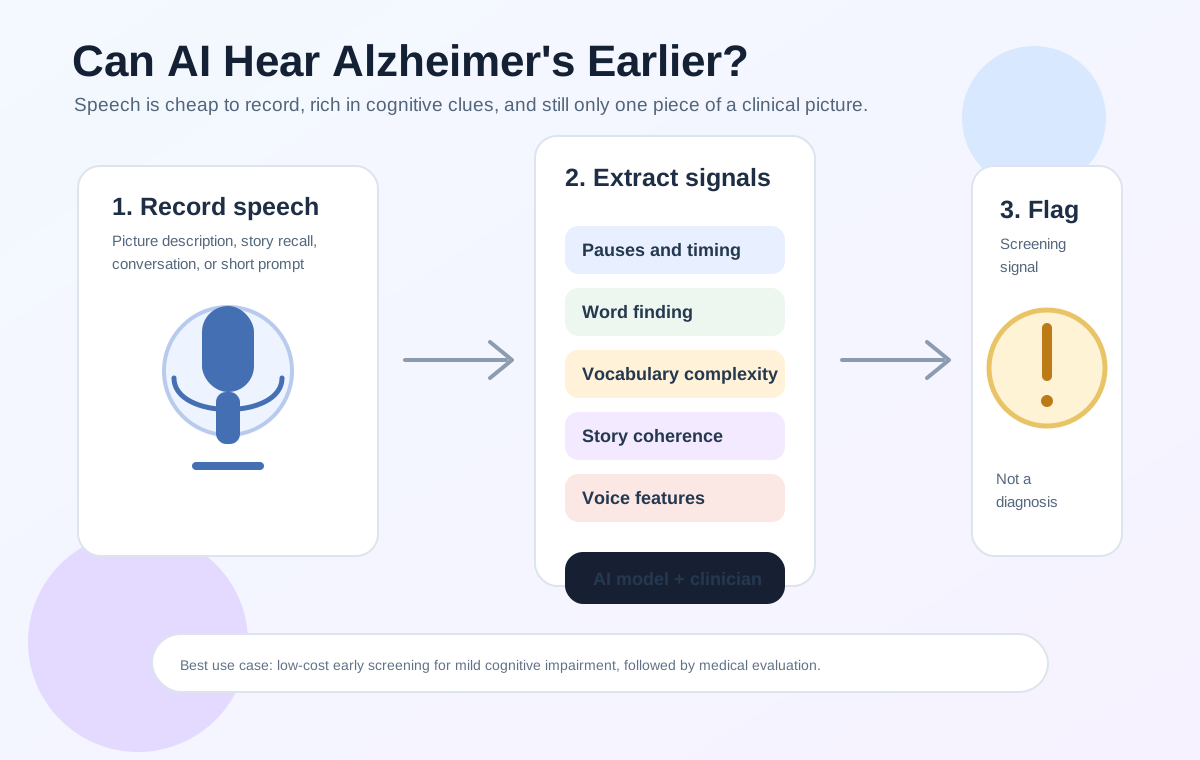
One of the more promising uses of AI in medicine is also one of the least invasive: listening to how someone speaks. Researchers have found that changes in speech and language can appear before obvious memory problems, and machine-learning systems can measure subtle patterns that family members, and sometimes even clinicians, may not notice in ordinary conversation.
The idea is not that an app listens for one magic phrase and declares someone has Alzheimer's disease. That would be both medically unsafe and technically unrealistic. The better framing is that speech may become a cheap early-warning signal: something that can suggest a person should receive a more complete cognitive evaluation.
What AI listens for
The first signal is word-finding difficulty. People in the early stages of cognitive impairment may pause more often, use vague substitutes such as "thing" or "stuff," have trouble naming objects, or begin a sentence and lose track of where it was going. A listener might hear this as ordinary hesitation. AI can count the pauses, measure their duration, and compare patterns over time.
A second signal is vocabulary and grammar. Models can examine vocabulary size, sentence length, grammatical complexity, word variety, and the density of ideas in a spoken or written sample. This is why the famous Nun Study is still relevant. Researchers found that autobiographical essays written by young nuns, decades before old age, contained linguistic patterns associated with later cognitive outcomes. That does not mean simple writing causes Alzheimer's, but it showed that language can carry long-range information about brain health and cognitive reserve.
A third signal is timing. Speech can sound normal in content while changing in rhythm. Longer pauses, more hesitations, slower speaking rate, and delayed responses can be meaningful. A 2025 study that added pause information to language models reported 83.1% accuracy on the ADReSSo speech dataset, showing why timing is now treated as a serious feature rather than background noise.
Storytelling may reveal more than word choice
Many studies do not rely on casual conversation alone. Participants may be asked to describe a picture, retell a story, or recall a recent event. AI then analyzes whether the account stays on topic, whether important details are omitted, whether pronouns become vague, and whether the narrative becomes disorganized.
This matters because Alzheimer's disease is not just forgetting a word. It affects memory, attention, planning, semantic knowledge, and the ability to organize information. A short speech sample can contain traces of all of those systems at once.
Voice features may add another layer
Some systems also analyze acoustic features: pitch variation, voice stability, breathing patterns, vocal effort, and other properties of the audio signal. These features are less specific to Alzheimer's because voice can be affected by age, medications, depression, Parkinson's disease, fatigue, hearing problems, respiratory illness, and recording quality. Still, acoustic data can improve performance when combined with language features and demographics.
Recent foundation-model research points in the same direction. A 2025 benchmark using spontaneous speech found that speech-model embeddings performed better than text-only language models for classifying cognitive status, while pause annotations improved text-based models. A 2025 National Institute on Aging PREPARE Challenge paper reported AUC values around 0.88 for classifying healthy controls, mild cognitive impairment, and Alzheimer's disease, and around 0.90 for MCI detection in its SpeechCARE system.
Why mild cognitive impairment is the key target
The most valuable use case is not detecting advanced dementia. By that point, family members and clinicians often already see the changes. The more important target is mild cognitive impairment, or MCI, where the person may still function independently but has measurable decline. Some people with MCI progress to Alzheimer's disease; others remain stable or improve, especially if another cause is found.
That uncertainty is exactly why speech AI should be treated as a screening tool. A speech signal might say, "This person should be evaluated." It should not say, "This person has Alzheimer's." A real evaluation still needs clinical history, cognitive testing, medication review, sleep and mood assessment, hearing and vision context, lab work, imaging when appropriate, and physician judgment.
Why this could matter
Speech is inexpensive. It does not require a scanner, spinal tap, or blood draw. It can be collected from a phone, tablet, telehealth visit, or short clinic recording. That makes it attractive for early screening, especially in primary care or rural areas where specialist access is limited.
In the future, passive monitoring may become possible. A phone could detect that a person's speech has changed over months or years and suggest a checkup. That idea is powerful, but it also raises privacy problems. Continuous voice monitoring would need strong consent, local processing where possible, clear data deletion rules, and protections against insurers, employers, or platforms misusing cognitive-risk signals.
The limits are real
Accuracy numbers in research often range from the 70% to 90% area, depending on the dataset, task, language, disease stage, and evaluation method. Those numbers are promising, but they can be misleading. A model trained on one dataset may perform worse in another clinic, another language, another accent group, or another recording environment. Some studies use small or carefully selected samples. Some compare clear Alzheimer's cases with healthy controls, which is easier than detecting subtle early decline in real-world patients.
Bias is another issue. Speech models can be confounded by education, native language, dialect, hearing loss, depression, medications, and socioeconomic background. A tool that works well for one population may over-flag another. The field is moving toward larger, more diverse datasets and explainable models, but this is still a research-to-clinic transition, not a finished product.
The practical takeaway
AI speech analysis is one of the more sensible directions for medical AI because it is cheap, repeatable, and tied to real cognitive changes. It will probably not replace doctors, memory clinics, imaging, or biomarkers. It may instead become the front door: a low-cost signal that tells people when to look more closely.
For families already seeing obvious decline, AI is less important than getting a proper medical evaluation. For people who seem normal in daily life, though, speech may eventually help detect cognitive decline five to ten years before anyone would otherwise notice. That is where the promise is: not replacing diagnosis, but moving the first warning earlier.
Sources and notes: Background on AI speech and language processing from de la Fuente Garcia, Ritchie, and Luz's systematic review, Artificial Intelligence, speech and language processing approaches to monitoring Alzheimer's Disease. Recent model performance examples from SpeechCARE and the National Institute on Aging PREPARE Challenge, benchmarking foundation speech and language models for ADRD detection, and pause-aware speech modeling on ADReSSo. Linguistic-history context from the Nun Study coverage and related published research. Clinical caution informed by current descriptions of mild cognitive impairment and the need for full clinical evaluation.