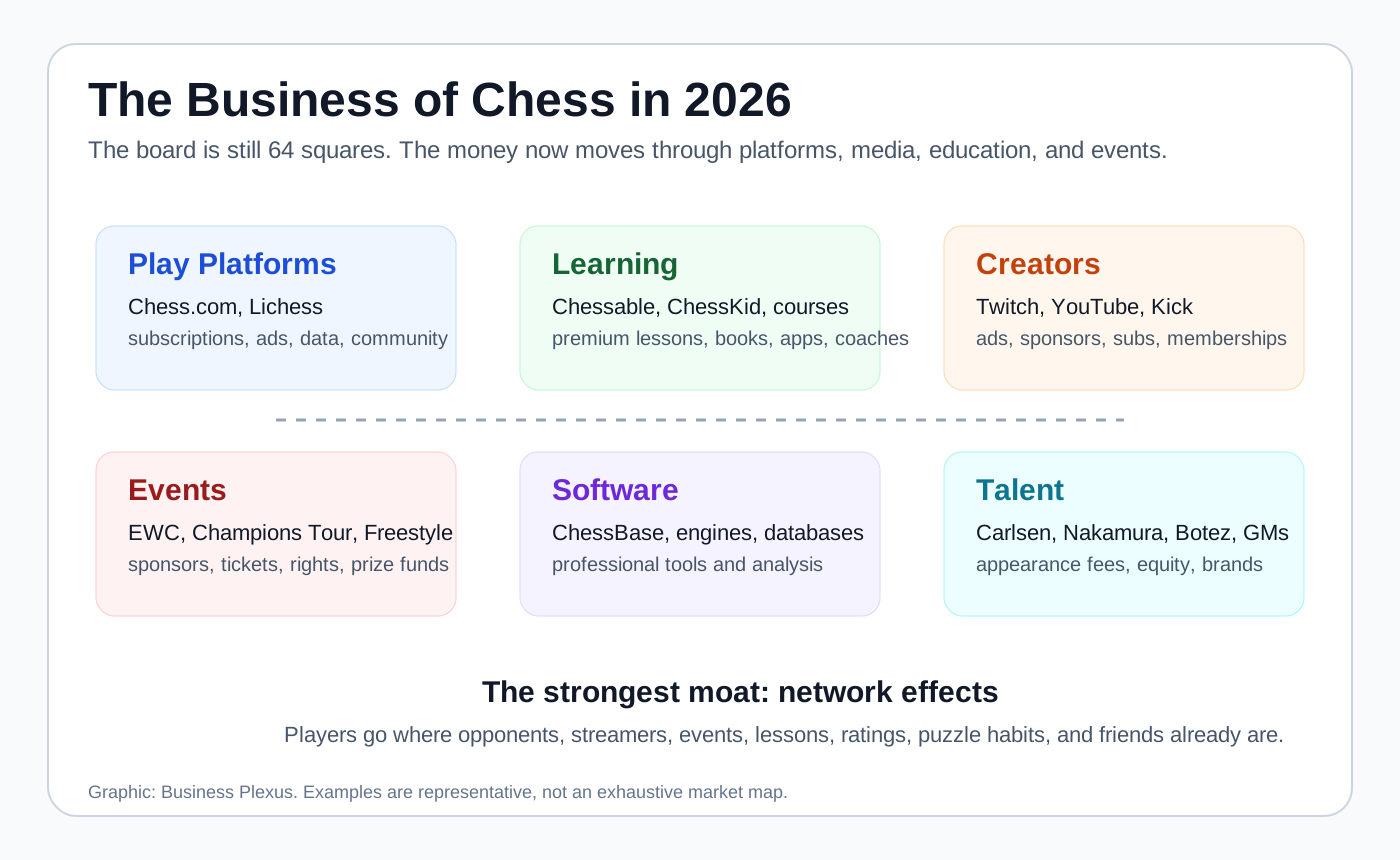
Chess used to be a strange business. The best players in the world could become famous, feared, and historically important while still living with unstable finances. That has changed. Chess is now an online platform business, a streaming category, a subscription product, a course marketplace, an esports property, a software industry, and a personal-brand machine for elite players.
That is the business layer underneath our earlier article on the millionaires of chess. The question there was who became wealthy. The question here is where the money is actually made.
The basic chess business model
The modern chess economy has several revenue streams layered on top of one another. The first is online play. Platforms bring players together, keep ratings, detect cheating, run events, sell subscriptions, show ads, and turn ordinary games into daily habits.
The second is education. Chess improvement is unusually monetizable because players can feel themselves getting better. Puzzles, lessons, opening courses, endgame drills, engine analysis, video courses, books, and coaching all sit naturally around the game.
The third is media. Chess became watchable online because fast games, streamer personalities, engine bars, puzzle-like tactics, and creator commentary made it easier for casual viewers to follow. A blitz game can be clipped, explained, and turned into a short video much more easily than a six-hour classical struggle.
The fourth is events. Traditional tournaments still matter, but the business has widened into online championships, streamer events, esports events, freestyle chess, sponsored rapid and blitz formats, and platform-owned tournament circuits.
The fifth is talent. Top players can now earn through prize money, sponsorships, courses, streaming, commentary, YouTube, equity, ambassador roles, private lessons, speaking, and appearances. Chess skill is still the credential, but distribution is what turns it into a business.
Chess.com: the center of gravity
Chess.com is the dominant commercial chess platform. It has the clearest flywheel: more players create better matchmaking, better matchmaking creates more daily use, more daily use supports subscriptions and ads, and more traffic gives Chess.com leverage in events, creators, education, and sponsorships.
The company crossed 100 million members in December 2022, the same month it completed its acquisition of Play Magnus Group. By April 2025, TechCrunch reported that Chess.com had passed 200 million members, including about 1.5 million paying users, with more than 20 million games played daily on the platform. Chess.com later announced it had reached 250 million members.
The Play Magnus deal is why Chess.com feels so central. In its own announcement, Chess.com said it acquired Play Magnus Group, whose brands included Chessable, chess24, AimChess, the Play Magnus app suite, New In Chess, Everyman Chess, iChess.net, and the Champions Chess Tour. That was not just a traffic deal. It brought together playing, learning, events, publishing, software, and Magnus Carlsen's brand orbit.
Is that a monopoly? In the legal sense, that is not something this article is claiming. In the practical business sense, Chess.com has strong network effects. If your friends play there, your favorite streamer plays there, the big online events are there, your rating history is there, and your puzzle streak is there, switching has a cost even if another site is free.
Lichess: the free counterweight
Lichess is the most important counterweight because it has a completely different philosophy. It is free, open-source, ad-free, and funded by donations rather than subscriptions or advertising. Its own about page says Lichess users play more than five million games every day and that the site is powered by volunteers and patrons.
That makes Lichess unusual. It competes with Chess.com in the core activity of online chess, but it does not need to win the same business model. It can be excellent because it does not have investors demanding profit. That is also its limitation: Lichess is a public-good style chess platform, not a vertically integrated media, education, and event empire.
For players, Lichess keeps pressure on the whole market. It proves that fast online play, analysis, studies, puzzles, broadcasts, and community tools can be offered without ads or paywalls. For the chess business, it is a reminder that not every valuable platform captures value in the same way.
Chessable and the course economy
Chessable is one of the most important education businesses in chess. It sells courses built around openings, tactics, endgames, strategy, and complete repertoires. Its key insight is that chess learning can become software: spaced repetition, move-entry training, video instruction, author branding, and progress tracking.
This is where grandmasters, international masters, coaches, authors, and popular streamers can make money without winning a tournament. A strong course can sell repeatedly. A player with a reputation for a certain opening can turn that expertise into a product. A coach with a clear teaching style can reach thousands of students instead of one at a time.
The course economy also explains why the business of chess is not only about the top ten players. A grandmaster outside the world championship cycle may still have a strong niche if they can teach, market, and build a loyal audience.
Streaming and YouTube changed who gets paid
Streaming shifted chess money toward personality. Hikaru Nakamura is the obvious elite example, but the broader lesson is bigger than one player. Chess creators can earn through Twitch subscriptions, YouTube ads, sponsorships, memberships, merchandise, coaching funnels, course launches, affiliate links, and platform deals.
The Botez sisters, GothamChess, Eric Rosen, Anna Cramling, Daniel Naroditsky, Agadmator, and many others show different versions of the same pattern. Some are entertainers. Some are teachers. Some are commentators. Some are elite competitors. The best creator businesses usually combine at least two of those identities.
This has changed the incentive structure. A player no longer needs to be world champion to make a good living. They need an audience. Rating still helps, but it is not the only asset. Clarity, humor, consistency, trust, and the ability to explain chess at the right level can be just as important commercially.
Events: from classical halls to esports arenas
Classical chess still carries prestige, but a lot of new money is flowing into rapid, blitz, online, and hybrid formats. These formats are easier to broadcast, easier to understand, and more compatible with modern attention spans.
The Esports World Cup is the clearest example. The official Esports World Cup site lists Magnus Carlsen as the 2025 chess champion with a $250,000 first prize, and Chess.com reported that the 2025 chess event had a $1.5 million prize fund. Chess.com also announced that chess would return to the Esports World Cup in Paris in 2026 with another $1.5 million prize fund.
Freestyle Chess is another example of chess being rebuilt as a premium event product. Freestyle's own release for its Las Vegas stop described the project as backed by a $20 million investment and co-founded by Magnus Carlsen and entrepreneur Jan Henric Buettner. The point is not only the variant. It is the packaging: luxury venues, elite players, high production value, sponsors, and a format designed to feel fresh.
FIDE remains essential because it controls official world championship structures, ratings, titles, and federation chess. But the business center of gravity has widened. A modern chess fan may care about the World Championship, Titled Tuesday, the Speed Chess Championship, the Champions Chess Tour, Freestyle Chess, the Esports World Cup, and a favorite streamer's match all in the same year.
ChessBase and professional tools
ChessBase is a different kind of chess business: less flashy to casual fans, but deeply important to serious players. It built the database and preparation tools that shaped professional chess for decades. Searchable game databases, opening preparation, engine-assisted analysis, and training material changed how grandmasters prepare.
In 2026, Chess.com reported that Freedom Holding acquired ChessBase in a €5 million deal, with plans to modernize the platform and integrate artificial intelligence. That is a sign that even old-school chess software is being pulled into the next phase: AI, cloud tools, training subscriptions, and platform integration.
Where the biggest money is made
The biggest money is probably not in prize funds. Prize money is visible, but it is concentrated and episodic. The stronger businesses are recurring: subscriptions, courses, memberships, sponsorships, software licenses, advertising, and creator audiences.
Chess.com makes money because millions of people return to the same platform repeatedly. Chessable makes money because serious players keep buying improvement products. Streamers make money because audiences return daily or weekly. Events make money when sponsors and broadcasters believe the audience is valuable. Software companies make money when preparation tools become indispensable.
That is why the richest people in chess are not always the best tournament performers in a given year. The money follows a combination of skill, audience, ownership, timing, language, personality, geography, and business structure.
Who is trying to get in on the action?
There are several challengers and adjacent players. Lichess competes on product quality and trust. Freestyle Chess competes on event innovation. ChessBase remains valuable in professional preparation. FIDE controls official status. Twitch, YouTube, and Kick compete for creator distribution. Take Take Take, associated with Magnus Carlsen, is trying to make chess viewing and commentary more accessible. National chess federations and school programs are trying to turn interest into participation.
There are also regional opportunities. India is probably the most important growth market because of its young player base, elite success, mobile-first internet culture, and enormous fan potential after Gukesh Dommaraju's rise. The United States remains important for creators, sponsors, and events. Europe still has deep chess institutions. Online platforms make all of these markets reachable at once.
What determines who makes the most money?
The first factor is audience. A grandmaster with a million followers has economic options that a stronger but less visible player may not have. Audience turns chess skill into media inventory.
The second factor is ownership. A player who owns equity, a course catalog, a newsletter, a channel, or an app has more upside than a player who only receives appearance fees.
The third factor is format. Blitz, bullet, rapid, puzzles, and streamer games are easier to monetize online than long classical games. Classical chess still has prestige, but online entertainment rewards speed and clarity.
The fourth factor is language and market. English-language creators can reach a global audience, but Hindi, Spanish, Russian, Turkish, French, and other language markets are large enough to support serious chess businesses.
The fifth factor is credibility. Chess fans care about strength. A creator does not always need to be world class, but credibility matters. A funny beginner channel can work, but a grandmaster explaining elite ideas has a different commercial position.
The bottom line
The business of chess is no longer just "who won the tournament?" It is a platform economy. Chess.com has the strongest commercial position because it combines play, audience, education, events, and acquired assets. Lichess keeps the ecosystem honest by offering a powerful free alternative. Chessable and ChessBase monetize improvement. Twitch and YouTube monetize attention. Esports and Freestyle Chess monetize spectacle. Players monetize identity.
That is why chess is producing more wealthy people than it used to. The game did not suddenly become richer by itself. The surrounding business model changed. The board stayed the same size, but the market around it got much larger.
Sources and further reading: Business Plexus companion piece on the millionaires of chess; Chess.com on the Play Magnus acquisition; TechCrunch on Chess.com reaching 200 million members; Lichess about page; Esports World Cup chess results; Chess.com on the 2026 Esports World Cup chess finals; Freestyle Chess Las Vegas release; Chess.com on Freedom Holding acquiring ChessBase.