A post circulating on X claims that Russian sources are complaining about a new Ukrainian tactic: connecting large numbers of FPV drones to a virtual server and letting skilled drone operators, possibly even gamers around the world, control them remotely for rewards.
The claim is fascinating. It is also not yet something that should be treated as confirmed fact. The screenshot appears to be based on Russian-language Telegram chatter amplified by Jay in Kyiv on X. Russian channels often mix real battlefield observations with exaggeration, panic, propaganda, and attempts to explain away battlefield losses. Still, the claim points toward a real trend: Ukraine's drone war is becoming more software-driven, more remote, and more dependent on people who can fly like high-level FPV racers or video-game players.
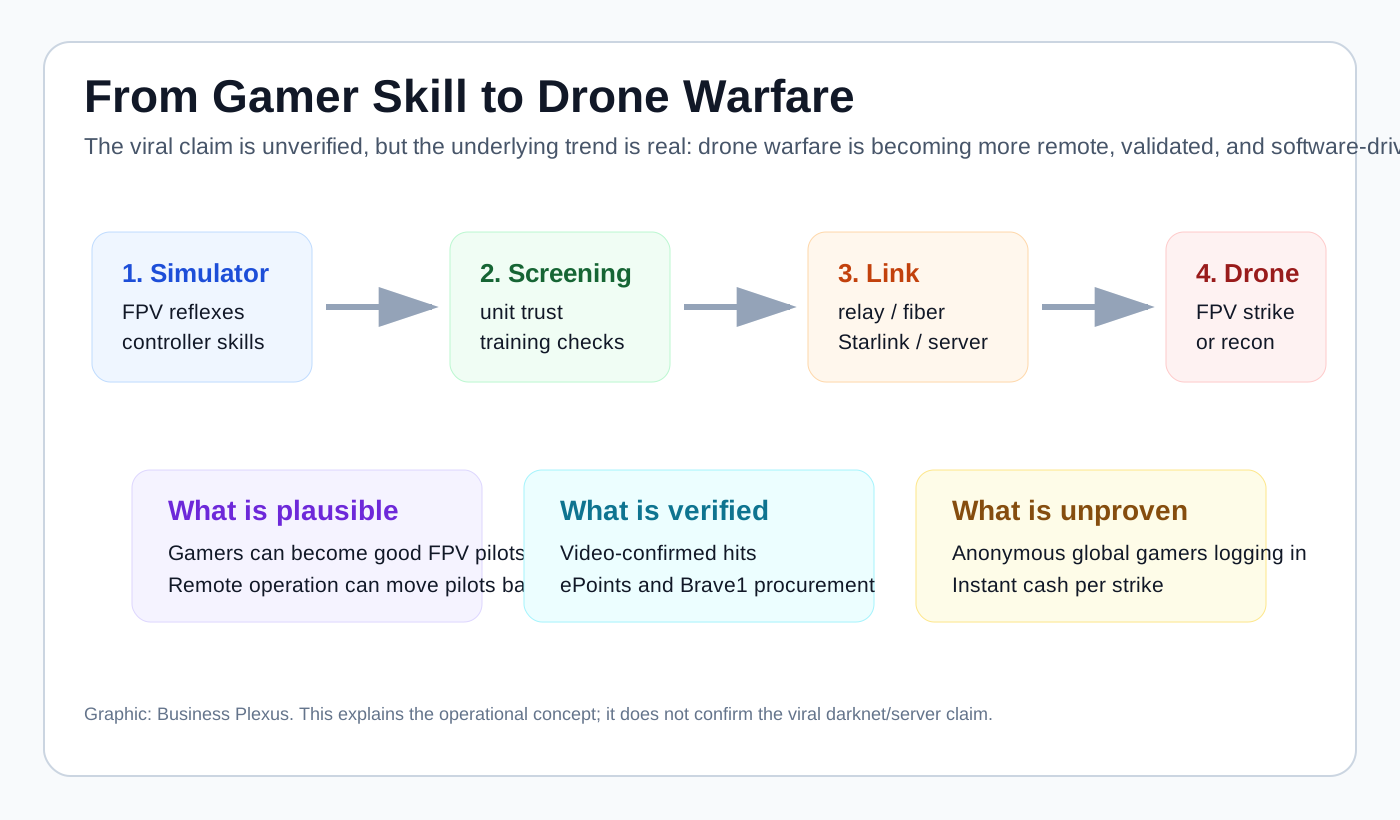
This article separates the viral claim from what is already known about Ukraine's drone ecosystem: remote-control links, simulator training, FPV operators, strike validation, ePoints, and the communications infrastructure that makes the whole system work.
What the screenshot says
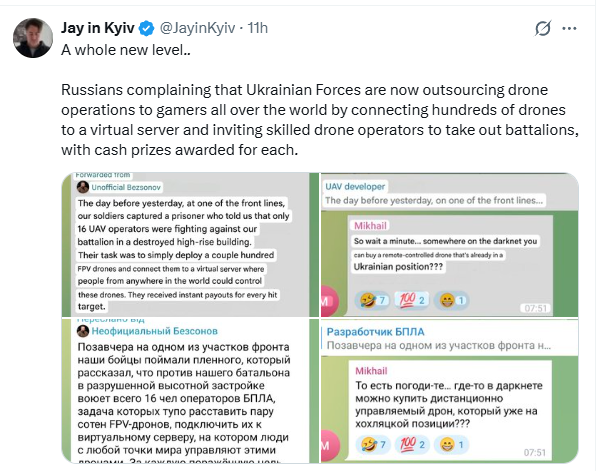
Screenshot supplied by the editor. The underlying claim should be treated as unverified unless corroborated by independent reporting.
The main Russian-language post in the screenshot is attributed to a channel labeled "Unofficial Bezsonov." It says, in paraphrased translation, that Russian troops captured a prisoner on one part of the front who allegedly said only 16 Ukrainian UAV operators were fighting against a battalion from a destroyed high-rise building. Their task, according to the post, was to deploy hundreds of FPV drones and connect them to a virtual server where people from anywhere in the world could control the drones. The post also claims operators received instant payments for every target hit.
A second screenshot, attributed to a "UAV developer," shows a user named Mikhail asking, in rough translation: "So wait a minute, somewhere on the darknet you can buy access to a remotely controlled drone that is already positioned on the Ukrainian side?" The original Russian uses a derogatory phrase for Ukrainians; the cleaned translation above keeps the meaning without repeating the slur.
That is the viral version. The careful version is narrower: Russian-linked accounts are claiming Ukraine may be using distributed remote drone operation, possibly with paid outside operators. There is not enough public evidence to say that anonymous gamers around the world are logging into live armed drones from a darknet marketplace.
What part is plausible?
The gamer part is plausible. FPV drones are physically different from video games, but the skill overlap is obvious. Good FPV pilots need fast hand-eye coordination, spatial awareness, comfort with first-person camera feeds, the ability to fly through cluttered terrain, and the nerve to steer under pressure. Those are not the same as playing a shooter or racing game, but they sit close enough that simulator training and gaming backgrounds matter.
Ukraine has already treated drone operation as a mass skill problem. The country has built drone schools, simulator pipelines, volunteer procurement networks, military units dedicated to unmanned systems, and battlefield feedback loops that reward successful operators. It is not strange that people with gaming or FPV racing experience would become valuable.
The remote-control part is also plausible. Ukraine has been working to move drone operators farther away from Russian counterbattery fire, artillery, electronic warfare, and direct targeting. Drone operators are valuable enough that both sides hunt them. Business Insider reported in June 2026 that Ukrainian drone operators remain high-value targets and that Ukraine is working on remote-control technologies and autonomous systems to reduce their exposure.
What is less proven is the open marketplace idea: the notion that unknown people anywhere in the world can simply buy access to a live Ukrainian FPV drone and attack targets for cash. That would raise obvious problems: authentication, operational security, latency, targeting discipline, friendly-fire risk, legal liability, intelligence leaks, and command responsibility.
What drones might be involved?
If there is any truth to the claim, the most likely drones are short-range FPV quadcopters or similar one-way attack drones. These are the small, fast, first-person-view drones used to hit vehicles, trenches, infantry, artillery, logistics trucks, and exposed positions. They are the closest battlefield equivalent to a "controller skill" weapon.
Fiber-optic FPV drones are another possibility, although they do not fit the "internet server" claim neatly. Fiber-optic drones trail a thin cable that makes them resistant to radio jamming. They still need an operator, but their control link is physical rather than wireless. They are useful in heavy electronic-warfare environments, but the operator still has to be connected through the fiber system and its ground equipment.
Heavy bomber drones, often called Baba Yaga-type drones, are less likely to be handed to casual outside operators. They carry larger payloads and require more careful mission planning. Reconnaissance quadcopters could theoretically be remotely observed or controlled, but a strike drone is where the gamer analogy becomes strongest.
Long-range one-way attack drones, the kind used against refineries and strategic infrastructure inside Russia, are a different category. Those systems are typically route-planned, guided, and coordinated as military operations rather than flown like a racing drone by someone in a live video feed. We covered that side of the war separately in our catalog of Ukraine's strikes on Russian oil refineries, depots, and logistics infrastructure.
The missing piece is the communications link
Remote operation only works if the communications link works. That is why this story connects to the broader drone-repeater problem. A drone needs command signals going out and video coming back. The farther the pilot is from the drone, the more important the relay system becomes: antennas, repeaters, fiber, satellite links, local servers, radios, mesh networks, and anti-jamming systems.
That is the same logic behind our earlier explainer on drone repeaters and why Belarusian relay towers matter. Whether the operator is Ukrainian, Russian, or somewhere far behind the front, the drone war increasingly depends on moving video and control signals through contested airspace.
Some Ukrainian groups have publicly discussed remote FPV-control concepts. Wild Hornets and related Ukrainian drone circles have promoted remote-control systems intended to move operators farther away from danger. Reports around systems such as HORNET VISION Ctrl describe pilots controlling drones from much greater distances through relay and internet-linked infrastructure. That does not prove the viral darknet claim, but it shows the technical direction: separate the pilot from the launch point, and the drone team becomes harder to kill.
The "cash prize" claim may be a distorted version of ePoints
The part of the Russian claim about "instant payouts" sounds dramatic, but there is a more documented Ukrainian system that may explain why the rumor spread. Ukraine uses a combat-points system known as ePoints. Drone units that produce verified battlefield results can earn points and spend them through the Brave1 Market on drones, electronic-warfare gear, ground robotic systems, and other equipment.
Ukraine's Ministry of Defense said in June 2026 that more than 500,000 drones had been ordered through Brave1 Market using combat points. According to the ministry, units receive points for confirmed enemy equipment destroyed through the DELTA combat system, and those points can be used to order equipment.
Business Insider reported separately that Ukraine's drone pilot scoreboard logged more than 800,000 recorded hits against Russian targets in the first half of 2026, with strikes verified through video evidence and reviewed through DELTA before units receive ePoints to spend through Brave1. That is a real gamified incentive structure. It is not the same thing as paying random gamers cash for individual kills.
How would operators be validated?
For a real military unit, validation would be much stricter than "good at games." A drone operator has to be trusted with live battlefield information, target identification, rules of engagement, radio discipline, unit coordination, and the risk of killing friendly troops or civilians. That requires screening, training, and command oversight.
A plausible validation path would look like this: simulator performance, instructor evaluation, test flights, unit affiliation, identity checks, operational-security training, limited permissions, supervised missions, and post-strike video review. A remote operator might not need to stand next to the drone, but the unit would still need to know who is controlling it and what they are allowed to do.
That is why the "anonymous global gamer marketplace" version is hard to accept without stronger evidence. Ukraine has every reason to recruit skilled FPV pilots and every reason to protect its operators. It has much less reason to let unknown outsiders steer live munitions from an uncontrolled marketplace.
Why Russia would complain about this
Russian troops already experience Ukrainian FPV drones as a constant tactical threat. If they believe the operator pool is expanding beyond trained Ukrainian soldiers into remote volunteers, gamers, or paid specialists, the psychological effect is obvious. It suggests the battlefield can be scaled like software: more drones, more pilots, more feeds, more verified hits.
It also explains why Russian accounts would describe the system in almost dystopian terms. From the soldier's perspective, the difference between a Ukrainian operator 2 kilometers away and a remote pilot farther back may not matter. What matters is that small drones keep appearing, maneuvering through windows, chasing vehicles, striking trenches, and recording the result.
The larger trend is real
Even if the viral post is exaggerated, it captures where the war is going. Drone warfare is becoming a networked system of cheap airframes, trained operators, remote-control links, battlefield software, video verification, electronic warfare, procurement points, and constant adaptation.
The same pattern is visible outside Ukraine. In our article on Myanmar's drone war, we looked at how commercial drones, agricultural drones, jammers, spare parts, and improvised workshops changed the balance between state and resistance forces. Ukraine is a more advanced version of the same lesson: the side with the better drone ecosystem, not just the better individual drone, gains the advantage.
Gamers may not be secretly logging into hundreds of Ukrainian drones from around the world. But people with gamer-like skills are absolutely part of the new battlefield. The operator is becoming as important as the drone. The software layer is becoming as important as the explosive. And the communications link may decide whether a cheap FPV quadcopter is just a toy, a scout, or a precision weapon.
Sources and notes: The viral claim discussed here comes from a screenshot of Jay in Kyiv's X post and translated Russian-language posts shown in that screenshot. Treat the specific "global gamers on a virtual server" claim as unverified. Background on verified drone strikes, ePoints, and DELTA from Business Insider and Ukraine's Ministry of Defense article on Brave1 Market combat points. Context on risks to drone operators from Business Insider's reporting on drone operators as high-value targets. Remote-control and repeater context from Business Plexus' prior articles linked above.