Is Ukraine quietly changing how ballistic missiles are designed and manufactured?
That may be the larger question behind recent comments from Ukrainian defense entrepreneur Denys Shtilerman, co-founder and chief designer of Fire Point. The technical details of Ukraine's emerging ballistic missile work remain limited in public sources, and some of Fire Point's claims should be treated as company claims until independently verified. But the philosophy behind those claims is worth taking seriously.
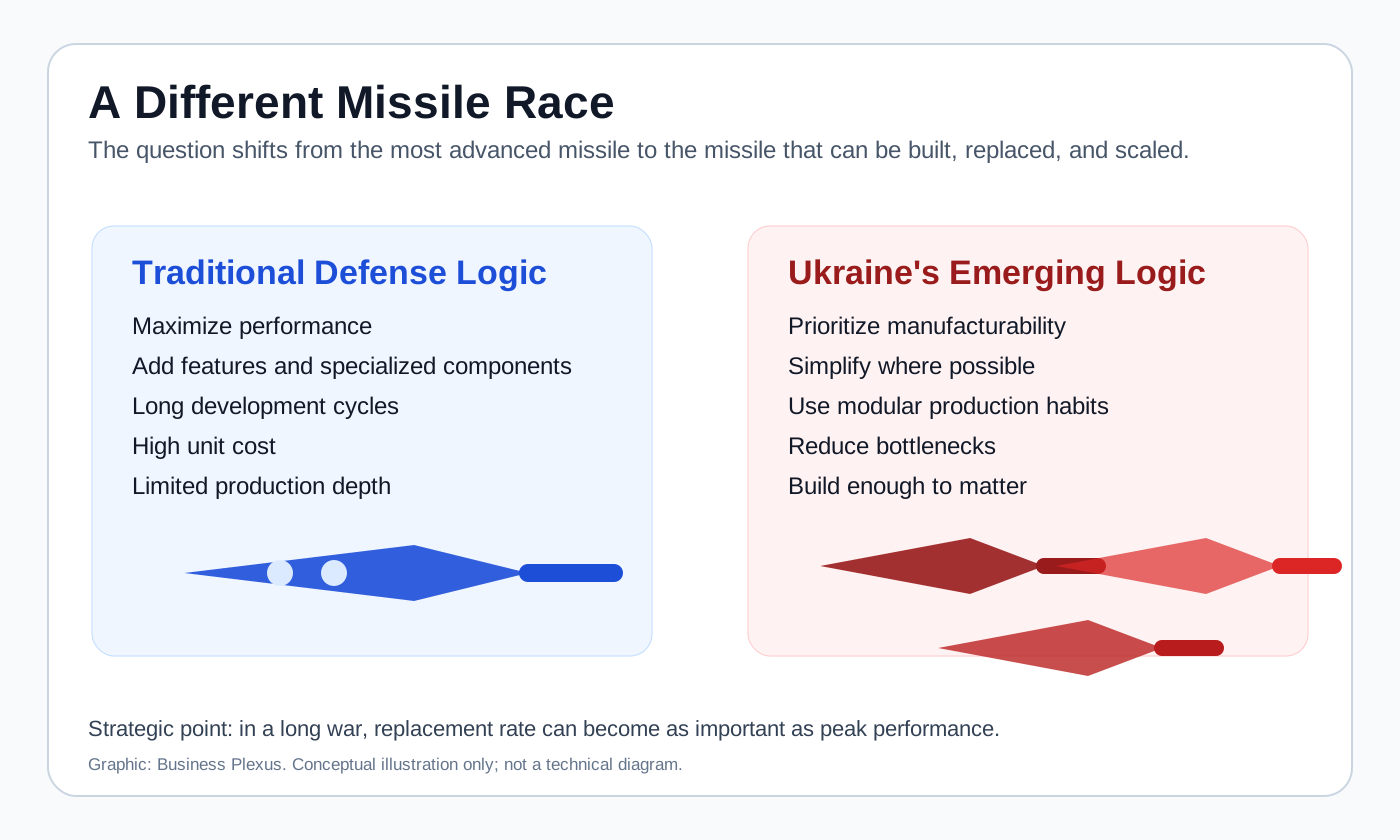
Ukraine appears to be emphasizing something less glamorous than peak missile performance, but potentially more decisive in a long war: manufacturability.
Part 1: A new philosophy of missile warfare
For decades, the world's major military powers shared a common philosophy when designing ballistic missiles: build the most capable weapon possible.
Engineers competed to achieve greater speed, longer range, higher accuracy, improved countermeasures, and increasingly sophisticated guidance systems. Every new generation of missiles became more technologically impressive, and usually more expensive. Development cycles stretched into years, while production often remained limited because each missile represented an enormous investment in engineering, specialized labor, and advanced manufacturing.
That philosophy dominated military planning throughout the Cold War and continued well into the 21st century. Whether examining American precision-guided weapons, Russian ballistic missiles, or China's growing missile arsenal, success was often measured by technical superiority.
But the war in Ukraine may be rewriting that playbook.
Recent public comments from Shtilerman suggest that Ukraine's emerging missile strategy is taking a different direction. Rather than competing to build the world's most technologically complex ballistic missile, Ukraine appears to be asking a simpler industrial question: can a missile be manufactured rapidly, at lower cost, and in quantities large enough to sustain years of high-intensity conflict?
If accurate, that represents more than an engineering decision. It reflects a shift in military thinking.
The Fire Point signal
Fire Point is already known for long-range strike drones and the FP-5 Flamingo cruise missile. Associated Press reporting described Fire Point as one of the Ukrainian firms driving the country's effort to build long-range drones and missiles for strikes deep inside Russia. Defense News reported in June 2026 that Fire Point-produced drones account for a large share of Ukraine's strikes inside Russia, citing Shtilerman's comments at Eurosatory.
The new question is ballistic missiles. UNITED24 Media reported that Shtilerman expects Fire Point to field a mass-produced Ukrainian ballistic missile and described a production philosophy built around rapid expansion, limited specialized labor, and scale. He also said the company's Flamingo cruise missiles were already in serial production.
The article's most striking line was not a claim about range or speed. It was a claim about production tempo. Shtilerman said the missiles would come out "like hotcakes." That is not the vocabulary of traditional defense procurement. It is the vocabulary of industrial scaling.
There are reasons for caution. Fire Point has faced public scrutiny and investigation in Ukraine over parts of its defense-contracting history, though the company denies wrongdoing and no charges against the company or founders have been reported in the sources reviewed here. Production claims from any wartime defense firm should be read with that context. Still, the underlying direction is consistent with what Ukraine has already done in drones: build, test, simplify, scale, and adapt quickly.
The lessons of a long war
When Russia launched its full-scale invasion in 2022, many analysts expected the conflict to be decided within weeks or months. Instead, it has evolved into one of the largest industrial wars since the Second World War.
The conflict has demonstrated that modern warfare is not determined only by which nation possesses the most advanced weapons. Increasingly, it depends on which nation can continue producing those weapons after years of combat.
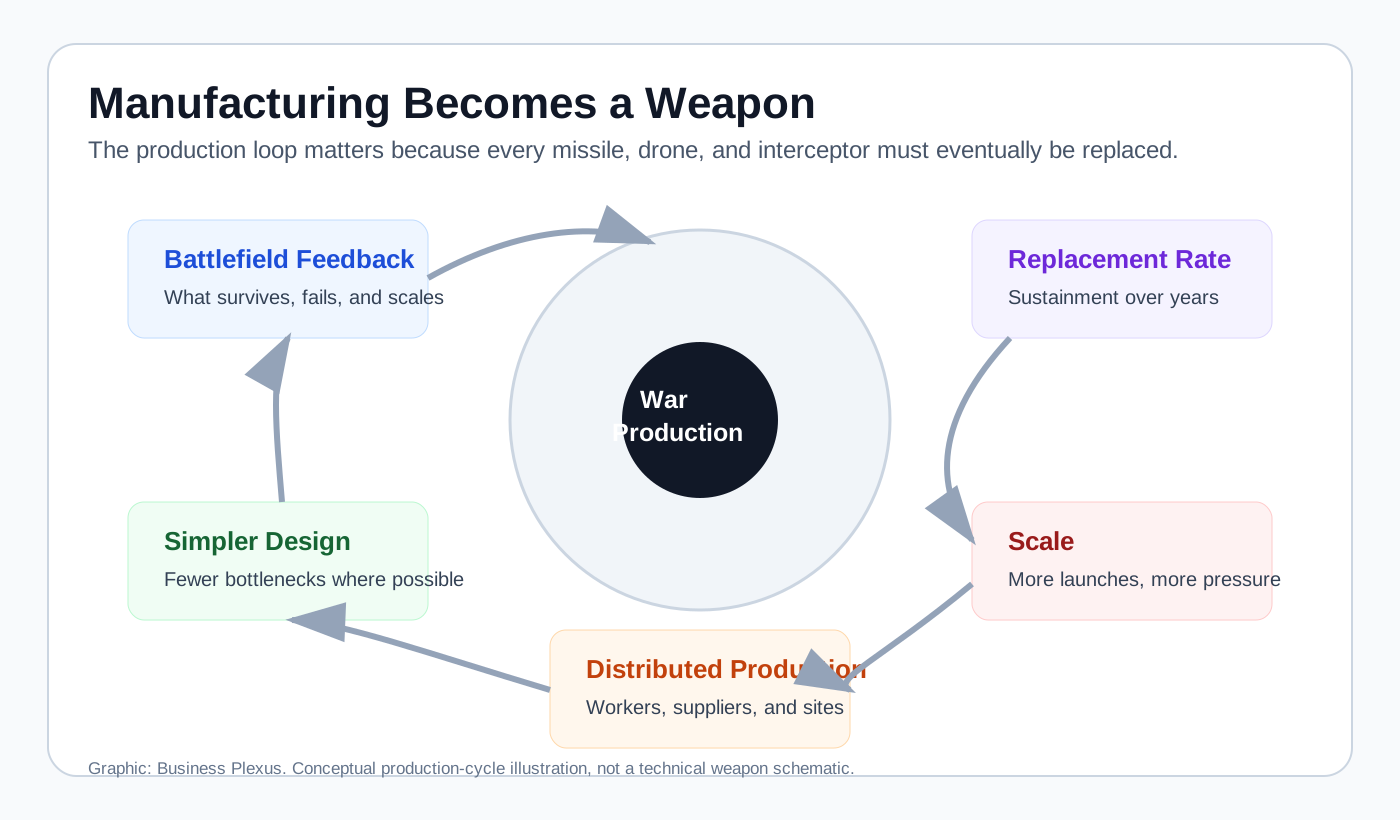
Every missile launched must eventually be replaced. Every interceptor fired from an air-defense battery must be manufactured again. Every drone destroyed over the battlefield represents another airframe, motor, flight controller, radio, camera, and battery that must return to the production line.
This has transformed manufacturing capacity into a strategic weapon.
Military planners have always understood logistics, but the Ukraine war has elevated industrial production itself to the center of battlefield strategy. Factories, machine tools, skilled workers, electronics suppliers, testing ranges, software teams, and supply chains have become almost as valuable as the weapons they produce.
For Ukraine, whose industrial infrastructure has been repeatedly targeted by Russian missile strikes, this creates a difficult challenge. Building a small number of exceptionally sophisticated missiles may not be enough if production cannot keep pace with operational demand.
Instead, Ukraine appears to be embracing a philosophy more familiar to commercial manufacturing than traditional defense procurement: simplify the design, reduce production bottlenecks, standardize components where practical, disperse production, and manufacture at scale.
The rise of the good-enough weapon
At first glance, intentionally simplifying a missile may sound like lowering standards.
In reality, engineers often face the opposite problem. Every additional feature increases complexity. More advanced sensors require additional electronics. Higher precision can demand tighter manufacturing tolerances. Specialized materials increase costs while slowing production. Complex guidance and communications systems require more software, more testing, and more highly trained engineers.
These improvements can make a missile more capable.
They also make it more difficult to build.
Ukraine's apparent strategy recognizes a reality that many industries learned decades ago: a product that is 95 percent as capable but can be manufactured five times faster may provide far greater real-world value than a technically perfect design that leaves the factory in small numbers.
That does not mean accuracy, survivability, safety, or reliability stop mattering. A missile that cannot reach its target, survives poorly, or fails too often is not useful merely because it is cheap. The point is tradeoff discipline. In a long war, a design feature has to justify not only what it adds in performance, but what it costs in production time, supply-chain fragility, and replaceability.
From drone factories to missile factories
The clearest example comes from Ukraine's expansion of unmanned aerial vehicle production.
At the beginning of the invasion, drones were often treated as specialized military equipment. Today they have become consumable battlefield tools. Thousands are lost every month. Instead of attempting to build the most sophisticated drone imaginable, Ukrainian manufacturers increasingly focused on designs that were inexpensive, modular, easy to repair, and quick to assemble.
Commercial electronics replaced custom hardware wherever practical. Components from multiple suppliers reduced dependence on any single source. Battlefield units fed lessons back to manufacturers quickly. Software, procurement, training, and repair became part of the same cycle.
That approach helped turn FPV drones from experimental tools into one of the defining weapons of the war. It also explains why we have treated drone-related articles as part of a broader business and industrial story on this site, from remote FPV operators and gaming-like drone skills to Ukraine's broader strike campaign against Russian refineries, depots, and logistics infrastructure.
Shtilerman's comments suggest that Ukraine hopes to apply a similar manufacturing mindset to missiles. Ballistic missiles will never be inexpensive in the way small drones are. Rocket propulsion, thermal stresses, flight stability, navigation, and structural integrity require serious engineering and testing. But the philosophical similarity is clear.
Instead of asking, "How can we build the world's most advanced missile?" the question becomes: "How can we build enough missiles to influence the outcome of a long war?"
A different kind of arms race
This shift carries implications beyond Ukraine.
For generations, military competition focused primarily on performance. Nations compared maximum range, speed, payload, radar signatures, and accuracy. Those characteristics remain important. A weapon still has to work.
But another competition is emerging beneath the surface.
Which country can manufacture precision weapons the fastest? Which nation can sustain production despite sanctions, supply-chain disruptions, and attacks on factories? Which defense industry can redesign products to reduce dependence on scarce components? Which companies can train workers quickly without sacrificing quality control?
And perhaps most importantly: can simplicity become a strategic advantage?
These questions may define the next generation of missile development as much as incremental improvements in speed or range.
What to watch next
The important signs will not only be test videos or official adoption announcements. Watch for production rates, supplier networks, launch-platform practicality, whether components are domestic or import-dependent, and whether Ukraine can keep producing even as Russia targets factories and energy infrastructure.
Also watch the language. If Ukrainian officials and companies talk less about a perfect missile and more about production packages, worker training, modularity, foreign manufacturing partnerships, and monthly output, that is the real story.
The future of missile warfare may not belong to the country that builds the single most impressive missile. It may belong to the country that can build enough effective missiles to keep fighting after the first wave is gone.
Part 2: Inside a modern ballistic missile
To understand why Ukraine appears to be emphasizing simplicity and mass production, it helps to understand what a modern ballistic missile actually is, and what it is not.
Hollywood often portrays ballistic missiles as highly intelligent machines that continuously steer themselves toward a target. In reality, most ballistic missiles spend much of their flight doing something more basic.
They fly according to physics.
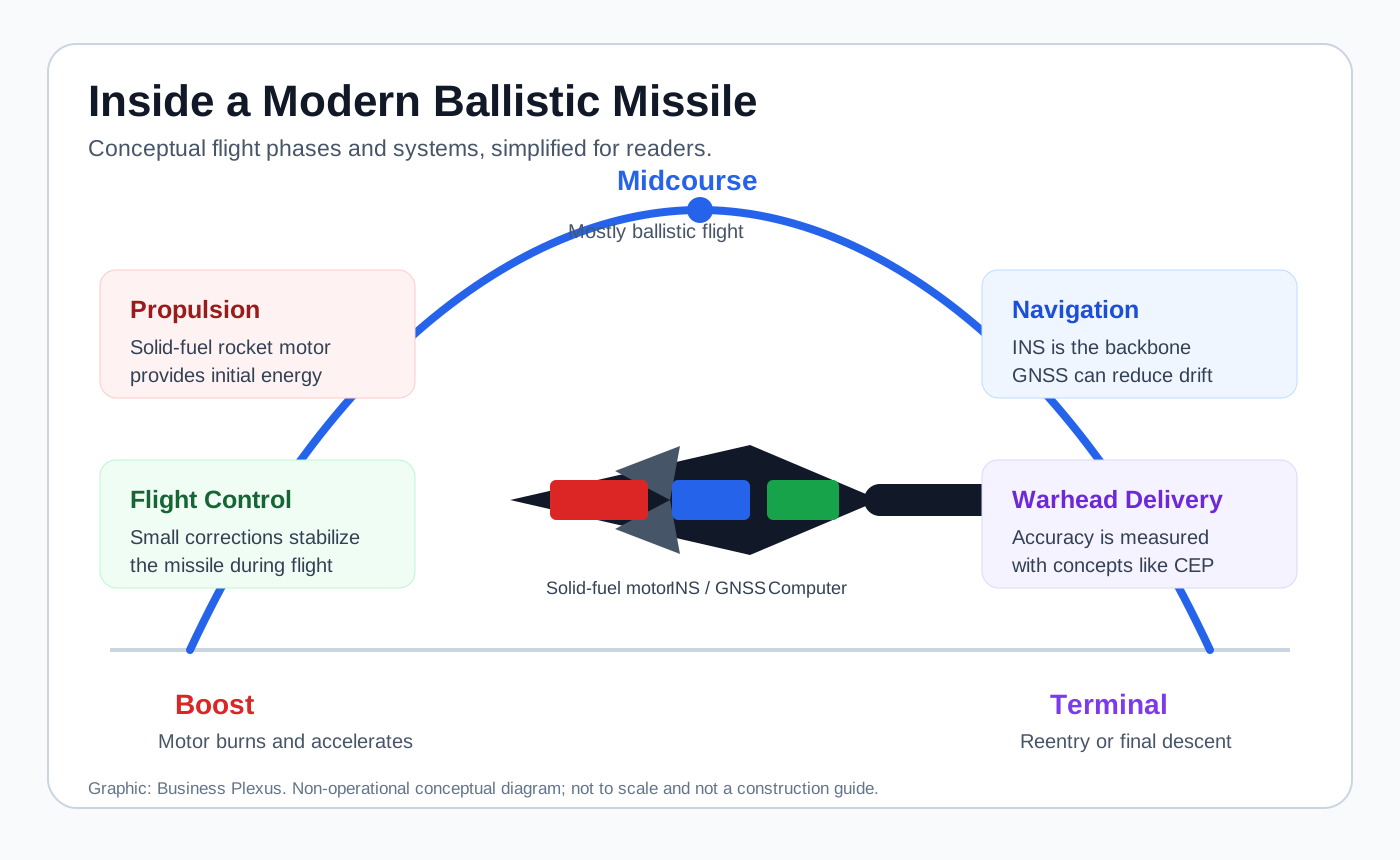
After launch, the missile's rocket motor accelerates it to very high speed before shutting down. From that point forward, the missile follows a ballistic trajectory, somewhat like a baseball thrown into the air, although at vastly greater speed, altitude, and consequence. Gravity, momentum, and aerodynamic forces determine much of the flight.
The engineering challenge is ensuring that the missile reaches the right conditions before entering this mostly unpowered phase of flight.
At a broad level, that challenge depends on four major systems: propulsion, guidance and navigation, flight control, and warhead delivery. Each creates opportunities to simplify manufacturing without necessarily sacrificing battlefield usefulness.
Solid-fuel rocket motors
One of the biggest changes in missile engineering has been the widespread adoption of solid-fuel rocket motors.
Early ballistic missiles often relied on liquid fuel, which required pumps, plumbing, valves, and fueling operations before launch. Those systems could be powerful, but they were also complex, maintenance-intensive, and vulnerable during preparation.
Solid-fuel motors changed that equation. The propellant is cast inside the motor casing, allowing the missile to be stored in a ready-to-launch condition. Once ignited, the fuel burns in a controlled pattern until it is exhausted.
This offers several advantages: faster launch times, reduced maintenance, greater reliability, simpler logistics, and improved survivability for mobile launch units.
For Ukraine's apparent strategy, solid-fuel motors also fit standardized manufacturing better than many liquid-fuel systems. Once production methods are established, factories can repeatedly manufacture motor sections without the same launch-preparation burden associated with liquid-fueled missiles.
That does not make production easy. Casting large, defect-free solid propellant requires precision and quality control. Small defects can affect burn behavior or cause failure. But compared with fielding liquid-fueled missiles, solid fuel is generally a better fit for a force seeking rapid deployment and sustained production.
Guidance systems: teaching a missile where it is
A missile cannot reach its target if it does not know where it is.
The core of that capability is the inertial navigation system, or INS. An INS operates independently of satellites or radio signals. Using gyroscopes and accelerometers, it measures the missile's movement from the moment it leaves the launcher.
Think of it as an extremely accurate dead-reckoning system. By calculating changes in speed and direction, the onboard computer estimates the missile's position throughout flight.
The major advantage is resilience. Because an INS does not rely on external signals, it cannot be disabled simply by interrupting satellite communications.
The disadvantage is drift. Tiny measurement errors accumulate over time. Over long distances, even small inaccuracies can gradually shift the predicted position.
GNSS: improving accuracy
To reduce accumulated error, many modern missiles supplement inertial navigation with Global Navigation Satellite System signals, or GNSS.
The American GPS constellation is the best known, but other systems include Europe's Galileo, Russia's GLONASS, and China's BeiDou.
Satellite updates allow a missile to periodically correct its estimated position, improving accuracy. But satellite navigation introduces vulnerabilities. Electronic warfare has become one of the defining features of the conflict in Ukraine, and both sides routinely attempt to jam, spoof, or interfere with navigation signals.
As a result, modern designers often treat satellite navigation as an enhancement rather than the foundation. A robust inertial navigation system remains the backbone.
Flight computers have become smaller and smarter
Another quiet revolution has taken place inside the missile itself.
Decades ago, missile guidance required specialized military computers that were expensive and difficult to manufacture. Today's electronics are dramatically more capable. Modern processors, miniature sensors, and advanced software allow sophisticated guidance logic to run on compact hardware using modest electrical power.
This opens the door to a manufacturing philosophy built around modular electronics and standardized computing platforms. Critical military components still need environmental hardening, testing, security, and quality control. But advances in commercial electronics have changed what is possible.
For manufacturers pursuing large-scale production, reducing the number of unique electronic assemblies can simplify supply chains and accelerate assembly.
Flight control without needless complexity
Knowing where the missile is represents only part of the challenge. The missile must also be able to adjust its flight path.
This is the role of the flight control system. Small aerodynamic control surfaces, or in some designs other control mechanisms, allow the onboard computer to make corrections during flight.
Contrary to popular imagination, many of these corrections are small. The goal is not dramatic maneuvering. It is stable, predictable flight.
Simple, reliable control systems are often preferable to highly complex mechanisms that increase manufacturing time, maintenance burden, and failure risk. For a country emphasizing scalable production, reliability can matter more than elegance.
Accuracy and circular error probable
When analysts discuss missile performance, one technical term appears repeatedly: circular error probable, or CEP.
CEP estimates the radius within which half of a missile's impacts are expected to land. A smaller CEP indicates greater precision.
Improving CEP has traditionally been one of the primary goals of missile designers. But reducing CEP often requires better sensors, more sophisticated software, tighter manufacturing tolerances, and additional testing. Each improvement can raise cost and slow production.
That creates an engineering tradeoff. If Ukraine's strategy truly prioritizes manufacturing speed and affordability, designers may accept a somewhat larger CEP if doing so dramatically increases production capacity.
For many military targets, absolute pinpoint precision is not always necessary. Fuel depots, logistics hubs, railway junctions, command facilities, aircraft shelters, and industrial sites can be vulnerable to consistent accuracy within an acceptable margin. The question is not whether precision matters. It is how much additional precision is worth when the alternative is far greater production volume.
Designing for manufacturability
One phrase rarely appears in newspaper articles but dominates industrial engineering: design for manufacturability, or DFM.
Rather than asking only whether a product can be built, DFM asks whether it can be built efficiently, consistently, and at scale.
This philosophy influences nearly every engineering decision. Can two parts be combined into one? Can a component be produced using automated machining? Can different variants share common parts? Can assembly require fewer specialized technicians? Can inspections be simplified without reducing safety?
These questions may seem mundane compared with hypersonic speeds or advanced warheads. Yet they often determine whether a factory produces dozens of weapons each year or far more.
If Shtilerman's comments accurately reflect Ukraine's design philosophy, DFM may be one of the most important concepts guiding the country's next generation of missile development.
Engineering for a long war
Traditional defense procurement often rewarded maximum technical performance regardless of production speed. Ukraine's experience suggests a different priority.
The country is fighting a prolonged, high-intensity conflict against a larger opponent with greater industrial capacity. In that environment, engineers must optimize not only for battlefield performance but also for production resilience.
A missile that can be manufactured quickly, upgraded continuously, and assembled from available components may ultimately prove more valuable than one that achieves marginally better performance at several times the cost.
That philosophy, balancing capability with manufacturability, could become one of the defining lessons of the war. If it does, missile engineers and defense planners around the world will study Ukraine's approach long after the conflict ends.
Part 3: The economics of missile production
Throughout military history, wars have often been won not simply by superior technology, but by superior production.
The Second World War remains one of the clearest examples. Germany developed some of the most advanced weapons of its era, including the V-2 ballistic missile and the first operational jet fighters. Yet the Allies ultimately overwhelmed German industry through manufacturing capacity. American factories produced ships, aircraft, trucks, artillery, and ammunition on a scale no Axis power could match.
Nearly a century later, the conflict in Ukraine is reminding military planners that industrial capacity remains one of the decisive factors in warfare.
The difference is that today's industrial battlefield looks different. Instead of measuring only how many tanks or fighter aircraft can be built each month, analysts increasingly examine production of drones, interceptor missiles, artillery shells, precision-guided munitions, and ballistic missiles.
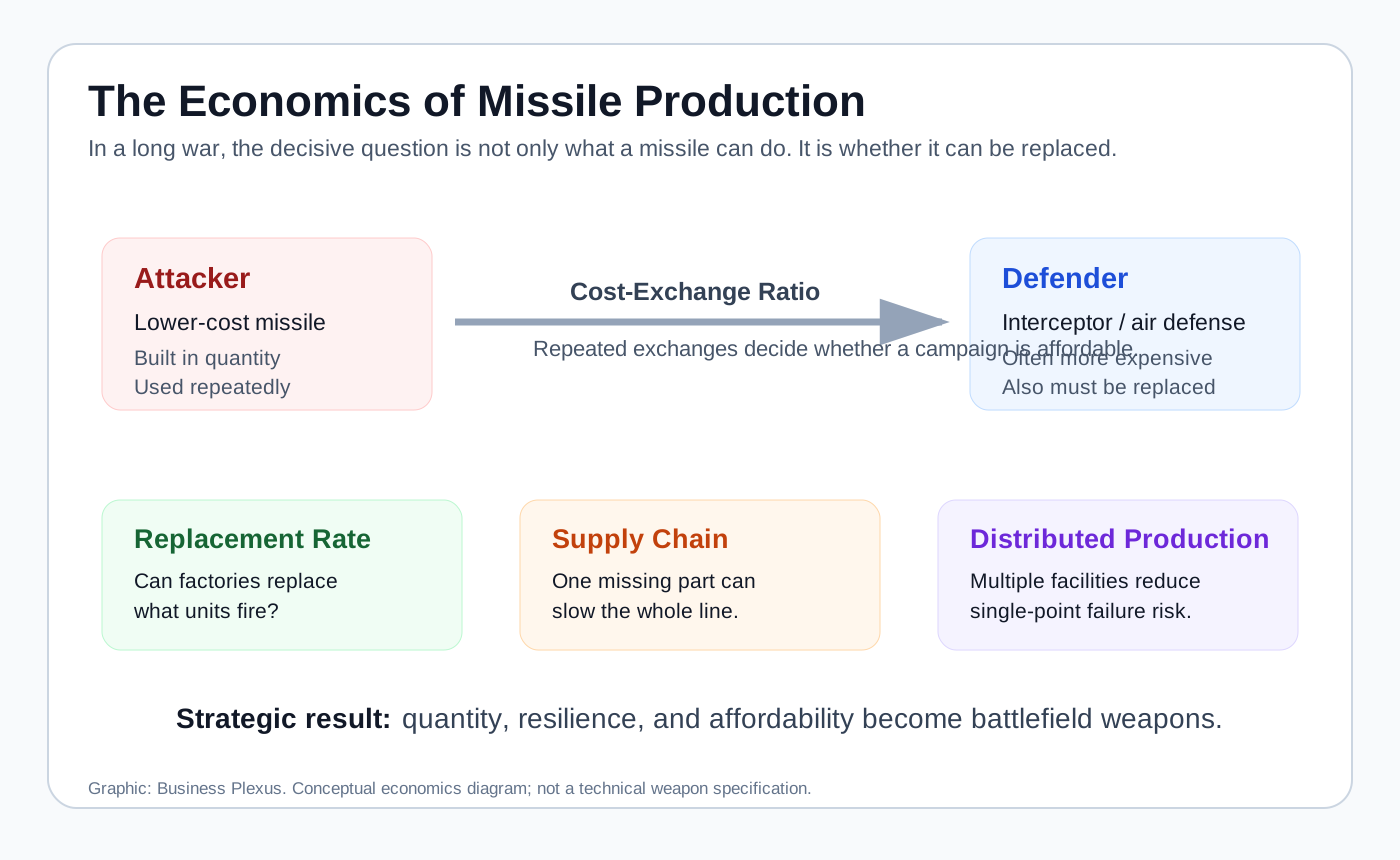
The central question has become simple: can you replace what you fire?
Every missile represents an investment
When the public hears that a missile has struck a military target hundreds of kilometers away, the discussion usually focuses on range, speed, or destructive power.
Military planners often begin with a different question: how much did that strike cost?
Modern precision weapons are expensive because they combine several advanced technologies into a single system: rocket propulsion, navigation, flight-control electronics, precision machining, specialized materials, warhead integration, testing, and quality assurance.
Each subsystem adds capability. Each also adds cost.
For decades, nations accepted those costs because precision weapons were expected to be used sparingly against high-value targets. Ukraine has changed that assumption. Long-range precision strikes now occur repeatedly over months and years. That changes the economics of missile production.
The cost-exchange ratio
One of the most important concepts in modern defense planning is the cost-exchange ratio.
Simply put, it compares the cost of attacking with the cost of defending.
Imagine a hypothetical example. An attacking nation launches a missile costing approximately $800,000. The defending country responds by firing an interceptor missile that costs $4 million. Even if the interceptor successfully destroys the incoming missile, the attacker may still gain a long-term economic advantage.
If that exchange occurs repeatedly over months or years, the defender could spend several times more money than the attacker. Military planners therefore seek favorable cost-exchange ratios. Defensive systems should neutralize threats without requiring dramatically more expensive interceptors. Offensive weapons should deliver strategic value that justifies their production cost.
This economic competition has become almost as important as battlefield performance.
Why good enough can be better than perfect
Defense engineers often speak of the gold-plating problem.
As new technologies become available, designers naturally want to incorporate them: better sensors, more powerful processors, higher accuracy, additional redundancy, and advanced materials.
Individually, each improvement may appear worthwhile. Collectively, they can transform a practical weapon into one that is prohibitively expensive and difficult to manufacture.
Commercial industries learned this lesson decades ago. Automobile manufacturers do not build Formula One race cars for everyday drivers. Smartphone companies avoid unnecessary complexity because every additional component increases manufacturing cost, defect risk, and supply-chain exposure.
Modern missile production faces similar pressure. The objective is no longer to build the single most advanced missile imaginable. The objective is to produce a missile that delivers enough military effectiveness while remaining affordable enough for sustained production.
That philosophy appears central to Ukraine's evolving strategy.
Designing for scale
Mass production does not happen automatically.
Factories must be designed around repeatability. Production engineers analyze each step of the manufacturing process. Can two machining operations become one? Can electronic modules be standardized? Can suppliers manufacture interchangeable components? Can inspection procedures detect defects more quickly? Can assembly be distributed without losing quality control?
These questions lack the spectacle of discussions about hypersonic speeds or advanced guidance systems, yet they often determine whether production can expand rapidly during wartime.
Modern defense manufacturing increasingly borrows techniques from commercial aerospace and automotive industries, where standardized components, modular assemblies, and streamlined quality control are used to improve efficiency.
For Ukraine, whose defense industry must operate despite ongoing missile attacks, these principles become even more important. Distributed manufacturing allows production to continue even if one facility is damaged. Rather than relying on a single massive factory, multiple smaller facilities can produce components before final assembly.
That approach improves resilience and complicates enemy targeting.
Supply chains: the hidden battlefield
A missile is only as reliable as the supply chain behind it.
One missing electronic component can halt production. One unavailable bearing can delay assembly. One specialized machine tool can become a bottleneck for an entire factory.
Russia has experienced many of these challenges under international sanctions. Although Russian industry continues to produce advanced weapons, public reporting and sanctions analyses have repeatedly pointed to difficulties obtaining certain high-performance electronics and precision components.
Ukraine faces different obstacles. Russian missile strikes have repeatedly targeted energy infrastructure, transportation networks, and industrial facilities. This has forced Ukrainian manufacturers to think differently about resilience.
Instead of concentrating production in a handful of large plants, the emphasis increasingly appears to be shifting toward flexible manufacturing networks capable of continuing operations under attack. In that sense, the factory itself has become part of the battlefield.
Manufacturing as strategic deterrence
Traditionally, deterrence focused on the size and sophistication of a nation's arsenal. Today, production capacity may be equally important.
An adversary contemplating a prolonged conflict must consider not only how many missiles an opponent currently possesses, but how many it can manufacture next month, the month after that, and the year after that.
If Ukraine can demonstrate the ability to replenish its missile inventory faster than Russia expects, that capability alone could influence strategic planning.
The same principle applies across NATO and allied nations. Many Western governments have begun expanding production of artillery ammunition, air-defense interceptors, and precision-guided weapons after recognizing that peacetime manufacturing assumptions were inadequate for sustained high-intensity conflict.
Industrial resilience has become a component of national security.
The new industrial arms race
The phrase "arms race" traditionally evokes images of increasingly powerful weapons. Today's competition looks different.
Nations are racing to improve production speed. They are investing in automated factories, advanced manufacturing techniques, digital engineering, additive manufacturing, and more resilient supply chains. Artificial intelligence is beginning to optimize production scheduling and quality control. Digital twins allow engineers to test manufacturing processes before physical production begins. Advanced machine tools reduce assembly time while improving precision.
These innovations may influence military capability as much as breakthroughs in propulsion or guidance.
The battlefield increasingly begins inside the factory.
Beyond engineering
The comments attributed to Denys Shtilerman suggest that Ukraine understands this transformation. His emphasis was not primarily on achieving the fastest missile or the longest range. Instead, he repeatedly returned to production speed, manufacturing simplicity, and affordability.
Those priorities may seem less dramatic than hypersonic weapons or exotic technologies. History suggests they may prove more consequential.
Wars are rarely decided by the most sophisticated prototype. More often, they are decided by the weapon that can be manufactured consistently, deployed rapidly, and replaced indefinitely.
If Ukraine succeeds in demonstrating that philosophy, the lessons will extend far beyond Eastern Europe. Defense ministries around the world may eventually conclude that the most important missile of the future is not the one with the highest specifications.
It is the one the factory can build again tomorrow.
Part 4: Four different missile philosophies
Every major military power builds ballistic missiles.
Yet they do not all build them for the same reasons.
A missile reflects more than engineering. It reflects a nation's military doctrine, industrial capacity, expected adversaries, and economic philosophy. The choices made by designers, including how much range to prioritize, how accurate a missile should be, how expensive it can become, and how quickly it can be manufactured, are shaped by strategic objectives as much as by technology.
The comments attributed to Denys Shtilerman suggest that Ukraine may be developing a distinctly different philosophy from many traditional missile powers. To understand why, it helps to compare the broader approaches taken by Russia, the United States, China, and Ukraine itself.
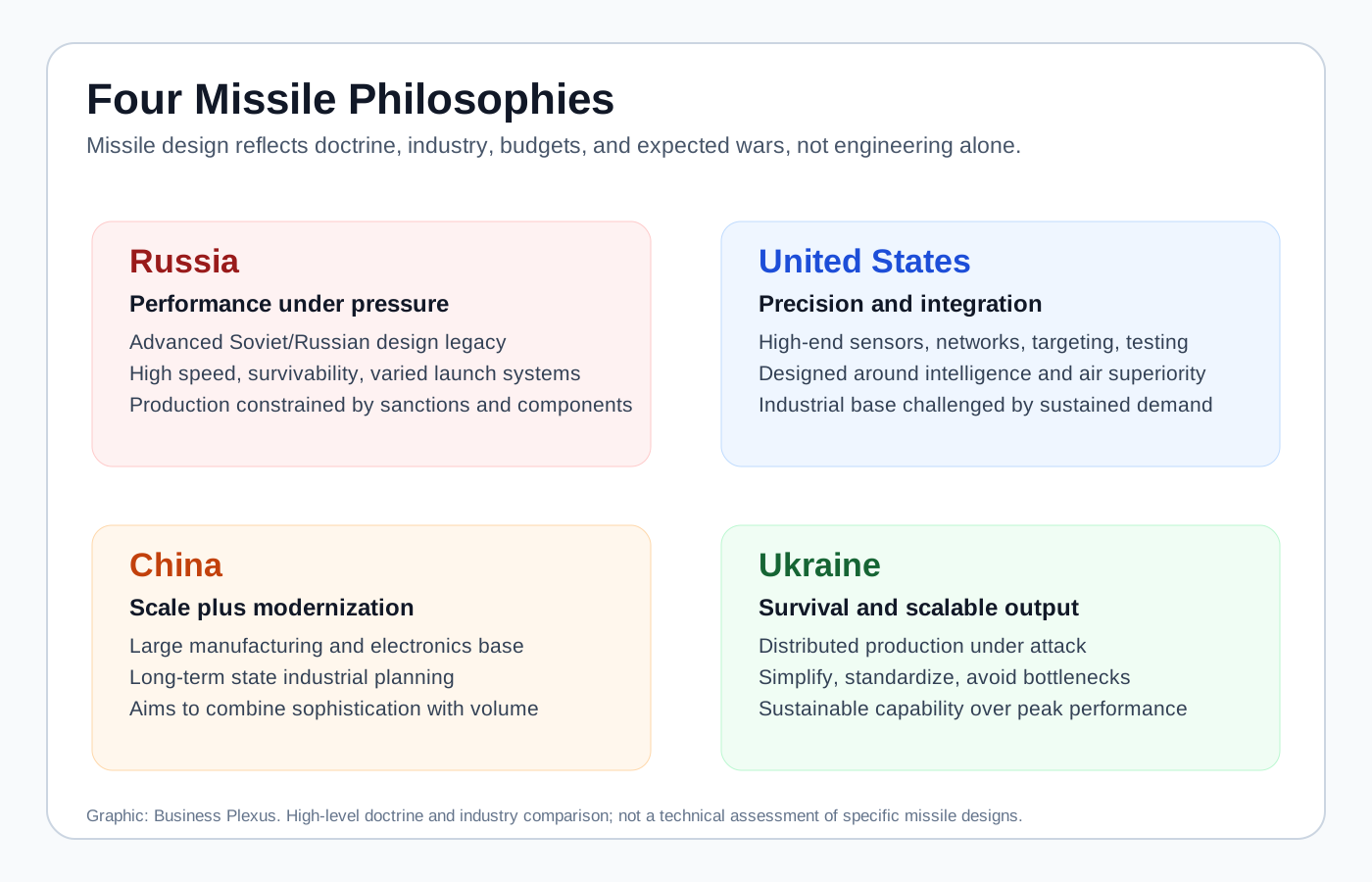
Russia: performance first, production under pressure
For decades, Russia inherited one of the world's most advanced missile engineering traditions from the Soviet Union.
The Soviet Union invested heavily in rocket science, guidance systems, and strategic missile forces, creating a network of research institutes, design bureaus, and manufacturing plants. Many of today's Russian missile systems trace their origins to engineering work begun decades ago.
The result has been a family of capable weapons, including the Iskander short-range ballistic missile, the Kalibr cruise missile, and several hypersonic systems that have received international attention.
Russia has consistently emphasized high speed, precision guidance, maneuverability, multiple launch options, electronic countermeasures, and survivability against missile defenses. These characteristics make Russian missiles difficult to intercept and capable of striking a wide variety of targets.
However, sophistication comes at a cost. Modern missile production depends on specialized electronics, precision machining, advanced materials, and trained engineers. Wartime production, international sanctions, and supply-chain disruption have created additional challenges for Russia's defense industry.
Russia continues producing missiles at a significant rate, and its ability to adapt should not be underestimated. But military analysts increasingly debate whether replacing expended inventories can keep pace with operational demand over many years of sustained conflict.
The United States: precision above everything else
American missile development has historically followed a different path.
Rather than maximizing production volume, the United States has generally emphasized precision, integration, and technological superiority.
Many American precision-guided weapons are designed to destroy a target with a single strike while minimizing unintended damage. That objective has driven decades of investment in advanced sensors, guidance systems, satellite navigation, secure communications, and networked battlefield integration.
American doctrine often assumes extensive intelligence support, air superiority, satellite connectivity, robust logistics, and high-value target selection. Under those conditions, fewer missiles may be required because each strike is expected to achieve a specific operational objective.
The downside is cost and production depth.
Modern American missiles often incorporate advanced electronics, complex software, and extensive testing requirements that contribute to long development timelines and high production costs. Recent conflicts have prompted renewed discussion inside the United States about expanding manufacturing capacity, particularly for precision-guided munitions and air-defense interceptors.
The war in Ukraine has reinforced the idea that industrial endurance remains as important as technological leadership. CSIS warned in its report on the U.S. defense industrial base that major regional conflicts could rapidly consume long-range precision munitions faster than peacetime stockpiles and production lines can replace them.
China: scale meets modern manufacturing
China presents perhaps the most interesting comparison.
Over the past two decades, Beijing has invested heavily in both missile technology and industrial modernization. Unlike many nations forced to choose between sophistication and production volume, China has attempted to pursue both simultaneously.
Its strategy benefits from several structural advantages: massive domestic manufacturing capacity, integrated electronics production, extensive machine-tool industries, a large engineering workforce, and long-term state-directed industrial planning.
Rather than relying solely on traditional defense contractors, China has leveraged commercial manufacturing expertise across multiple sectors. This integration has allowed rapid improvements in production efficiency while supporting increasingly advanced missile designs.
Many defense analysts believe China's greatest long-term advantage may lie not in any single missile system, but in its ability to manufacture large quantities of complex military equipment if required. Whether that capacity could be sustained during a prolonged conflict remains unknown, but it has become an important factor in strategic planning throughout the Indo-Pacific region.
Ukraine: optimizing for survival
Ukraine's situation differs fundamentally from all three.
Unlike Russia, it cannot assume access to a larger industrial base. Unlike the United States, it cannot rely on decades-long procurement cycles supported by enormous defense budgets. Unlike China, it does not possess the world's largest manufacturing sector.
Instead, Ukraine has been forced to optimize for survival.
Its missile industry must continue operating despite repeated attacks on infrastructure, interruptions to electrical power, workforce displacement, and constant pressure on logistics.
Those realities encourage a different set of engineering priorities. Rather than asking, "What is the most capable missile we can design?" engineers may increasingly ask: can this component be manufactured in multiple factories? Can another supplier produce it if one facility is damaged? Does this feature justify the additional production time? Can the missile be assembled using commercially available machine tools? How quickly can production increase if demand suddenly doubles?
These questions are characteristic of resilient manufacturing, an approach that prioritizes continuity and scalability alongside performance.
From peak performance to sustainable performance
There is an important distinction between designing for maximum capability and designing for sustainable capability.
Maximum capability seeks the best possible technical performance regardless of complexity. Sustainable capability asks whether that performance can be maintained year after year under wartime conditions.
History suggests the distinction matters. Many revolutionary military technologies have proven difficult to manufacture in large numbers. Others, while less sophisticated, achieved strategic significance because they could be produced continuously.
Ukraine appears to be embracing the latter philosophy. If reports about its emerging missile program are accurate, engineers may be deliberately accepting modest compromises in exchange for greater production potential.
That would represent a meaningful shift in modern missile design.
Lessons beyond Ukraine
The implications extend well beyond Eastern Europe.
NATO countries have already begun expanding ammunition production after recognizing that existing industrial capacity was insufficient for sustained conflict. Similar discussions are taking place regarding interceptor missiles, precision-guided munitions, rocket motors, and critical electronic components.
The same questions now confront defense ministries worldwide. How much sophistication is enough? When does additional complexity become counterproductive? How can factories remain productive during wartime? Can commercial manufacturing techniques accelerate defense production without compromising quality?
These questions have no simple answers, but they increasingly dominate discussions among military planners and defense economists.
The return of industrial strategy
For much of the post-Cold War era, many Western nations assumed that future conflicts would be relatively short and that existing weapons inventories would be sufficient.
The war in Ukraine has challenged those assumptions.
Industrial policy, once considered primarily an economic issue, has reemerged as a cornerstone of national defense. Governments are investing not only in new weapons but also in machine tools, skilled labor, supply chains, semiconductor production, rocket-motor manufacturing, and critical minerals.
In many respects, this represents a return to lessons learned during the industrial conflicts of the twentieth century. The difference is that today's factories are increasingly automated, digitally connected, and supported by advanced manufacturing technologies that would have been unimaginable only a generation ago.
More than missiles
Ultimately, the most important lesson from Ukraine's evolving missile strategy may have little to do with missiles themselves.
It is a reminder that military strength depends not only on innovation but on the ability to transform innovation into repeatable production.
The nation that consistently manufactures capable weapons at scale gains options that cannot be matched by isolated technological breakthroughs.
As defense planners look toward the coming decades, that may prove to be one of the defining strategic lessons of the war.
Coming in Part 5: We will examine one of the most debated questions surrounding Ukraine's emerging missile industry: can it realistically outproduce Russia in ballistic missiles? We will separate optimistic claims from measurable industrial realities and explore what factors will ultimately determine the answer.
Sources and further reading: UNITED24 Media on Shtilerman's mass-production comments; Defense News on Fire Point moving into ballistic missile defense; Associated Press on Fire Point's drones and missile work; Ukrainska Pravda on Ukraine's defense-industrial capacity; Business Insider on Ukraine's flexible drone manufacturing; CSIS on missile stocks and unit-cost pressures; CSIS on the U.S. defense industrial base and munitions depth; NDU Press on U.S. crisis-era munitions production; SIPRI on Ukraine's transformed arms industry; U.S.-China Economic and Security Review Commission on China's industrial modernization; U.S. State Department sanctions targeting Russia's military-industrial supply chains; Business Plexus coverage of Ukraine's strikes on Russian oil infrastructure and remote FPV drone operations.