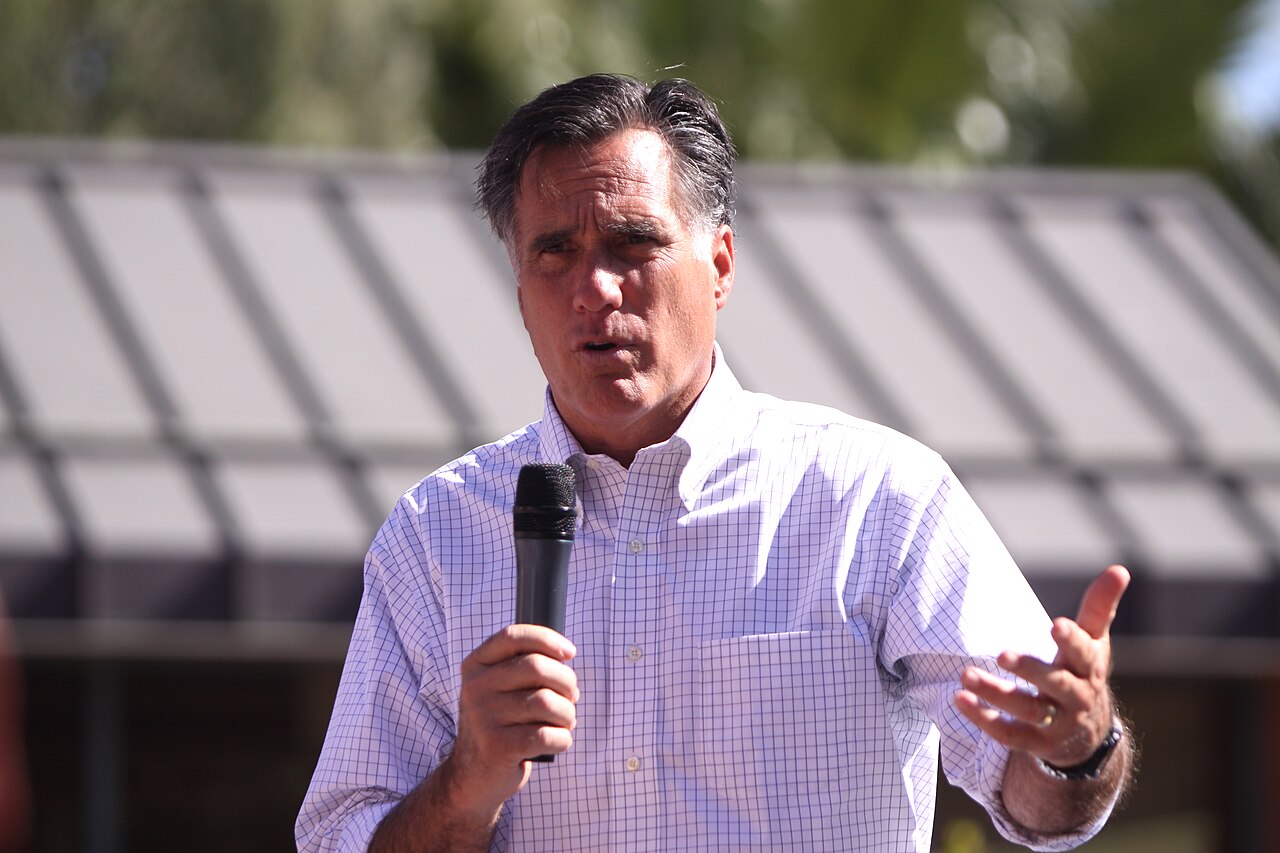
Mitt Romney speaking in Tempe, Arizona, in April 2012. Photo by Gage Skidmore, CC BY-SA 2.0, via Wikimedia Commons.
Romney was a HUGE proponent and recipient of government spending for the Olympics at the local, state and federal levels. His plan must be to send Olympians to restore the damage, and he will be sure and let you know more about this plan AFTER the election. You need to recognize that things like tax returns, and records at Bain, the Olympics and as Governor of Massachusetts are none of YOUR business. As a matter of fact, they are HIS business, because this is how he makes so much money, such as the profits of 3000% on the auto bailout money or on the outsourcing of jobs. If he were to tell you more, it would reveal important secrets, and remember business is his specialty, not yours.
How much Olympic money are we really talking about?
The sharper version of the argument is not that Mitt Romney personally pocketed federal Olympic money. The money did not work that way. The Salt Lake Organizing Committee, Utah, Salt Lake City, transportation agencies, security agencies, contractors, venues, and public infrastructure projects were the direct recipients. Romney's benefit was different: he was the executive put in charge of a troubled Olympic operation, and the large public funding stream helped make the rescue possible. That rescue then became one of the central credentials of his political career.
FactCheck.org, using Government Accountability Office figures, separated the money into two buckets. The narrower bucket was about $342 million in direct federal costs related to the Salt Lake Games. That included security, transportation, temporary housing, access roads, and other staging and operations support. FactCheck noted that this was more than just post-9/11 security money; much of it was planned before the attacks.
The broader number was about $1.3 billion. That figure included roughly $1.1 billion in indirect federal support, mainly highways, transit, and other capital improvements that officials said would probably have happened eventually but were prioritized or accelerated because the Olympics were coming. That is why both sides could argue over the number. Romney and his defenders could say much of the infrastructure was not a pure Olympic bailout. Critics could answer that acceleration itself was valuable, and that hosting the Games gave Utah and the organizing committee extra leverage in Washington.
Compared with Romney's personal wealth, the scale is striking. ABC News reported in 2012 that Romney's financial disclosure put his net worth as high as $250 million. The $342 million direct federal figure was larger than that estimate. The $1.3 billion broader figure was roughly five times as large. But that comparison should be understood carefully: those public funds were not personal income to Romney. They were public support for an event and for the infrastructure around it.
So how did it help him? First, it helped stabilize the Olympics at a moment when the organizing committee had been hurt by scandal, sponsor anxiety, budget problems, and security concerns. Second, it gave Romney a highly visible success story: the businessman who arrived, imposed discipline, negotiated, raised money, worked Washington, and delivered the Games. Third, it allowed him to campaign later as a turnaround executive while also criticizing other forms of government dependency.
That is the tension in the original criticism. Romney did not become rich because of Olympic appropriations. He was already very wealthy from Bain and other investments. But the Olympic rescue story that helped his public reputation was not a purely private-sector triumph. It rested on corporate sponsorships, ticket revenue, volunteer labor, state and local cooperation, and a substantial amount of federal support. If government spending was wasteful when it helped others, the 2002 Games showed that Romney was very capable of recognizing when public money could help something he was responsible for succeed.
The Olympics also complicate the FEMA angle from 2012. Disaster response, Olympic security, and large public events are different categories, but they all expose the same reality: some problems are too large, too risky, or too nationally significant to be handled by private actors alone. Romney's own Olympic record showed that he understood that when the stakes were high enough.
Sources and notes: Funding figures are based on FactCheck.org's 2012 review and related GAO reporting on federal support for the 2002 Winter Olympics. Romney wealth context comes from ABC News reporting on his 2012 financial disclosure. Image source: Wikimedia Commons.