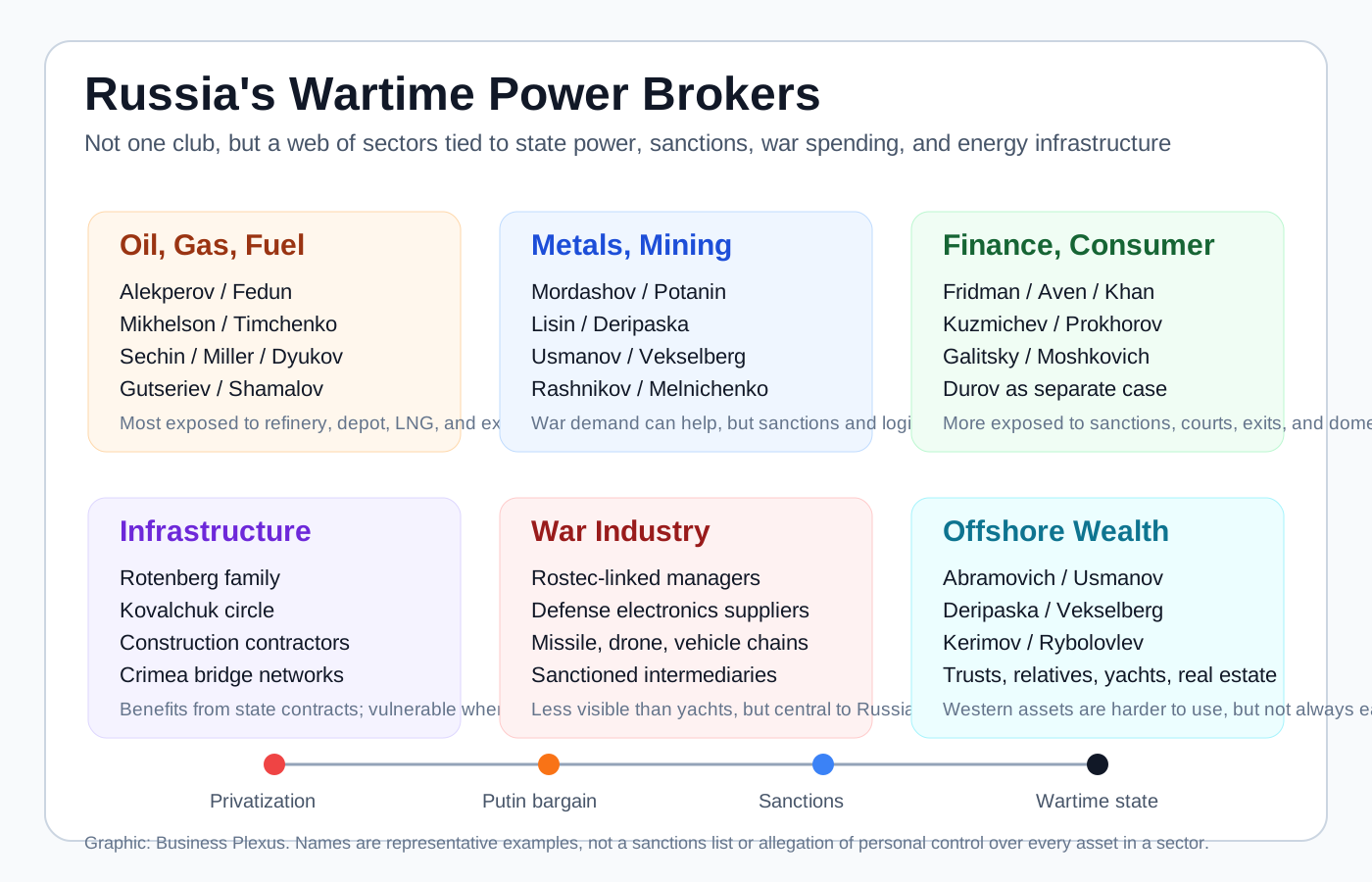
Business Plexus graphic. The map groups major Russian billionaires and power brokers by sector; it is not a sanctions list or a claim that every named person directly controls every asset in that category.
The word "oligarch" gets used loosely, but in Russia it still describes something real: private wealth that exists inside a political system where the state can protect, redirect, or destroy fortunes. Some Russian oligarchs are classic 1990s privatization winners. Some are Putin-era insiders. Some are state-company chiefs who may not own the company but sit on top of strategic assets. Some are families and intermediaries whose value comes from contracts, logistics, banks, or access.
This matters now because Ukraine's war strategy is increasingly aimed at Russia's economic infrastructure. In our recent catalog of Ukraine's strikes on Russian oil refineries, depots, terminals, and logistics hubs, the target list was mostly physical: refineries, oil depots, pumping stations, Crimea fuel infrastructure, bridges, and terminals. This article looks at the human and corporate map behind that infrastructure.
The point is not that every refinery fire personally bankrupts an oligarch. Russia's energy system is too state-directed for that. The point is that the same sectors that created Russia's billionaire class - oil, gas, metals, logistics, banking, and state contracts - are now being squeezed by sanctions, wartime controls, drone strikes, export disruption, and the Kremlin's growing demand for loyalty.
How oligarchs fit into Putin's Russia
In the 1990s, Russia's first oligarchs became powerful by acquiring state assets during chaotic privatization. Oil companies, metals plants, banks, media groups, ports, and mines were transferred into private hands at prices that later looked absurdly low. In the Yeltsin years, some of these men did not merely own businesses; they influenced politics directly.
Under Vladimir Putin, the bargain changed. The Kremlin tolerated great wealth, but demanded political discipline. The old lesson was Yukos and Mikhail Khodorkovsky: a billionaire could keep wealth, but not independent political power. Since then, Russia's elite economy has moved closer to state capitalism. Some billionaires remain formally private. Others operate through state-controlled giants such as Rosneft, Gazprom, Gazprom Neft, Rostec, and state banks. The line between owner, manager, contractor, and political instrument is often blurry.
That is why a catalog of oligarchs has to include more than yacht owners. It should also include state-company bosses, sanctioned insiders, infrastructure contractors, defense-industrial managers, and financiers who help the system keep moving.
Energy oligarchs and state oil bosses
Vagit Alekperov is the founder and former president of Lukoil, Russia's largest private oil company. He resigned shortly after the United Kingdom imposed sanctions on him in 2022, but his wealth remains closely associated with Lukoil. Lukoil assets have repeatedly appeared in strike reporting and Ukrainian target summaries, including refineries and fuel facilities in places such as Perm, Volgograd, and Ukhta. When Ukraine hits refining capacity, people connected to private oil fortunes feel pressure through repairs, lost product output, insurance, logistics, sanctions, and export restrictions.
Leonid Fedun, a longtime Lukoil figure and former Spartak Moscow owner, belongs in the same orbit. He is not the public face of Lukoil in the way Alekperov is, but he represents the private-oil generation that built wealth from post-Soviet energy assets.
Igor Sechin is different. He is usually described less as a private oligarch and more as a state-power figure. As the longtime head of Rosneft, he sits at the center of Russia's state oil system. The U.S. Treasury described Rosneft as one of Russia's two largest oil companies and a vertically integrated energy company covering exploration, extraction, production, refining, transport, and sale of petroleum products. Rosneft-linked assets matter directly to the strike campaign. The Ufa refining complex, including Bashneft-Novoil and Bashneft-Ufaneftekhim, became part of Rosneft when Bashneft joined Rosneft in 2016, according to Rosneft's own downstream description.
Alexander Dyukov, the head of Gazprom Neft, is another state-corporate power broker. Gazprom Neft operates the Moscow Oil Refinery in Kapotnya. Reuters reporting summarized by the Kyiv Independent said the refinery was struck twice by Ukrainian drones in June 2026 and could remain offline for months. That facility is a good example of how the war touches corporate elites: not by seizing a villa, but by damaging a strategic asset tied to fuel supply for the capital.
Alexey Miller, the head of Gazprom, is also more state manager than classic oligarch. Gazprom's export power has already been weakened by the loss of much of the European gas market, sanctions, and the rerouting of Russian energy flows. Ukraine's current strike campaign has focused more heavily on oil and refined products than on Gazprom's core gas export system, but energy infrastructure risk still sits across the entire sector.
Leonid Mikhelson and Gennady Timchenko are tied to Novatek, Russia's largest private gas producer. Mikhelson owns a large stake in Novatek, while Timchenko is closely associated with Putin's circle and holds energy interests. Arctic LNG, Yamal LNG, and tanker routes have made this group central to Russia's attempt to keep energy revenues flowing under sanctions. The Barents Observer, summarizing Forbes Russia's 2026 list, placed Mikhelson and Timchenko among the richest Russians and emphasized their connection to Arctic energy projects.
Mikhail Gutseriev, associated with Safmar and RussNeft, belongs to the oil-and-finance overlap. Carnegie has noted that Gutseriev failed to get sanctions lifted. He illustrates a newer wartime reality: even wealthy Russians who try to maneuver legally in Europe remain exposed to both Western restrictions and Kremlin suspicion.
Metals and mining oligarchs
Alexey Mordashov, the Severstal co-owner, returned to the top of the Russian billionaire ranking in 2026. The Moscow Times reported that Forbes counted a record 155 Russian billionaires in 2026 and placed Mordashov at the top of the Russian list. Metals fortunes like his are not as directly exposed to refinery strikes, but they are deeply tied to the wartime economy. Steel, mining, logistics, domestic demand, state orders, and sanctions all shape the value of these companies.
Vladimir Potanin controls Interros and is the dominant figure at Norilsk Nickel. He is one of Russia's richest men and has been sanctioned by several Western jurisdictions. Nornickel is central to nickel, palladium, copper, and other metals. For the Kremlin, these companies are strategically valuable because metals are hard currency, export leverage, and industrial inputs.
Vladimir Lisin, tied to NLMK, represents the steel-export side of Russian wealth. Like Mordashov, his exposure is more indirect: sanctions, transport disruption, energy costs, and state pressure matter more than a single refinery attack.
Oleg Deripaska, associated with Rusal and En+, is one of the best-known sanctioned Russian oligarchs. He has long had Western assets and legal fights connected to sanctions. The point of including him is that Russia's oligarch system was never only domestic. Aluminum, offshore holdings, banks, yachts, mansions, and Western capital markets were part of the old model.
Alisher Usmanov, associated with USM, metals, telecom, and technology holdings, is another example of globalized Russian wealth. OCCRP's Russian Asset Tracker and related reporting have described how assets connected to Russian elites can sit inside complex offshore structures, family arrangements, and high-value Western property.
Viktor Vekselberg of Renova straddles metals, energy, and technology. The U.S. Treasury's earlier oligarch designations described Renova as owning and managing assets across several sectors, including energy. He is useful as an example of an oligarch whose holdings cut across neat categories.
Andrey Melnichenko, Viktor Rashnikov, Iskander Makhmudov, Alexander Abramov, Andrei Skoch, and Suleiman Kerimov round out much of the metals, fertilizer, coal, transport, gold, and industrial circle. They do not all sit equally close to Putin, and their legal situations vary. But collectively they show how Russia's wealth base is still heavily weighted toward commodities rather than software or consumer technology.
Finance, banking, and consumer oligarchs
Mikhail Fridman, Petr Aven, German Khan, and Alexey Kuzmichev are tied to Alfa Group, Alfa Bank, and related holdings. Their story is different from the oil-refinery story. They have fought sanctions in European courts, attempted to separate themselves from direct responsibility for the war, and faced the problem of being wealthy Russians with assets and reputations in the West during a period of war.
In 2024, AP reported that Fridman and Aven won a court case over an earlier EU sanctions decision for the period from February 2022 to March 2023, although sanctions litigation and later listings remained complicated. Their case illustrates a major difference between legal sanctions and physical infrastructure strikes. Sanctions can be appealed, narrowed, or challenged. A drone-damaged refinery cannot file an appeal; it has to be repaired.
Sergei Galitsky, the founder of Magnit, represents retail and consumer wealth. Vadim Moshkovich of Rusagro shows the danger of being wealthy inside Russia even if one is not an energy oligarch. Carnegie described his 2025 arrest after efforts to get sanctions lifted, noting that the motivation could have involved loyalty concerns or business competition. In Putin's Russia, falling out of favor can matter as much as market performance.
Pavel Durov is a special case. He is Russian-born and wealthy, but Telegram is not a Kremlin oligarch company in the traditional sense. He belongs in the article mostly as a reminder that not every Russian billionaire is part of the same political category.
Infrastructure and Putin-circle wealth
Arkady Rotenberg, Boris Rotenberg, and related family interests are often discussed as Putin-circle infrastructure beneficiaries. Bridges, roads, pipelines, construction contracts, and state procurement have been central to this group. The Kerch Bridge is the obvious symbolic example of how infrastructure wealth and wartime logistics overlap. If Ukraine is trying to isolate Crimea, it is not only attacking a military route; it is attacking the physical world built by Putin-era state contracting.
Yuri Kovalchuk, often described as a close Putin ally and media-finance figure, represents another category: influence infrastructure. Banks, media assets, and political access matter even when they are not directly connected to an oil refinery.
Konstantin Malofeyev, a nationalist financier and media figure, is not in the same wealth tier as the largest metals and oil billionaires, but his political role matters. Modern Russia's elite structure includes ideological entrepreneurs as well as commodity billionaires.
Who has been affected by Ukraine's infrastructure strikes?
The clearest direct exposure is in oil refining and fuel logistics.
Rosneft-linked assets have been hit through Bashneft's Ufa refining complex and other Rosneft-associated refineries and subsidiaries. Rosneft is state-controlled, so the personal impact on Sechin is not like a shareholder watching a private company collapse. But the political impact is real: Rosneft must keep production, refining, export, and domestic fuel supply functioning while under sanctions and physical attack.
Those sanctions also explain why Moscow has leaned harder into non-dollar settlement, especially with China. That shift is part of the larger currency question discussed in our article on China's effort to reduce dollar dependence and expand the yuan's role.
Lukoil-linked assets matter because Lukoil remains Russia's most important private oil company. The U.S. Treasury designated both Rosneft and Lukoil in 2025, saying the companies fund the Kremlin's war machine and operate in the Russian energy sector. When Lukoil refineries or regional fuel systems are hit, the pressure falls on a company historically tied to Alekperov and Fedun, even if ownership and management details have changed since sanctions.
Gazprom Neft has been directly affected through the Moscow Oil Refinery. That strike connects to Dyukov, Gazprom, and the state energy system around the capital. It also matters politically because fuel supply in Moscow is not just a commercial issue; it is a stability issue.
Novatek and Arctic LNG interests are less directly tied to the current refinery campaign, but they are exposed to the broader energy war: sanctions on LNG projects, shipping constraints, Arctic construction delays, and the risk that Ukraine's strike range eventually makes more northern or export-linked energy infrastructure vulnerable.
Infrastructure contractors and Crimea-linked networks are affected when Ukraine targets bridges, ports, oil depots, ferry routes, and electricity nodes in occupied Crimea. The damage is not only to steel and concrete. It undermines the prestige of the projects that were supposed to make Crimea permanently integrated into Russia.
The rest are affected indirectly
Metals, fertilizer, retail, banking, and agriculture oligarchs are not all losing assets to Ukrainian drones. But they are living inside a wartime economy where the state needs more taxes, more production, more loyalty, and more silence. The Kremlin can reward compliant businesses with contracts, cheap assets, import-substitution opportunities, and protection. It can also punish disloyalty, seize assets, open criminal cases, or encourage a competitor to move in.
That is the wartime tightrope Carnegie described: many Russian billionaires want to preserve assets in Europe, challenge sanctions quietly, avoid becoming too visible, and stay acceptable to Moscow. The problem is that the space for neutrality keeps shrinking. A billionaire who criticizes the war risks the Kremlin. A billionaire who supports the war risks sanctions. A billionaire who says nothing may still be treated as part of the system.
A practical catalog of major names
| Name | Main sector or role | How they fit the system | Strike exposure |
|---|---|---|---|
| Vagit Alekperov | Lukoil / oil | Private-oil founder and former chief | High, through refinery and fuel-system pressure on Lukoil assets |
| Igor Sechin | Rosneft / state oil | State-power oil boss, not a classic private oligarch | High, through Rosneft and Bashneft-linked refining assets |
| Alexander Dyukov | Gazprom Neft | Manager of a strategic state-linked oil company | High, because Gazprom Neft operates the Moscow refinery |
| Leonid Mikhelson | Novatek / LNG | Private gas and Arctic LNG billionaire | Medium, more exposed to sanctions, shipping, and future energy-target risk |
| Gennady Timchenko | Energy / Putin circle | Close Putin ally with energy and infrastructure interests | Medium, tied to energy and logistics pressure |
| Alexey Mordashov | Severstal / steel | Top Russian billionaire in 2026 Forbes-based rankings | Low direct strike exposure; high sanctions and war-economy exposure |
| Vladimir Potanin | Nornickel / metals | Strategic metals billionaire | Low direct strike exposure; major sanctions and export-market exposure |
| Vladimir Lisin | NLMK / steel | Export-oriented industrial billionaire | Low direct strike exposure; transport and sanctions exposure |
| Oleg Deripaska | Aluminum / energy | Sanctioned globalized oligarch with industrial holdings | Low direct strike exposure; high sanctions and asset-tracing exposure |
| Mikhail Fridman / Petr Aven | Alfa / banking | Finance oligarchs fighting sanctions and reputational risk | Low direct strike exposure; high legal and sanctions exposure |
| Roman Abramovich | Steel / investments | Symbol of offshore Russian wealth and Western asset freezes | Low direct strike exposure; high offshore asset and sanctions exposure |
| Rotenberg family | Infrastructure / state contracts | Putin-circle contractors linked to roads, pipelines, bridges | Medium to high where Crimea and logistics infrastructure are targeted |
The bottom line
Russia's oligarchs are not a single political party and not a single ownership group. They are a layered elite: commodity billionaires, state-company bosses, infrastructure contractors, bankers, media figures, defense suppliers, and offshore asset holders. Some are more independent than others. Some are closer to Putin. Some are useful because they own things; others are useful because they manage strategic assets on behalf of the state.
Ukraine's infrastructure strikes are therefore not just a battlefield tactic. They are a pressure campaign against the economic architecture that makes Russia's war sustainable. The people most directly affected are those tied to oil, fuel, refineries, ports, logistics, and Crimea infrastructure. The rest are affected indirectly by the same wartime transformation: sanctions, state demands, rising taxes, loyalty tests, and shrinking room to stay rich without taking a side.
Sources and further reading: Ukraine strike context from Business Plexus' 2026 Russian oil infrastructure strike catalog. Energy-sector sanctions from the U.S. Treasury designation of Rosneft and Lukoil. Moscow refinery damage from Kyiv Independent/Reuters reporting. Bashneft/Rosneft ownership context from Rosneft's downstream profile. Strike-campaign analysis from Rice University's Baker Institute, Quantifying Ukraine's Strikes on Russian Energy Infrastructure. Elite pressure and sanctions maneuvering from Carnegie, Russia's Oligarchs Must Walk a Wartime Tightrope to Keep Their Fortunes. Billionaire ranking context from The Moscow Times, The Barents Observer, and The Insider. Asset-tracing background from OCCRP's Russian Asset Tracker and the OpenSanctions Russian Oligarch/Billionaires Database.