Poland is not becoming broadly pro-Russia. That is the first point to get right. Poland remains one of the European countries most historically alert to the danger from Moscow, and Ukraine still functions as a strategic buffer between Russia and Poland's eastern frontier.
But Polish support for Ukraine is becoming more conditional. The old emotional consensus from 2022 has weakened. Refugee fatigue, agricultural competition, welfare politics, historical grievances, and the rise of nationalist language have created a more complicated landscape. The message from part of the Polish right is no longer "abandon Ukraine." It is closer to: support Ukraine against Russia, but not at the expense of Polish national interests, Polish farmers, Polish taxpayers, or Polish historical memory.
The leadership split: Tusk and Nawrocki
Poland's government is divided institutionally and politically. Prime Minister Donald Tusk leads a centrist, pro-European government that still sees Ukraine as central to Polish security and Poland's role inside the EU and NATO. President Karol Nawrocki, elected in 2025 with right-wing support, has taken a more nationalist line on Ukraine-related disputes, especially history and refugee benefits.
The Polish president has real blocking power. The UK House of Commons Library notes that Poland's president can veto legislation and that overriding a veto requires a three-fifths majority in the Sejm, which Tusk's government does not have. That makes foreign policy and refugee policy more vulnerable to domestic political conflict than they might appear from outside.
The latest dispute has made that tension visible. On June 19, 2026, Nawrocki announced that he would revoke President Volodymyr Zelenskyy's Order of the White Eagle, Poland's highest state honor, after Ukraine named a military unit after the Ukrainian Insurgent Army, or UPA. The official Polish presidential statement said the decision was not directed against the Ukrainian people and did not change Poland's strategic view that Russian aggression threatens Poland and Europe.
That last sentence matters. Nawrocki is not saying Poland should side with Russia. He is saying Poland should support Ukraine on Polish terms.
The UPA and Volhynia issue
The emotional center of the current dispute is the UPA and the Volhynia massacres. In Ukraine, parts of the Ukrainian nationalist movement are remembered by some as anti-Soviet and anti-imperial resistance. In Poland, the UPA is widely associated with the killing of Polish civilians in Volhynia and Eastern Galicia during World War II. Poland's parliament has recognized those massacres as genocide.
AP reported that Nawrocki moved to strip Zelenskyy of the Order of the White Eagle because of the unit naming. Al Jazeera reported that Zelenskyy and senior Ukrainian officials responded by returning Polish awards. The Guardian reported that Tusk warned the dispute was a strategic mistake that harms both countries politically, economically, and reputationally.
The issue is real. It is not simply Russian propaganda. Polish historical grievances over Volhynia are deep and legitimate. But Russia benefits when those grievances are pulled into current war politics in a way that weakens Polish-Ukrainian coordination.
What the polling actually says
The polling does not show Poland turning pro-Russian. It shows fatigue and conditionality.
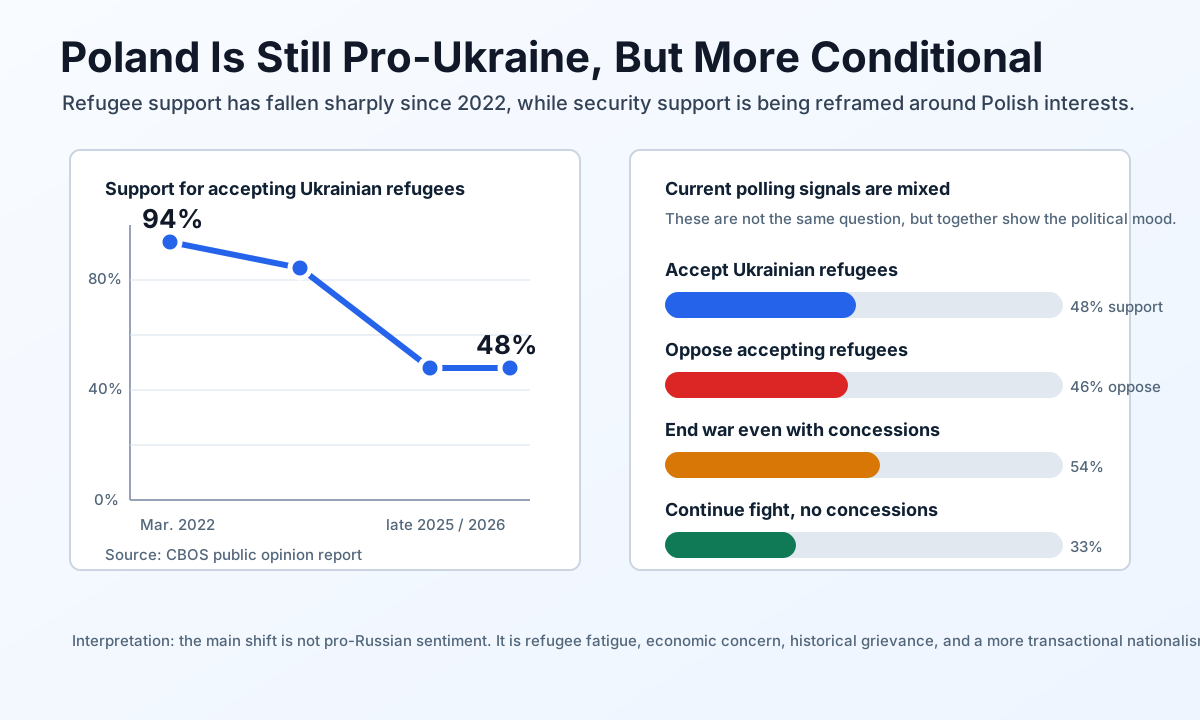
CBOS reported in 2026 that 48 percent of Poles still support accepting Ukrainian refugees from conflict-affected areas, while 46 percent oppose it. That is a dramatic fall from March 2022, when 94 percent supported accepting refugees after Russia's full-scale invasion.
The same CBOS report found that 54 percent of Poles support ending the war even at the cost of Ukraine losing part of its territory or independence, while 33 percent believe the fight should continue and no concessions should be made to Russia. That does not mean a majority of Poles like Russia. It means war fatigue and fear of escalation are stronger than they were in 2022.
Other polling points in the same direction. An IBRiS survey reported by Notes from Poland found that only 35 percent of Poles supported Poland backing Ukraine's EU accession and 37 percent supported backing NATO accession, while 42 percent opposed both. A Mieroszewski Centre survey also found more conditional attitudes toward Ukraine's EU and NATO path.
The rough claim that perhaps "30 percent" of Poles are part of a harder nationalist or skeptical bloc is better understood as a political estimate, not a clean statistic. Different polls ask different questions: refugees, welfare, military aid, NATO, EU membership, trade, history, or negotiations. The numbers vary. What is consistent is the trend: less unconditional support, more demands for limits and reciprocity.
Refugees: the core social pressure
Poland took in a very large number of Ukrainians after 2022. That early response was one of the most important humanitarian efforts in Europe. But three and four years later, the politics have changed. Housing, schools, healthcare, benefits, jobs, wages, and local administrative capacity are now part of the debate.
UNHCR's Poland guidance notes that legal rules for Ukrainians changed in March 2026, moving temporary protection into a different legal framework. The European Commission has also described changes to Polish rules, including linking some benefits more closely to work and tax status. This is the policy version of the polling shift: Poles are not necessarily saying Ukrainians should be abandoned, but many want the system to be narrower, more rules-based, and more visibly tied to contribution.
That distinction matters. Opposition to current refugee benefits is not identical to opposition to Ukraine's survival. A voter can believe Russia is a threat, support Ukrainian independence, and still oppose expanded welfare for Ukrainian refugees in Poland.
Farmers and economic competition
Agriculture is another pressure point. Polish farmers have protested Ukrainian grain and food imports, arguing that cheaper Ukrainian products undermine local producers. This issue predates the latest UPA dispute and has been one of the main ways Polish-Ukrainian solidarity has become transactional.
For Ukraine, access to European markets is a survival issue. For Polish farmers, it can feel like a direct economic threat. Russia benefits from the dispute, but the dispute itself is not imaginary. It is an economic conflict between a country fighting for export routes and a neighboring country whose farmers fear being undercut.
How this affects Ukraine
The most direct effect is political. Ukraine needs Poland as a logistical hub, diplomatic partner, military-support corridor, refugee host, and advocate inside Europe. A public fight with Warsaw makes all of that harder.
The Gdansk recovery conference is a good example. The Guardian reported that Zelenskyy will skip the Ukraine Recovery Conference in Gdansk amid the dispute, with Ukraine's delegation instead led by Prime Minister Yulia Svyrydenko. That is not just symbolism. Recovery conferences are where Ukraine tries to lock in money, investment, reconstruction plans, and political support.
The deeper danger is normalization of conditional support. If Polish politics shifts from "Ukraine must win because Russia is dangerous" to "Ukraine deserves support only if it satisfies Polish historical, economic, and refugee-policy demands," Moscow gains room to exploit every grievance.
Russia's role
Russia does not need to invent every grievance. It only needs to amplify the ones that already exist. The Volhynia dispute is real. Refugee fatigue is real. Farmer anger is real. Welfare resentment is real. The Russian information advantage comes from pushing those issues toward a conclusion useful to Moscow: less trust, less aid, less coordination, and more suspicion between Poland and Ukraine.
That is why Tusk's warning is strategically sound even if one agrees that Ukraine handled the UPA naming badly. The choice is not between historical truth and strategic unity. Poland and Ukraine need both. The hard part is preventing unresolved history from becoming a live weapon during an active war.
Where things stand
Poland's majority position is still anti-Russia and broadly pro-Ukraine in the strategic sense. But that support is no longer blank-check emotional solidarity. It is becoming conditional, transactional, and more vulnerable to domestic politics.
The nationalist right is not necessarily winning a majority for abandoning Ukraine. It is winning ground by redefining support: yes to Ukrainian resistance, no to unlimited refugee benefits; yes to opposing Russia, no to forgetting Volhynia; yes to security cooperation, no to Ukrainian farm exports hurting Polish farmers; yes to aid, but only if Polish interests come first.
That position is politically powerful because parts of it are reasonable. Countries do have national interests. Refugee systems do need rules. Historical crimes do need recognition. Farmers do need protection from unfair shocks. The risk is that Russia benefits when every legitimate concern becomes a reason to weaken the alliance Ukraine needs to survive.
My read is this: Poland is not turning against Ukraine. Poland is entering a more difficult phase of support. The early-war moral clarity is being replaced by coalition management, budget pressure, history disputes, and electoral competition. That is normal in a long war, but it is also dangerous. Ukraine and Poland can survive the tension if leaders keep the strategic frame clear: Russia is the threat, and the disputes between Warsaw and Kyiv need to be managed so they do not become Moscow's leverage.