The SpaceX IPO was not just another hot technology listing. It was a market event built out of almost every term investors use when they talk about a major public offering: scale, valuation, fees, allocation, price discovery, key-person risk, index inclusion, wealth creation, and the famous IPO pop.
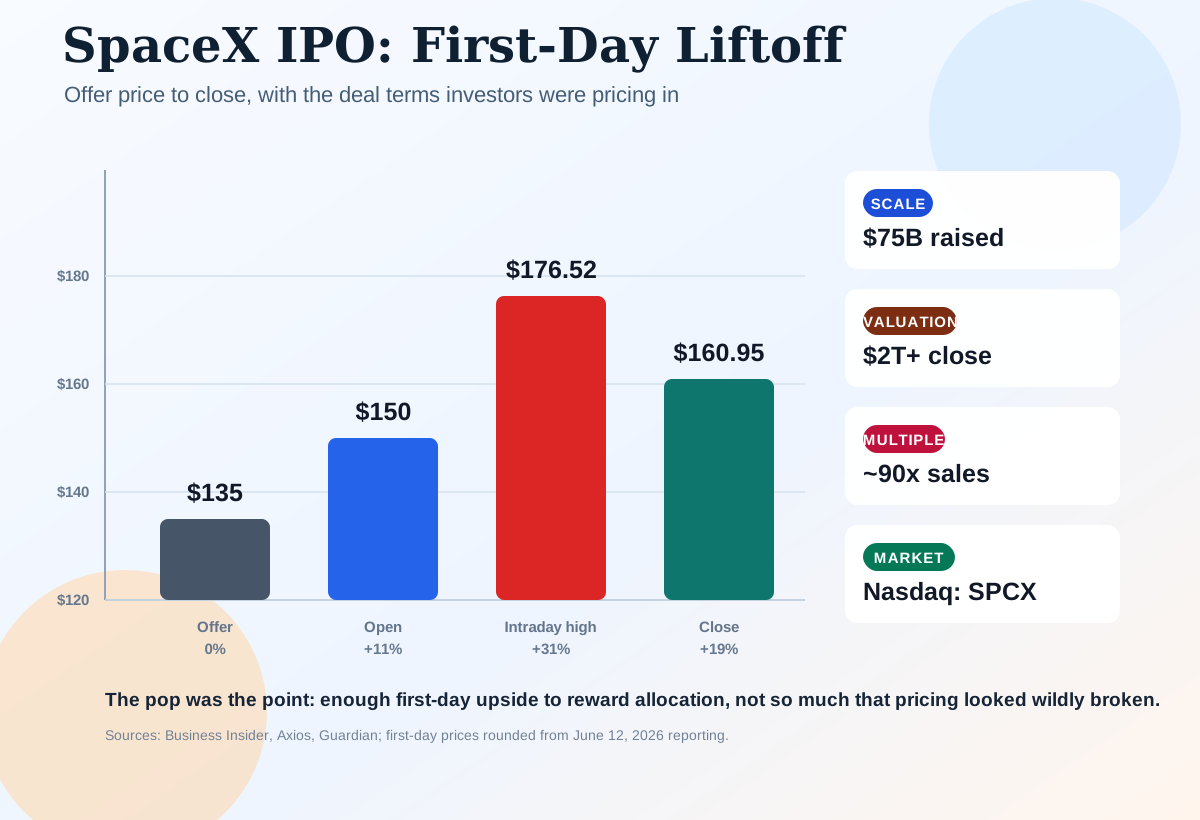
That vocabulary matters because it shows why the offering was bigger than one company raising money. SpaceX came public as a rocket, satellite, internet, defense, and AI story all at once. It raised a reported $75 billion, began trading under the ticker SPCX, and finished its first session with a valuation above $2 trillion, according to first-day reporting from Business Insider, Axios, and the Guardian.
Scale
Scale is the first reason this IPO will be remembered. A normal successful IPO gives a private company access to public capital. SpaceX did that at a size normally associated with entire stock-market sectors. A $75 billion raise would be enormous even for a mature public company. For an IPO, it rewrites the comparison set.
The scale also changed the market around it. A company entering public markets above $1.7 trillion at the offering price and above $2 trillion after trading begins is not a niche new issue. It instantly becomes one of the largest companies in the market, which means index funds, benchmarked managers, retail traders, and rivals all have to react.
Valuation
Valuation is where the excitement becomes uncomfortable. Axios reported that SpaceX came public at about 90 times sales, while Business Insider cited 2025 revenue of $18.7 billion and a net loss near $4.9 billion. That means investors were not mainly buying current profits. They were buying a future: Starlink cash flow, launch dominance, defense contracts, AI infrastructure, and the possibility that SpaceX becomes a platform company rather than only an aerospace company.
That kind of valuation can be justified only if future growth is extraordinary. It also leaves less room for disappointment. If launches slow, Starlink margins compress, AI ambitions take longer than expected, or regulators push back, the stock can fall even if the underlying business remains impressive.
Fees
Fees matter because a deal this large is a once-in-a-generation payday for the banks, advisers, exchanges, law firms, and market infrastructure around the transaction. In a huge IPO, the fee pool is not just compensation for paperwork. It is payment for distribution, risk management, allocation decisions, messaging, legal protection, and the choreography of getting a private giant into the public market without a disorderly opening.
That is why a first-day pop of around 19% to 20% can look almost perfect from the banks' point of view. It rewards investors who received shares at the offering price, helps the company avoid the embarrassment of a broken IPO, and still avoids the criticism that a 100% first-day surge would invite: that the company left too much money on the table.
Allocation
Allocation is the question of who got shares before public trading began. MarketWatch reported that retail investors were discussing partial allocations and that many received far fewer shares than they requested. Business Insider reported very large retail demand, with only a limited portion of the offering available to everyday investors.
That matters because allocation creates instant winners and instant resentment. If you received IPO shares at $135 and the stock closed near $161, you had a large paper gain on day one. If you were shut out and had to buy in the open market, you were buying after the pop had already happened.
Price discovery
Price discovery is the process by which the market figures out what something is worth. In a conventional IPO, bankers test demand across a price range, adjust the offering, and then let the first trade reveal whether they were close. The SpaceX deal was unusual because reporting described a more fixed, take-it-or-leave-it price before trading began.
The result was a dramatic public test. Shares priced at $135, opened around $150, traded as high as roughly $176.52, and closed around $160.95, according to Business Insider's first-day data. That is a clean example of price discovery happening in the open: the market quickly accepted a valuation above the offering price, then pulled the stock back from its intraday peak.
Key-person risk
Key-person risk is the risk that too much of a company's value depends on one individual. For SpaceX, that person is Elon Musk. The positive version of the risk is obvious: Musk is part of why investors believe the company can attempt missions, products, and timelines that would sound impossible elsewhere. The negative version is also obvious: the public company now carries his governance style, public controversies, and personal brand directly into ordinary portfolios.
That does not mean the company is a one-person operation. Gwynne Shotwell and SpaceX's engineering organization are central to its execution. But the market is still valuing not only rockets and satellites, but also the Musk premium. A premium can become a discount if confidence changes.
Fast-tracked index inclusion
Index inclusion is one of the most underappreciated pieces of the story. MarketWatch reported that Nasdaq and other index operators created or used fast-entry pathways that could bring SpaceX into major benchmarks quickly, while S&P did not immediately follow the same path for the S&P 500.
This matters because index inclusion changes demand. When a stock enters a major index, funds that track or benchmark against that index may need exposure. That means SpaceX's valuation is no longer just a question for people who love the company. It becomes a question for retirement accounts, passive funds, and institutions whose rules push them toward owning the market's largest names.
Wealth creation
The IPO also created a sudden wave of wealth. Early employees, founders, venture backers, and strategic investors saw private paper gains turn into publicly marked fortunes. The Guardian reported that the debut made Musk the world's first trillionaire by market close, while Business Insider highlighted multibillion-dollar gains for early insiders and backers.
That wealth creation is part of why IPOs have cultural force. They do not only raise capital. They redistribute status, liquidity, and influence. SpaceX's IPO turned years of private-company belief into public-market wealth in a single trading day.
The pop, and the market around it
The first-day pop is the headline number, but it is also a signal. A roughly 19% close-to-offer gain, with a much larger intraday move, says investors wanted exposure even after a massive valuation. It also helped pull attention, and in some places sentiment, toward the rest of the market. A successful mega-IPO can make investors more willing to fund other ambitious AI and frontier-technology companies.
That is the lesson of the SpaceX debut. It was not simply a rocket company going public. It was the public market trying to price a hybrid of aerospace, telecom, defense, AI, celebrity leadership, and national ambition. The first day said demand was real. The next several years will decide whether the valuation was foresight or fever.
Sources and notes: First-day prices, valuation, offering size, revenue, and loss figures are drawn from Business Insider, Axios, and the Guardian. Allocation and index-inclusion discussion references MarketWatch on retail allocations and MarketWatch on fast-entry index rules. This is market commentary, not investment advice.