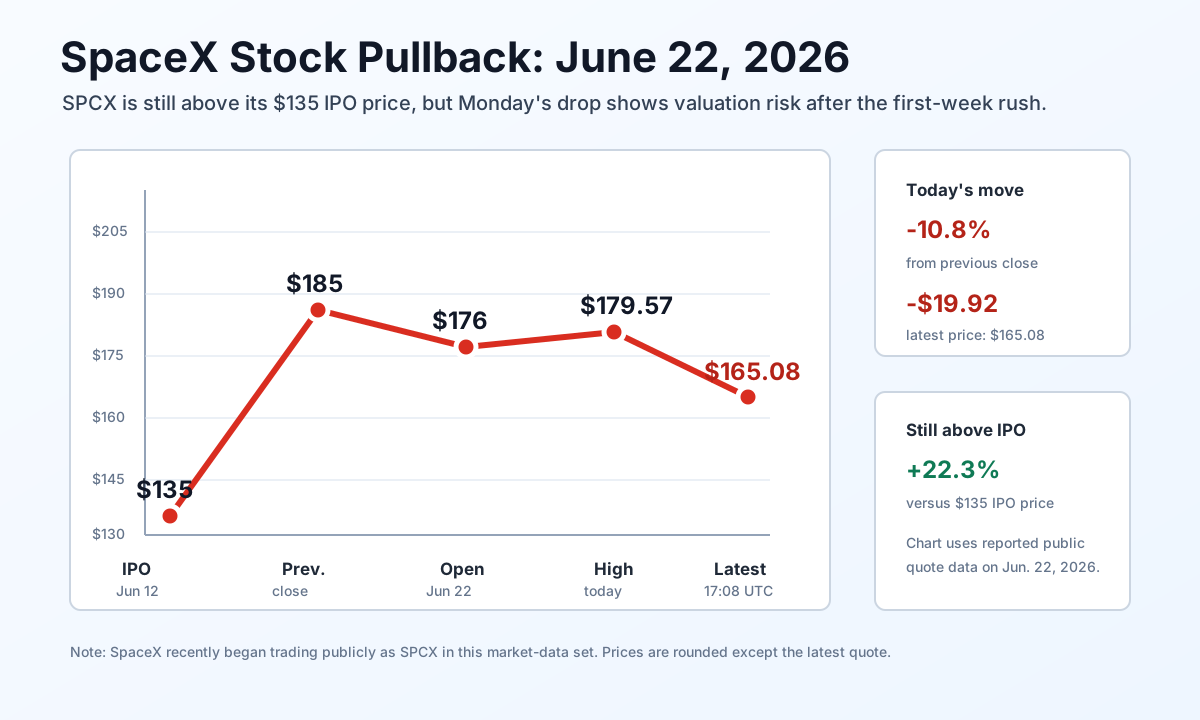
June 22, 2026: SpaceX stock is falling sharply today. According to current market quote data for SPCX on Yahoo Finance, the stock was recently around $165.08, down about $19.92, or roughly 10.8 percent, from the previous close. It opened near $176.03, traded as high as $179.57, and then slid toward the $165 area.
That does not mean SpaceX is suddenly a bad company. It means the market is testing how much future greatness was already built into the price. SpaceX can be an extraordinary business and still be an expensive stock.
The useful way to think about this is not through slogans. It is through a simple business-owner question: if you owned the whole company, how much revenue, profit, and future growth would you need to justify the price?
A better version of the vending-machine analogy
Imagine a vending machine that produces $400 per month in sales. That is $4,800 per year in revenue. If the machine makes no profit after product costs, rent, electricity, card fees, repairs, theft, and restocking, then the machine is not worth very much as a financial asset unless you believe profits will improve later.
If someone pays $48,000 for that machine, they are paying 10 times annual sales. If they pay $144,000, they are paying 30 times annual sales. If they pay $552,000, they are paying 115 times annual sales. Those are not normal vending-machine prices. They are prices that only make sense if the buyer believes the machine is about to become much larger, much more profitable, or strategically valuable in some other way.
That is the more realistic analogy for SpaceX. The company is not a vending machine doing $400 a month. It is a launch, satellite, defense, broadband, and space-infrastructure company with real revenue, real technology, and a dominant position in several markets. But the stock market is still asking a vending-machine-style question: how many dollars of value are investors paying for each dollar of sales?
The current valuation problem
Using the recent SPCX quote near $165 and reported share-count discussion around 13 billion shares outstanding, the market value is roughly $2.1 trillion. Business Insider reported that SpaceX had 2025 revenue of about $18.7 billion and a 2025 loss of about $4.9 billion. On that trailing revenue figure, the stock would be trading at more than 100 times sales, with no positive earnings multiple because the company lost money.
That does not automatically mean the stock is wrong. Early-stage public growth companies often trade on future revenue rather than current profit. But it means investors are paying for a future that has to be very large. A company cannot stay at 100-plus times sales forever unless revenue explodes, margins become enormous, or the market keeps assigning it a rare strategic premium.
Barron's reported today that KeyBanc initiated coverage with a neutral Sector Weight rating and no price target, citing valuation and uncertainty around the Starship program. Barron's also noted that the company was trading around 29 times projected 2027 revenue, a very high multiple compared with more ordinary aerospace, telecom, defense, and technology peers.
For a more formal valuation framework, Aswath Damodaran's post-prospectus SpaceX valuation discussion is useful because it separates trading momentum from intrinsic value. His point is similar: even an exceptional company can be too richly priced if the market price already includes too much of the future.
Why the stock can fall even if the company is impressive
There are several reasons a stock like SpaceX can fall after an exciting debut.
First, the IPO pop may have pulled future returns forward. If investors bought aggressively in the first few days, the stock may have quickly reached a valuation where good news was already priced in.
Second, the float is limited. Reports have noted that only a fraction of the total shares are freely trading. A limited float can exaggerate moves up and down. It can create scarcity during the first rally and then volatility when sellers appear.
Third, analysts are starting to model the business. SpaceX is not easy to value. It has launch services, Starlink broadband, Starshield government work, Starship development, potential Mars ambitions, and possible future infrastructure businesses. Some of those could be enormous. Some may take longer and cost more than investors expect.
Fourth, losses still matter. A company can lose money while building something valuable. But when a company is valued in the trillions, investors eventually ask when scale becomes profit.
Fifth, future share supply matters. Lockup expirations, employee liquidity, insider selling windows, and future capital raises can all pressure a newly public stock if investors worry more shares are coming.
The math in plain English
Here is the valuation math without hype. If SpaceX is worth about $2.1 trillion and produced roughly $18.7 billion in 2025 revenue, then investors are paying around 115 dollars of market value for every dollar of trailing sales. If a vending machine produced $4,800 per year in sales, the equivalent 115-times-sales price would be about $552,000.
That is the point. The problem is not that SpaceX is fake. The problem is that the stock price requires very large future assumptions. If SpaceX grows revenue from $18.7 billion to $75 billion, the valuation multiple falls dramatically. If it becomes a high-margin satellite internet and defense platform, the valuation becomes more understandable. If Starship works at scale and unlocks a new space economy, bulls can justify numbers that look absurd on current revenue.
But if revenue growth slows, Starship takes longer, Starlink margins disappoint, defense work is politically constrained, or capital needs keep rising, the valuation can compress quickly. That is what high-multiple stocks do. They do not need bad news to fall. They only need the market to become less willing to pay for distant good news.
Why the exaggerated version of the analogy is not quite fair
Some online comparisons make the point too aggressively by implying SpaceX is like paying $100 million for a vending machine that makes $400 per month. That overstates the valuation gap. At $400 per month, a $100 million price would be more than 20,000 times annual sales. SpaceX is expensive, but it is not trading at 20,000 times sales.
A more realistic version is this: SpaceX is like paying several hundred thousand dollars for a vending machine that currently sells $4,800 a year, loses money today, but might become a national distribution network, a telecom company, a military contractor, and a logistics platform over the next decade. That could be a brilliant bet. It could also be a very expensive bet.
The bull case has real substance
The bullish argument is not foolish. SpaceX has changed the launch market. Reusable rockets are real. Starlink has become a major satellite broadband network. Government demand for resilient space infrastructure is rising. U.S. defense and intelligence agencies increasingly care about satellites, launch cadence, communications, and orbital logistics. If any company is positioned to benefit from that shift, SpaceX is near the top of the list.
There is also an intangible scarcity premium. Public investors rarely get a chance to buy a company with SpaceX's combination of technical ambition, brand power, government relevance, and private-market mystique. That scarcity can support a premium valuation for a while.
The bear case is about price, not rockets
The bearish argument is mostly about price. At a multi-trillion-dollar valuation, SpaceX has to become one of the most valuable companies in the world and then keep growing from there. That requires more than successful launches. It requires revenue scale, durable margins, disciplined capital allocation, and proof that Starship and Starlink economics can support the expectations built into the stock.
That is why today's selloff matters. It is not just a bad trading day. It is the market beginning to separate the company from the price. Investors can admire SpaceX and still decide that $2 trillion-plus is too much to pay right now.
What investors should watch next
Watch the next few closes, not only the intraday drama. A one-day drop can reverse. A pattern of lower highs and lower lows after an IPO is more meaningful. Watch analyst coverage, Starship milestones, Starlink subscriber and margin data, government contract announcements, debt issuance, lockup schedules, and any updated revenue guidance.
Most importantly, watch whether SpaceX begins trading like a story stock or like a financial statement. Story stocks can move on imagination for a while. Financial-statement stocks eventually need margins, cash flow, and credible forecasts.
As of June 22, 2026, SpaceX is still above its IPO price. But the stock's slide shows the core risk clearly: the company may be extraordinary, yet the valuation may already assume an extraordinary amount of success.
This article is for general financial commentary and is not investment advice.