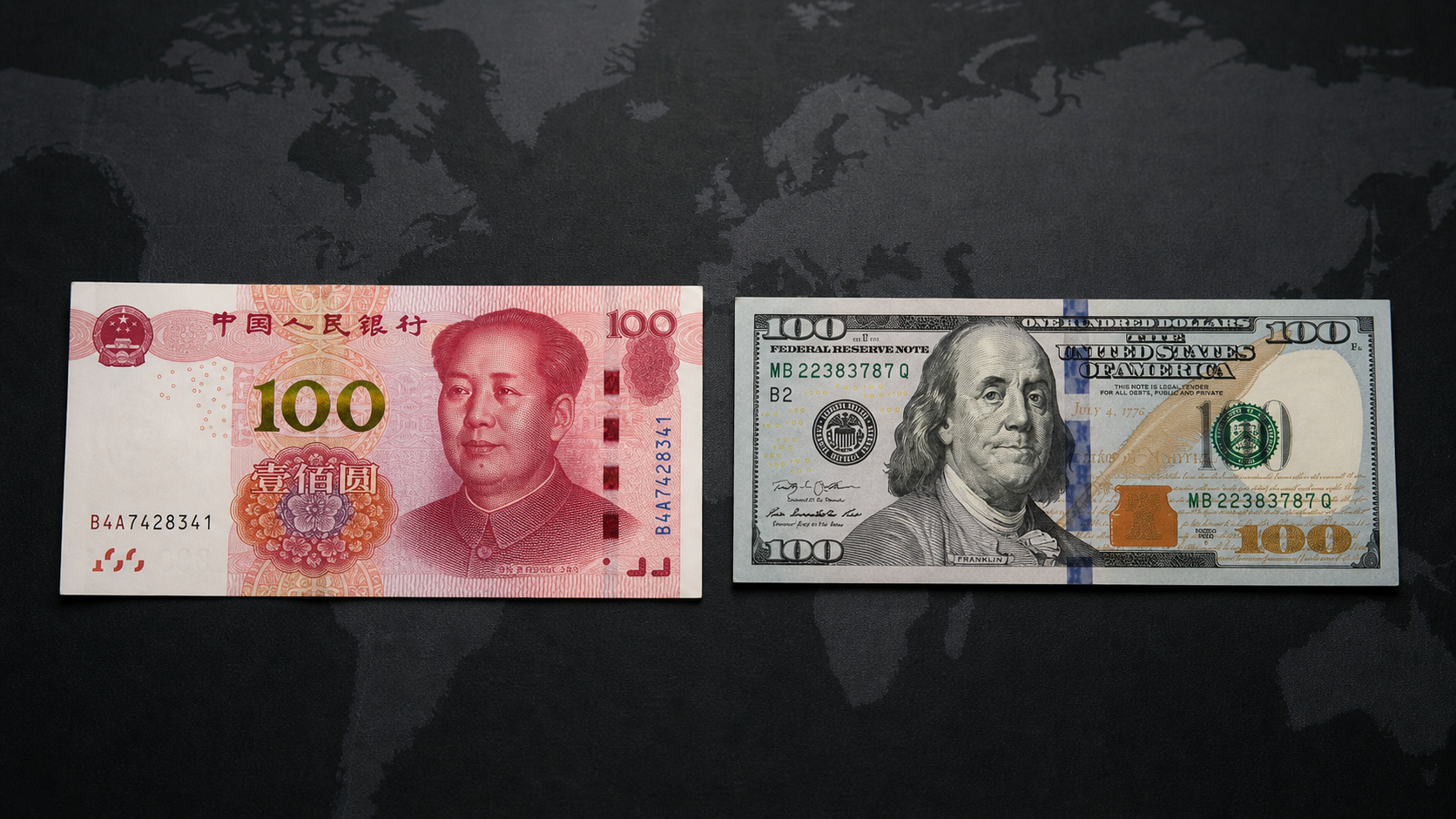
Illustration generated for Business Plexus.
China is not trying to replace the dollar in one dramatic move. It is trying to reduce dependence on the dollar where it can, expand the use of the renminbi in trade and finance, and build payment infrastructure that gives Beijing more room to operate if U.S. sanctions, tariffs, or financial pressure become more severe.
That distinction matters. The yuan is making real progress in China-linked trade settlement, cross-border payments, swap lines, commodity deals, and financial infrastructure. But it is still nowhere close to replacing the dollar as the world's dominant reserve currency, funding currency, trade-finance currency, or foreign-exchange vehicle.
The best answer is therefore mixed: China is succeeding at partial de-dollarization around its own trading network, but failing, at least so far, to make the yuan a true global substitute for the dollar.
What China wants
China's goals are strategic as much as financial. Beijing wants more trade settled in yuan, more countries willing to hold yuan assets, more commodity contracts priced or paid in yuan, and more cross-border payments routed through Chinese-controlled or China-friendly infrastructure. It also wants to reduce the risk that the United States can use the dollar system as a choke point.
Russia's experience after the invasion of Ukraine gave Beijing a practical warning. If a major economy can be sanctioned, frozen out of parts of the dollar system, or cut off from financial messaging channels, then China has reason to build alternatives before it needs them. That is why the dollar question links naturally to Russia's wartime economy. We recently looked at Russia's wartime power brokers and the oil-linked infrastructure under pressure; Russia's turn toward the yuan is part of the same larger shift away from Western-controlled financial channels.
China's goal is not necessarily to make the yuan the only global currency. A more realistic goal is a multipolar system where the dollar remains important but China and its partners can settle more trade outside the dollar when they want to.
Where the yuan is gaining ground
The strongest gains are in payments connected to China itself. Carnegie's analysis of China's dollar dilemma notes that the dollar's share of mainland China's cross-border payments has fallen sharply since 2016, while the renminbi's share rose and surpassed the dollar in early 2023. By mid-2024, the renminbi reportedly accounted for more than half of mainland China's cross-border payments.
That is real progress, but it needs context. Carnegie also notes that these figures are not the same as global trade payments. They are heavily influenced by financial flows between Hong Kong and mainland China, including securities purchases. In goods trade, dollars and euros remain much harder to displace because commodities, shipping, finance, and hedging markets are still heavily dollar-centered.
China has also expanded the plumbing. The Cross-Border Interbank Payment System, or CIPS, gives banks a more efficient way to clear and settle yuan payments. CIPS says it had 193 direct participants and 1,573 indirect participants after its December 2025 participant announcement, with later announcements continuing to add institutions. That is meaningful infrastructure, especially for countries that trade heavily with China.
The People's Bank of China has also built a large network of bilateral swap lines with foreign central banks. These arrangements can provide yuan liquidity to partner countries and make it easier to use the yuan in trade or emergency financing. For countries under dollar pressure, or countries that want more options, this is attractive.
Where the dollar still dominates
The dollar's advantage is not only habit. It is market depth. The United States has the largest and most liquid safe-asset markets, especially Treasury securities. Global banks fund in dollars. Commodities are mostly priced in dollars. Trade finance is dollar-heavy. Foreign-exchange markets use the dollar as the vehicle currency. Central banks know they can buy and sell dollar assets quickly in stress.
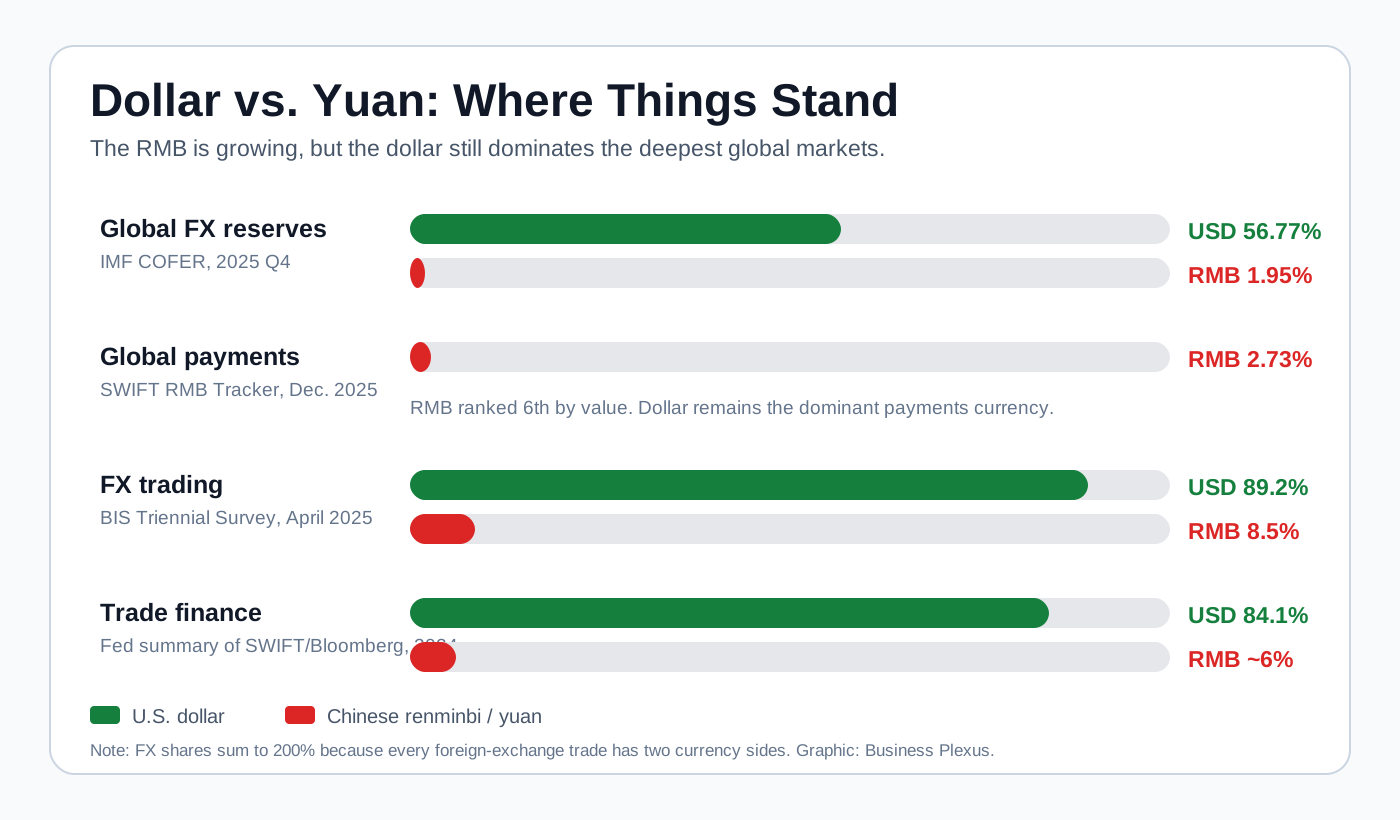
The IMF's latest COFER data showed that in the fourth quarter of 2025, the U.S. dollar still accounted for 56.77 percent of allocated global foreign-exchange reserves. The Chinese renminbi accounted for 1.95 percent. That gap is the core reality of the reserve-currency question.
In global payments, the yuan is also still small. SWIFT's January 2026 RMB Tracker said the renminbi ranked sixth in December 2025 global payments by value, with a 2.73 percent share. That is a long way from dollar dominance.
Foreign-exchange trading tells the same story. The Bank for International Settlements reported that in April 2025, global foreign-exchange turnover reached $9.6 trillion per day. The U.S. dollar was on one side of 89.2 percent of all trades, while the Chinese renminbi was on one side of 8.5 percent. The yuan's share rose, but the dollar remained the central trading currency.
Trade finance is even more dollar-heavy. A Federal Reserve note on renminbi internationalization cited SWIFT and Bloomberg data showing the dollar at roughly 84 percent of trade finance in April 2024, while the renminbi was around 6 percent. That is important because trade finance is where a currency proves it can support real-world importers, exporters, banks, and insurers at scale.
The biggest obstacle: China still controls the yuan
The main reason the yuan has not become a dollar replacement is not that China is too small. China's economy and trade network are enormous. The problem is trust, convertibility, and capital controls.
China manages the yuan's exchange rate and restricts capital movement. Those controls help Beijing maintain financial stability, limit capital flight, and manage domestic credit. But they also make global investors cautious. A true reserve currency needs to be easy to buy, sell, hold, borrow, lend, and move across borders, even during a crisis.
This is the basic contradiction in China's currency strategy. Beijing wants the yuan to be used more internationally, but it does not want to give up the control that would make the yuan more attractive as a reserve currency. Carnegie describes this as a dollar dilemma: China wants less exposure to the dollar, yet maintaining confidence in the offshore yuan often requires a perception that yuan can be converted into dollars when needed.
Is CIPS a SWIFT replacement?
CIPS is important, but it is often overstated. It clears and settles yuan-denominated payments. SWIFT is primarily a global financial messaging network. The two systems are not identical. In many cases, CIPS participants still interact with the broader global banking system, and indirect CIPS payments can still involve SWIFT messaging.
That means CIPS is not a simple sanctions-proof escape hatch. Carnegie points out that many CIPS direct participants are affiliates of global banks or offshore branches of Chinese state-owned banks that remain connected to the dollar financial system. If those institutions violate U.S. sanctions, they can still face serious consequences.
The practical role of CIPS is narrower but still important: it makes yuan settlement easier, gives China more infrastructure of its own, and creates an alternative channel for countries that want to do more business in RMB. It reduces dependence at the margin. It does not yet replace the dollar-based global system.
Where China has the best chance
China's best chance is not replacing the dollar everywhere. It is expanding the yuan in specific corridors.
The first corridor is China trade. If a country imports heavily from China or exports commodities to China, settling more trade in yuan can make sense. This is especially true where Chinese banks, Chinese buyers, and Chinese financing are already central.
The second corridor is sanctioned or sanctions-wary economies. Russia is the obvious case. If a country faces restrictions in dollar markets, the yuan becomes more attractive even if it is imperfect. That does not make the yuan globally dominant; it makes it useful in a subset of geopolitically constrained transactions.
The third corridor is emerging-market finance. Swap lines, RMB clearing banks, Belt and Road lending, and local-currency settlement agreements can make the yuan more useful in Asia, the Middle East, Africa, and parts of Latin America.
The fourth corridor is digital and wholesale payment experimentation. Projects involving central bank digital currencies, cross-border settlement pilots, and regional payment networks could gradually reduce dollar use in some transactions. But pilot systems are not the same as global monetary dominance.
What would have to change?
For the yuan to seriously challenge the dollar, China would likely need to make several hard choices. It would need deeper and more open capital markets, more transparent policy, stronger legal protections for foreign investors, less fear of sudden capital controls, more willingness to tolerate exchange-rate flexibility, and a much larger supply of safe yuan-denominated assets that foreign central banks and institutions can hold with confidence.
Those changes would reduce Beijing's control. That is why they are difficult. The same controls that protect China's domestic financial system also limit the yuan's global appeal. China can expand yuan usage without full liberalization, but replacing the dollar would require a level of openness that Beijing has not shown it wants.
How it is going
China is making progress, but not in the simple way implied by headlines about the dollar being replaced. The yuan is becoming more important in China-centered trade and finance. It is more useful to Russia and other countries trying to avoid U.S. financial pressure. CIPS and swap lines give Beijing more tools. The yuan's foreign-exchange trading share has grown.
But the dollar remains far ahead in the places that matter most: reserves, funding markets, trade finance, commodity pricing, crisis liquidity, and global FX trading. The dollar's share of reserves has declined over time, but the lost share has gone to several currencies, not mainly to the yuan.
The most likely outcome is not a yuan takeover. It is a more fragmented system. The dollar remains dominant, but more trade around China, Russia, and parts of the Global South moves through yuan or local-currency channels. That weakens the dollar at the margins, gives China more strategic flexibility, and makes the global payment system less uniform. It does not yet end dollar dominance.
Sources and further reading: IMF COFER fourth-quarter 2025 reserve data; SWIFT January 2026 RMB Tracker; BIS 2025 Triennial Survey of foreign-exchange turnover; Federal Reserve note, Internationalization of the Chinese renminbi: progress and outlook; Carnegie Endowment, China's Dollar Dilemma; CIPS participant announcements and system overview; Atlantic Council Dollar Dominance Monitor.