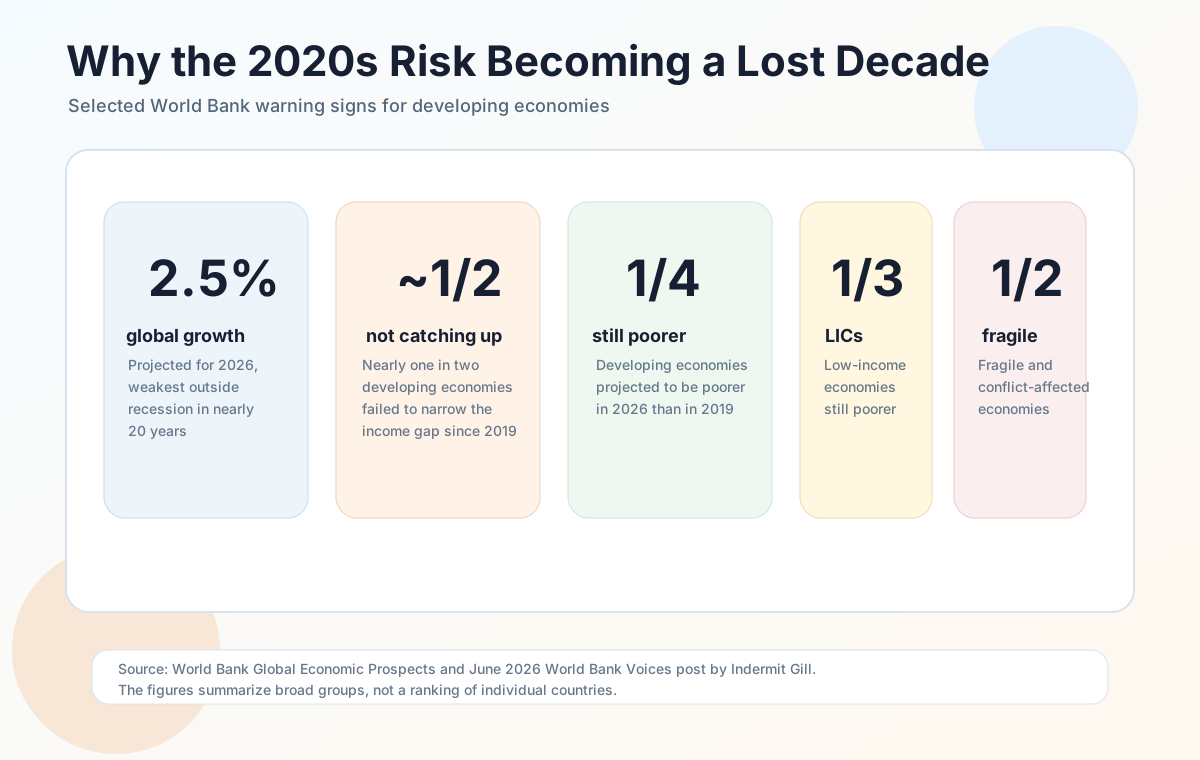
The warning in the image is real. It comes from World Bank chief economist Indermit Gill's June 2026 discussion of the latest Global Economic Prospects report. His phrase was blunt: the 2020s are at risk of becoming a "lost decade" for many developing economies.
The basic idea is not that every poorer country is collapsing. It is that a large share of developing economies have stopped catching up. Since 2019, nearly one out of every two developing economies has failed to narrow the income gap with the world's richest economies. That is a serious reversal because the promise of development is not just growth. It is convergence: poorer countries gradually gaining ground on richer ones.
The World Bank's June 2026 outlook is especially gloomy because the global economy is being hit by overlapping shocks. Global growth is projected at only 2.5% in 2026, the weakest pace outside recession in close to two decades. The World Bank also says that by the end of 2026, one-quarter of developing economies, one-third of low-income economies, and half of fragile and conflict-affected economies will still be poorer than they were in 2019, before COVID-19.
What makes this different from an ordinary slowdown
Developing economies are used to volatility. Commodity prices move, currencies weaken, capital flows reverse, and governments sometimes face debt trouble. What makes the 2020s different is the density of shocks. Countries did not get one problem and then a recovery period. They got COVID-19, supply-chain disruption, inflation, higher interest rates, Russia's invasion of Ukraine, food and fertilizer shocks, debt-service pressure, climate disasters, trade uncertainty, and now renewed Middle East conflict and energy risk.
That matters because development depends on compounding gains. A country needs years of rising investment, better infrastructure, improving schools, healthier workers, expanding exports, and stable institutions. Repeated shocks interrupt that compounding. Governments spend scarce money on emergency relief, debt service, fuel subsidies, food imports, and security. Private firms delay investment. Families pull children from school, cut nutrition, migrate, or use up savings. Each response may be rational in the moment, but the long-term effect is slower catch-up.
The biggest shocks behind the lost-decade risk
The first shock was the pandemic. COVID-19 hit tourism, remittances, employment, schooling, health systems, and fiscal balances at the same time. Rich countries borrowed heavily too, but they generally borrowed more cheaply and could support households on a larger scale. Many developing countries came out of the pandemic with more debt and weaker public finances.
The second shock was inflation and interest rates. When global inflation surged, central banks in advanced economies raised rates. That made dollar debt more expensive, pulled capital away from riskier markets, and raised borrowing costs for countries already carrying heavier debt loads. UN Trade and Development reported that developing countries' net interest payments on public debt reached $921 billion in 2024, and that a record 61 developing countries allocated at least 10% of government revenues to interest payments.
The third shock was food and energy. Russia's invasion of Ukraine disrupted grain, fertilizer, and energy markets. Middle East conflict adds another layer because disruptions in oil, gas, shipping, or insurance costs can quickly hit import-dependent countries. For households already spending a large share of income on food and transport, these price increases are not abstract. They reduce nutrition, school attendance, savings, and social stability.
The fourth shock is climate. Droughts, floods, heat, storms, and crop failures now arrive more often in places with the least fiscal space to respond. Climate stress is not only an environmental issue. It is a macroeconomic problem when it damages harvests, roads, ports, power systems, water supplies, and health.
The fifth shock is the weakening of the global trade environment. Export-led growth has historically helped many countries move from low income to middle income. But trade policy uncertainty, geopolitical fragmentation, industrial policy in rich countries, and supply-chain reshoring can make that path less predictable. A country that was hoping to industrialize through global supply chains now has to navigate a more political trading system.
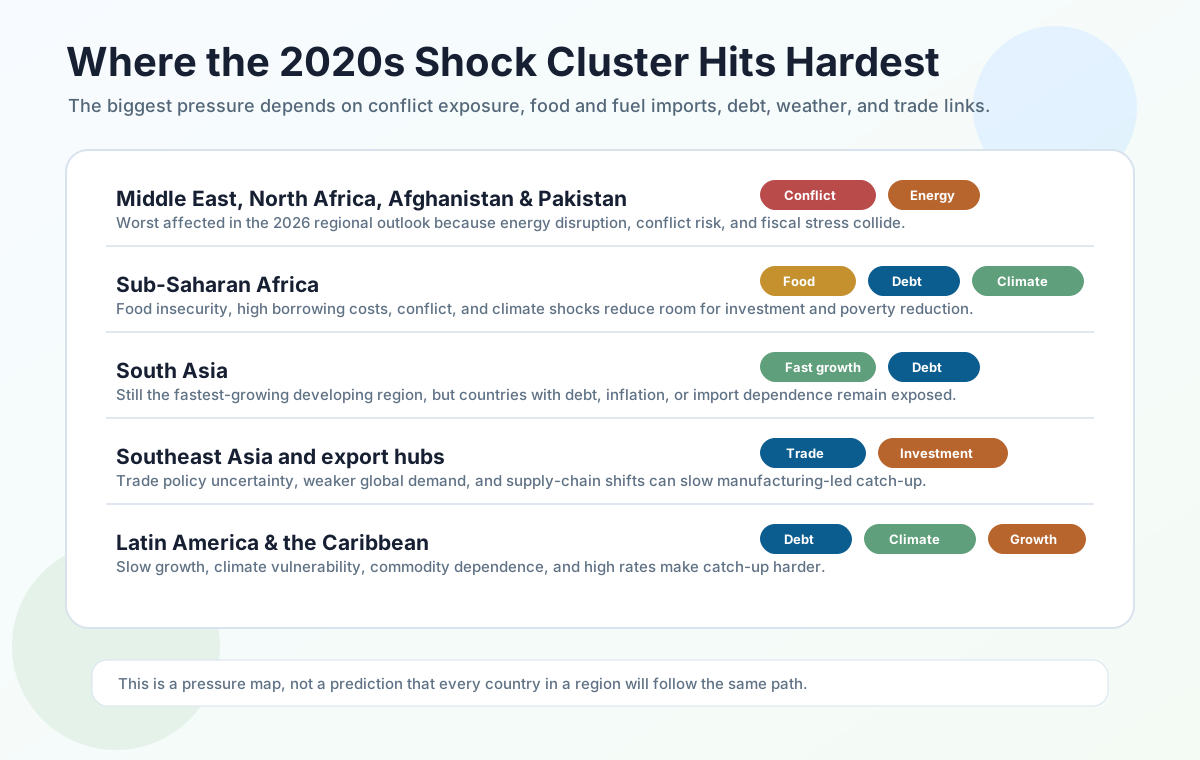
Which regions face the biggest problems?
The World Bank says all emerging market and developing economy regions are expected to decelerate in 2026 because of the Middle East conflict, but the effect is not evenly distributed. The Middle East, North Africa, Afghanistan, and Pakistan region is described as the worst affected in the regional outlook. That makes sense because the region is exposed to conflict risk, energy-market disruption, fragile fiscal positions, and refugee or security pressures.
Sub-Saharan Africa faces a different but equally serious combination: food insecurity, debt costs, conflict, climate shocks, and limited access to cheap capital. The World Bank's food-security update recently pointed to tens of millions of people needing food assistance in East and Southern Africa, with severe risks in Sudan, and large numbers projected to be acutely food insecure in West and Central Africa during the lean season. Countries in and around the Sahel, the Horn of Africa, Sudan, and the Democratic Republic of Congo are especially vulnerable where conflict and food stress overlap.
South Asia remains the fastest-growing developing region, so it should not be treated as a failure story. India remains a major source of global growth. But the region still contains countries exposed to debt, imported energy, climate stress, and political instability. Pakistan, Bangladesh, Sri Lanka, and Nepal each face different versions of the same problem: how to keep growth moving while protecting households from inflation, debt pressure, and climate vulnerability.
Southeast Asia is better positioned than many regions because of manufacturing, trade links, and regional integration, but it is not insulated. Vietnam, Indonesia, the Philippines, Thailand, Cambodia, and others are exposed to weaker global demand, trade-policy uncertainty, China-linked supply chains, and weather shocks. The risk is not collapse; it is that export-led catch-up becomes slower and harder than it was for earlier industrializers.
Latin America and the Caribbean face slow growth, high rates, climate exposure, and commodity dependence. Some countries benefit when commodity prices rise, but the same volatility can destabilize public budgets. Small Caribbean states are especially exposed to hurricanes, tourism swings, and debt. Larger economies such as Brazil, Mexico, Argentina, Colombia, and Chile face different mixes of weak productivity growth, fiscal pressure, political uncertainty, and exposure to global financial conditions.
The countries most at risk are not always the ones in the headlines
It is tempting to think only of crisis countries such as Sudan, Haiti, Yemen, Afghanistan, Lebanon, or Sri Lanka. Those countries matter, and many are facing severe stress. But the World Bank warning is broader. A lost decade can also happen quietly in countries that avoid spectacular collapse but fail to catch up year after year.
That is why the phrase "nearly one out of every two developing economies" is so important. It points to a convergence problem, not just a humanitarian emergency. If countries grow, but not fast enough to close the gap with rich economies, then the global income hierarchy becomes more fixed. Young workers enter labor markets with fewer opportunities. Governments collect less revenue than they need. Infrastructure plans are delayed. Private investment goes elsewhere.
Why debt makes every other shock worse
Debt is not automatically bad. Borrowing can finance roads, power systems, schools, hospitals, and water infrastructure. But when interest costs rise faster than revenue, debt becomes a trap. Money that should be going into development goes to creditors instead.
This is the heart of the problem for many developing economies in the 2020s. They need to invest more just as borrowing becomes more expensive. They need climate adaptation just as disasters become more frequent. They need stronger food systems just as food imports become more volatile. They need more jobs just as private investment weakens.
The World Bank has warned that rising EMDE debt is driving up borrowing costs, especially for countries with weaker credit ratings, default histories, or governance problems. UNCTAD's debt work points in the same direction: public debt and interest costs are crowding out social spending and investment in many developing countries.
What could keep the 2030s from becoming another lost decade?
The World Bank is not only pessimistic. Gill's article argues that the 2030s could be better if countries and global institutions prepare now. He points to three possible engines: artificial intelligence, clean-energy investment, and deeper regional trade.
Those opportunities are real, but they are uneven. AI can lift productivity only if countries have electricity, broadband, data infrastructure, skills, and languages represented in the models. Clean energy can create jobs and reduce fuel-import vulnerability, but countries with high debt and weak grids may struggle to finance it. Regional trade can reduce dependence on distant markets, but it requires better border systems, standards, logistics, and financing for small firms.
So the policy challenge is not simply to wait for AI or clean energy to arrive. It is to rebuild the foundations of development: debt sustainability, food security, reliable power, basic education, health systems, roads, ports, digital infrastructure, and rules that encourage long-term private investment.
The takeaway
The image you shared captures the right warning: the 2020s have become a development stress test. The phrase "lost decade" is not just rhetoric. It means many countries may exit the decade with less progress, weaker balance sheets, poorer households, and a larger gap with the richest economies than they had hoped in 2019.
The countries facing the worst problems tend to be those where several shocks overlap: conflict plus food insecurity, debt plus high interest rates, climate damage plus weak infrastructure, or trade exposure plus slowing global demand. That is why the risk is concentrated in fragile states, low-income economies, food-importing countries, commodity-dependent countries, small climate-vulnerable states, and countries with heavy external debt.
There is still a path out, but it runs through the 2030s. The immediate task is to stop the shocks from permanently scarring economies. The longer-term task is harder: turn AI, energy transformation, and regional trade into broad-based development rather than another advantage captured mostly by countries that were already ahead.
Sources and notes: The quoted phrase "lost decade" and the broader warning come from Indermit Gill's World Bank Voices post, Three trends that could unlock a golden decade for developing economies, and the World Bank's June 2026 Global Economic Prospects page. Debt context from UN Trade and Development's A World of Debt 2025 and related public-debt update. Food-security context from the World Bank Food Security Update. The article paraphrases the long passage shown in the user-provided image rather than reproducing it in full.