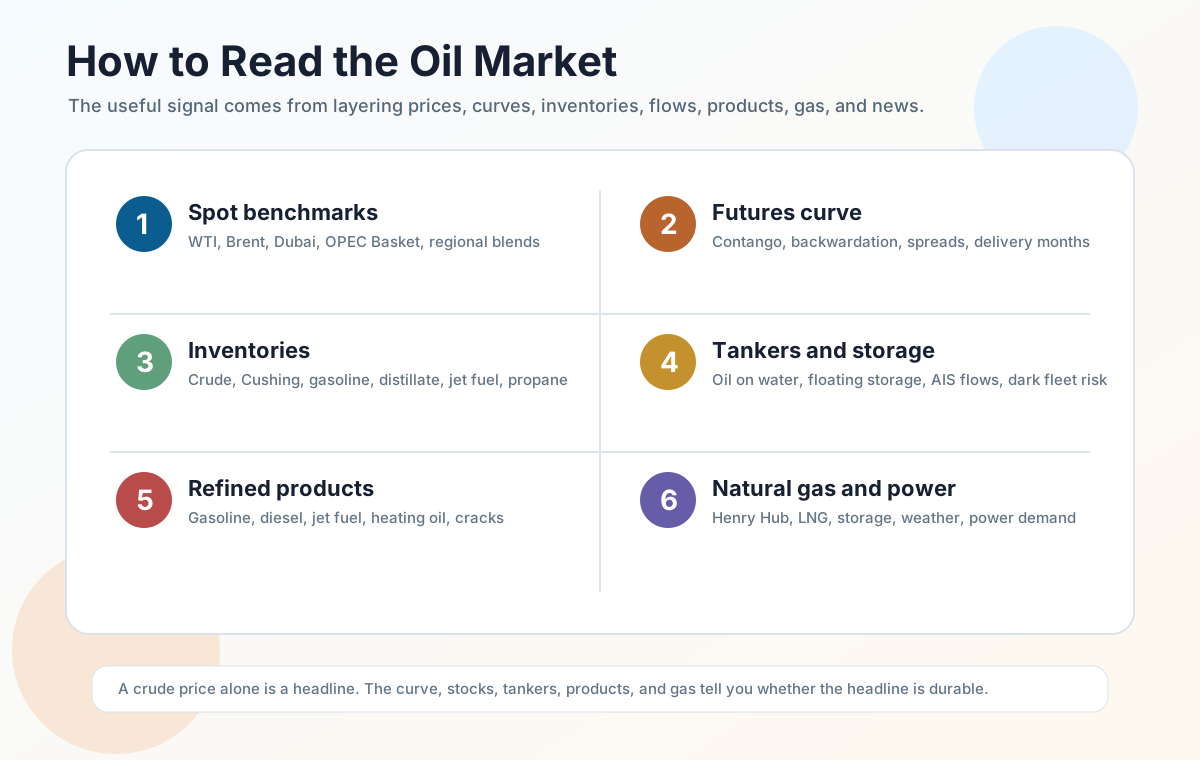
If you want to understand oil prices, a single quote is not enough. A headline number such as WTI or Brent tells you where one benchmark is trading, but the real picture comes from layering several signals: spot prices, futures curves, inventories, refinery margins, tankers, floating storage, refined products, natural gas, weather, geopolitics, and demand.
A site like OilPrice.com is a useful starting point because it puts many energy prices and headlines in one place. But if you want to go deeper, it helps to know what each price means and where to find more primary data.
Start with the main crude benchmarks
The first layer is the basic crude-oil benchmark. OilPrice.com's oil price charts are good for a quick dashboard because they list many crude blends and indexes. For public historical data, the U.S. Energy Information Administration's spot prices for crude oil and petroleum products page is one of the best free references.
WTI, or West Texas Intermediate, is the main U.S. crude benchmark. It is a light, sweet crude delivered at Cushing, Oklahoma, and it is the basis for the CME/NYMEX WTI futures contract. Track it through EIA's spot-price tables, CME WTI futures quotes, or FRED's WTI spot-price series.
Brent is the main international crude benchmark. It reflects seaborne crude pricing and is widely used for global trade. Track it through EIA's Europe Brent spot price, ICE's Brent Crude Futures, CME's Brent futures page, or FRED's Brent spot series.
Dubai and Oman matter for Middle East crude pricing into Asia. Murban is a light Abu Dhabi crude that has become more visible as a regional futures benchmark. OPEC Basket is an average of selected OPEC member crudes and is useful as a policy reference, especially when following OPEC. OPEC publishes its OPEC Reference Basket information directly.
Regional blends also matter. Mars is a U.S. Gulf Coast medium sour crude. Western Canadian Select is a heavy Canadian crude that often trades at a discount because it is harder to refine and must move through constrained transport routes. Bonny Light is a Nigerian light sweet crude. These regional prices help explain why a producer or refinery may experience a very different market from the headline WTI or Brent number.
Understand what crude quality means
Crude prices differ because not all crude oil is the same. "Light" crude generally has more valuable lighter molecules that can become gasoline, diesel, and jet fuel. "Heavy" crude requires more complex refining. "Sweet" crude has lower sulfur. "Sour" crude has more sulfur and usually requires more processing. Refiners pay based on what their equipment can handle and what products they can sell profitably.
So when WTI, Brent, Dubai, Mars, WCS, and OPEC Basket move differently, it is not always a contradiction. It can reflect quality, geography, transportation, sanctions, refinery demand, or local storage constraints.
Watch the futures curve: contango and backwardation
The second layer is the futures curve. A futures curve shows prices for delivery in different months. CME's WTI quotes and Brent quotes let you compare the front month with later months. OilPrice.com also has futures pages such as WTI futures.
Contango means later delivery months trade above near-term prices. CME explains that contango often appears when a market is oversupplied because storage, insurance, and financing costs make future barrels more expensive. In plain English: if future oil is worth more than oil today, traders may have an incentive to store barrels.
Backwardation is the opposite: near-term oil trades above later months. That often signals tight prompt supply, strong demand for immediate barrels, or a high value to having physical oil available now. CME's educational material on contango and backwardation is a good basic primer, and its discussion of WTI oil futures in backwardation explains how storage costs and convenience yield shape crude curves.
A simple habit is to check the front month, the second month, and a contract roughly one year out. If the front is much higher than the back, the market may be tight. If the back is much higher than the front, the market may be encouraging storage. The spread is often more informative than the flat price.
Use inventories to check whether the price story makes sense
The third layer is inventory. In the United States, the core public source is EIA's Weekly Petroleum Status Report. It covers crude stocks, Cushing inventories, refinery runs, gasoline, distillate fuel oil, jet fuel, propane, imports, exports, and product supplied. EIA also has a broader Petroleum & Other Liquids Data hub.
API's Weekly Statistical Bulletin is another inventory source, though it is industry-reported and often discussed as a preview before EIA's more widely followed government data. If crude prices rise while inventories are falling and refinery runs are high, the price action has more fundamental support. If prices rise while inventories are building and demand is weak, the move may be more about geopolitics, positioning, or futures-market structure.
Track tankers, oil on water, and floating storage
The fourth layer is waterborne oil. A lot of crude moves by tanker, and not every barrel in motion immediately shows up in onshore inventory. Stanford's oil trade and transportation overview is a useful introduction to seaborne crude, including the difference between "dirty tankers" that carry crude and "clean tankers" that carry refined products.
There are three related ideas to watch. Oil on water means cargoes currently in transit. Floating storage usually means oil sitting on tankers for an extended period rather than moving directly to a refinery or terminal. Dark fleet activity refers to vessels that may obscure tracking, ownership, insurance, or routing, often in connection with sanctioned oil flows.
Some tanker-flow data is commercial. Vortexa and Kpler are widely cited professional providers. Public or semi-public places to watch include MarineTraffic, VesselFinder, TankerTrackers.com, and chart aggregators such as MacroMicro's Vortexa global crude floating storage chart.
For high-level context, the International Energy Agency's Oil Market Report often discusses global stocks, oil on water, and floating storage. During disruptions, this can be crucial. Oil trapped at sea is not the same thing as oil available at a pricing hub. That is why tanker data can explain why the market feels tight even when there are barrels somewhere in the system.
Do not ignore refined products
Crude oil is only the feedstock. Consumers and businesses feel refined-product prices: gasoline, diesel, jet fuel, heating oil, propane, and fuel oil. EIA's Gasoline and Diesel Fuel Update tracks U.S. retail gasoline and on-highway diesel prices. EIA's spot-price table also includes wholesale gasoline, RBOB, heating oil, diesel-related products, and jet fuel.
For jet fuel, EIA's U.S. Gulf Coast kerosene-type jet fuel spot price is a useful public benchmark, and FRED republishes the U.S. Gulf Coast jet fuel series. Airlines for America also provides a daily Argus U.S. Jet Fuel Index, with Argus attribution rules noted on the page.
Diesel deserves special attention because it is tied to trucking, farming, construction, mining, rail, shipping, and backup power. A diesel spike can feed into broader goods inflation even when ordinary drivers focus mainly on gasoline. Gasoline is more consumer-facing; diesel is more industrial and freight-facing.
Watch refinery margins and crack spreads
If crude prices are flat but gasoline or diesel prices are rising, the issue may be refining rather than crude supply. A crack spread is the difference between the cost of crude and the value of refined products. Traders often watch the 3-2-1 crack spread, which roughly compares three barrels of crude with two barrels of gasoline and one barrel of distillate.
CME has product futures for RBOB gasoline and NY Harbor ULSD/heating oil. Product futures can reveal refinery and product-market stress even before it is obvious at the pump.
Natural gas is a separate but connected market
Natural gas has its own fundamentals: weather, power demand, LNG exports, pipeline constraints, storage, and regional basis. In the United States, Henry Hub is the central benchmark. Track it through EIA's Henry Hub spot price, EIA's natural gas spot and futures prices, CME's Henry Hub Natural Gas futures, or FRED's Henry Hub daily spot series.
For storage, EIA's Weekly Natural Gas Storage Report is the key U.S. report. Natural gas is more seasonal than oil because heating and cooling demand matter so much. A hot summer can lift power burn; a cold winter can drain storage quickly. LNG exports increasingly connect U.S. gas to Europe and Asia, so global gas prices can feed back into Henry Hub when export capacity is tight.
A practical weekly routine
Here is a simple workflow. First, check OilPrice.com or EIA's daily energy prices page for the headline move. Second, compare WTI, Brent, and major products on EIA or FRED. Third, look at CME or ICE futures to see whether the curve is in contango or backwardation. Fourth, read EIA's Weekly Petroleum Status Report for crude stocks, Cushing, refinery runs, gasoline, distillate, jet fuel, imports, and exports.
Fifth, check tanker and floating-storage context if the market is being driven by sanctions, war, shipping lanes, or refinery outages. Sixth, look at diesel, jet fuel, and natural gas separately because each can send a different signal about the real economy. Finally, read a narrative source such as the IEA Oil Market Report, EIA Short-Term Energy Outlook, Reuters commodities coverage, OilPrice.com, or a specialized market note to understand what traders think changed.
What to avoid
Do not assume WTI and Brent always tell the same story. Do not assume a futures curve is a literal forecast. Do not assume barrels at sea are immediately available to refineries. Do not assume crude prices automatically determine gasoline or diesel prices; refinery margins, taxes, logistics, outages, and seasonal fuel specifications matter. And do not rely on one source when geopolitics, sanctions, or shipping disruptions are involved.
The strongest read comes when several indicators agree. Falling inventories, strong backwardation, rising product cracks, declining floating storage, and firm diesel demand tell a different story from a one-day price spike caused by headlines. The oil market is noisy, but the structure is readable if you know where to look.
Useful links: OilPrice.com homepage; OilPrice.com oil price charts; EIA spot prices; EIA Weekly Petroleum Status Report; EIA Short-Term Energy Outlook; CME WTI futures; ICE Brent futures; IEA Oil Market Report; Vortexa; Kpler; MarineTraffic; TankerTrackers.com; EIA gasoline and diesel update; FRED jet fuel; EIA natural gas storage; FRED Henry Hub natural gas.