President Volodymyr Zelenskyy has warned Belarusian leader Alexander Lukashenko that Ukraine will act if Belarus does not remove repeater equipment that Ukraine says is helping Russian attacks on Ukrainian civilians. In a translation of Zelenskyy's remarks posted by Anton Gerashchenko on X, Zelenskyy said repeaters on towers in Belarusian territory are being used to adjust fire on Ukrainian population centers.
The word "repeater" may sound minor, almost like ordinary communications hardware. But in a drone war, repeaters can be part of the nervous system of an attack. They do not have to carry explosives. They do not have to look like a missile launcher. Their importance is that they help information travel farther, more reliably, and sometimes around obstacles.
What is a repeater?
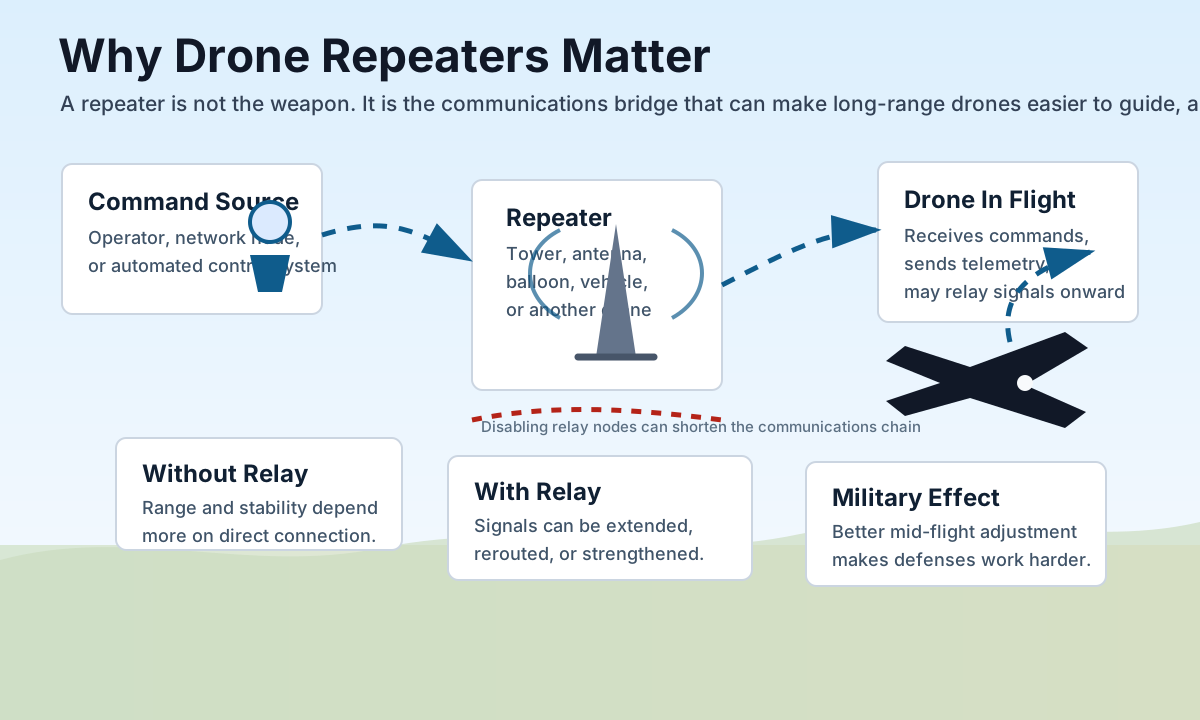
A repeater is a communications relay. At the simplest level, it receives a signal and retransmits it so the signal can go farther than it otherwise would. That can mean a radio repeater on a tower, equipment on a building, a mobile system, an airborne relay, a balloon, or even another drone acting as part of a mesh network.
For civilian life, repeaters are familiar even if people do not usually use the word. Cell towers, radio towers, Wi-Fi mesh devices, and emergency communications relays all solve a similar problem: direct signals weaken with distance, terrain, buildings, weather, and interference. A relay point gives the signal another place to go.
In military use, that same basic idea becomes more consequential. A drone may need to receive commands, send back telemetry, carry video or sensor data, update its route, or maintain contact after moving beyond a direct line of communication. A repeater can extend that communications chain.
Why repeaters matter for Shahed drones
Russia's Iranian-designed Shahed-type attack drones were once commonly described as relatively simple one-way weapons that flew toward pre-programmed coordinates. That is still part of the story. But the drone war has evolved. Ukrainian officials and outside analysts have described newer Russian efforts to make some Shahed-type drones more controllable in flight, including through antennas, modems, relays, and mesh-style communications.
Business Insider reported in May 2026 that Russia is increasingly turning Shahed-style drones into operator-guided weapons that can hunt moving targets and try to evade defenses. That reporting cited Ukrainian officials and drone analysts who described the use of mesh modems and antennas to relay signals over long distances.
That is where repeaters become strategically important. If a drone can be adjusted in flight, it may be able to change route, react to air defenses, aim at moving or newly selected targets, or maintain contact for longer. A repeater does not make a drone unstoppable, but it can make the drone harder to defend against because the attack is less dependent on a single pre-planned path.
Why Belarus matters
Belarus has been central to the war from the beginning. Russian forces used Belarusian territory as a launch platform during the full-scale invasion in 2022, and Ukraine has never been able to treat the northern border as neutral. The current concern is not only whether Belarusian troops cross the border. It is whether Belarusian territory, towers, airspace, communications infrastructure, and logistics are being used as part of Russia's attack system.
Recent reporting has pointed in that direction. The Guardian reported on June 18, 2026, that Ukraine has reinforced northern defenses amid fears that Belarus is being drawn more deeply into Russia's war, including a rise in Russian surveillance drone activity from Belarusian airspace. Earlier, Ukrinform reported Zelenskyy saying that modern Shahed repeaters had appeared on Belarusian territory and were helping strikes on Ukrainian people and energy facilities.
The Kyiv Independent also reported earlier this year that Zelenskyy said Ukraine had acted to remove several such repeaters. Ukrainian media reports have described antennas and related equipment placed near the border, including on ordinary buildings, to help guide Shahed drones toward western and northern Ukraine.
Why Zelenskyy is pressuring Lukashenko
Zelenskyy's message to Lukashenko is political as well as military. Lukashenko often says Belarus does not want to enter the war directly. But if Russian strike infrastructure is operating on Belarusian soil, Ukraine's argument is that Belarus is already participating in a meaningful way.
That is why Zelenskyy's warning focuses on a simple test: remove the equipment. If Lukashenko truly wants to keep Belarus out of the war, Ukraine says he should shut down the systems that help Russian drones reach Ukrainian civilians. If he does not, Ukraine is signaling that it may treat those systems as legitimate military infrastructure supporting attacks.
The distinction matters because modern war is not only about tanks crossing a border. A country can contribute to an attack by providing airspace, launch areas, intelligence, logistics, radio links, repair facilities, or communications infrastructure. Repeaters fall into that gray zone: quiet, technical, and easy to deny, but potentially decisive.
Why removing repeaters helps Ukraine
Ukraine has three broad reasons to care about repeaters. First, removing or disabling relay points can reduce the reliability of Russian drone command and control. If a drone depends on a relay chain, weakening that chain can shorten the drone's effective reach or make it harder to adjust in flight.
Second, repeaters can make Russian strikes more precise. A purely pre-programmed drone is dangerous, but a drone that can be updated, observed, or redirected during flight may be even more dangerous. That is especially true if Russian forces are trying to hit energy infrastructure, rail, air-defense teams, or other targets that require mid-course adjustment.
Third, repeaters expand the battlefield without an obvious invasion. A tower or antenna across the border can support an attack while allowing Belarus to claim that it is not openly fighting. Removing those nodes is a way for Ukraine to push back against that creeping involvement without waiting for Belarusian ground forces to move.
Russia's drone war is becoming a communications war
The repeated focus on towers, antennas, mesh modems, and relay balloons shows how much the war has become a contest over signals. Ukraine has invested heavily in electronic warfare, air defenses, mobile fire teams, drone interception, and spoofing. Russia responds by changing routes, adding communications links, hardening navigation, using decoys, and building more drones.
Euromaidan Press reported in May 2026 that Ukrainian border officials identified a balloon entering from Belarus as a relay station intended to boost signals for Russian airborne strike weapons. RBC-Ukraine has also reported on claims that Shahed-related mesh networks can use radio modems that receive, transmit, and amplify signals.
The same communications problem appears on the Ukrainian side as well, where remote-control systems can move FPV pilots farther from the launch point. That is why recent claims about gamers or remote operators controlling Ukrainian drones should be read through a communications lens: the real bottleneck is not only pilot skill, but whether video, command, authentication, and relay links can survive on a jammed battlefield.
That does not mean every Russian drone depends on a Belarusian repeater. Some drones can fly pre-programmed routes, use satellite navigation, or rely on other communications paths. But the more Russia tries to guide drones dynamically over longer distances, the more relay infrastructure matters.
The broader risk for Belarus
Lukashenko's problem is that he is trying to preserve deniability while remaining tied to Moscow. Ukraine is making that deniability harder. If Belarusian towers, rooftops, or airspace help Russian drones strike Ukrainian cities, then Ukraine can argue that those assets are part of the battlefield.
That is the real significance of Zelenskyy's warning. It is not just about a handful of antennas. It is about whether Belarus can allow Russia to use its territory as a technical platform for killing Ukrainian civilians while still claiming to be outside the war.
Repeaters are small compared with missiles, tanks, or fighter jets. But in a drone-heavy war, small communications nodes can have outsized importance. They extend reach, stabilize control, and help turn a cheap drone into a more adaptable weapon. For Ukraine, taking them out is not a technical footnote. It is part of defending cities from a war that increasingly travels through towers, modems, antennas, and invisible radio links.