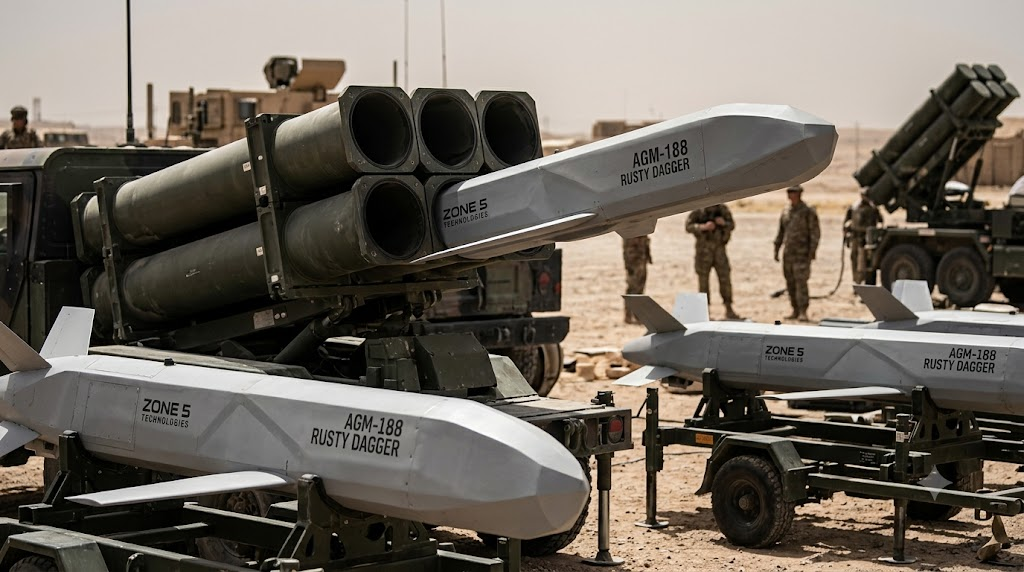
Illustrative image supplied by the editor. The missile type used in the Voronezh strike remains disputed.
Ukraine says it struck a Russian electronics and semiconductor facility in Voronezh on June 22, 2026, targeting a plant linked to components for Russian missile systems. The attack matters because it was not aimed at a frontline position. It was aimed at Russia's military-industrial chain: the factories that help turn electronics, guidance systems, power modules, and onboard controls into weapons used against Ukraine.
The strike has also triggered a political argument. Russian sources have framed the attack as evidence that Western intelligence, satellite data, targeting support, or navigation assistance are enabling Ukraine's long-range strike campaign. That charge is politically important, but it should be separated from what is confirmed: Ukraine's military says it hit a missile-electronics facility in Voronezh, and several independent outlets have reported damage at the plant.
Where was the target?
The reported target was the Voronezh Semiconductor Devices Plant, often identified in reports as VZPP or VZPP-S/Sborka, in the city of Voronezh in western Russia. Voronezh is well inside Russian territory, east of Ukraine's northeastern border region, and it is not a random industrial site. Ukrainian and independent reporting describe the facility as part of Russia's defense electronics base.
Al Jazeera reported that Ukraine called the facility a critical component in Russian defense production, while local Russian authorities confirmed an attack in the region. Novaya Gazeta Europe reported that the plant has been sanctioned by the United States for its role in providing equipment to the Russian military and that it produces integrated circuits and power modules for missiles and combat vehicles.
The Kyiv Independent reported that Ukraine's General Staff described the plant as producing components for Russian missile systems, including Iskander and Kh-101. The Insider similarly reported that Ukrainian forces said they had targeted an electronics plant that makes components for Iskander and Kh-101 missiles.
What damage was reported?
The full damage assessment is still uncertain. Open-source imagery and reports indicate a major fire and visible structural damage at the facility. Defence UA, analyzing close-up footage, reported that the strike caused the collapse of two floors of a production building and destroyed a substantial portion of the structure. That is significant damage if the affected building housed specialized electronics production, testing, storage, or assembly equipment.
Semiconductor and electronics plants are not easy to replace quickly. Even when the building remains partly standing, production can be disrupted by fire, smoke, water, broken clean-room conditions, damaged test equipment, destroyed inventory, power loss, and contamination. The military value of the strike depends less on whether one wall collapsed and more on whether Russia loses time, qualified equipment, stockpiled components, or production continuity.
Why this matters to Russia
Russia's long-range strike campaign depends on electronics. Missiles such as Iskander and Kh-101 require guidance components, power electronics, control modules, sensors, and onboard computing. Air-defense systems and combat vehicles also rely on specialized microelectronics. Russia has adapted to sanctions through stockpiles, smuggling networks, domestic substitution, parallel imports, and redesigns, but advanced electronics remain a bottleneck.
That makes factories like the Voronezh plant attractive targets. Hitting a missile component facility is different from intercepting one missile after launch. It aims upstream. If Ukraine can slow component production, disrupt quality control, destroy specialized machinery, or force Russia to reroute scarce parts, the effects can ripple through missile production schedules.
This does not mean one strike will cripple Russia's missile program. Russia has multiple plants, stockpiles, subcontractors, and workarounds. But repeated strikes on electronics, fuel, explosives, air bases, and logistics nodes can create cumulative friction. The strategic purpose is to make Russian attacks more expensive, slower, and harder to sustain.
Was the missile really an AGM-188 Rusty Dagger?
That is the most uncertain part of the story. Some Russian and defense-focused accounts have claimed that Ukraine used AGM-188A Rusty Dagger cruise missiles. Defence Blog reported that a Russian Telegram channel made this claim, but also noted that it was unconfirmed by official sources. That caveat matters.
The AGM-188A Rusty Dagger is reported to be a low-cost, air-launched stand-off munition associated with the U.S. Air Force Extended Range Attack Munition, or ERAM, effort. Designation Systems identifies Rusty Dagger as Zone 5 Technologies' entry in the program and says the AGM-188A designation was assigned in 2025. Other reporting has tied the concept to rapid production of lower-cost cruise missiles for Ukraine.
If the AGM-188 claim is true, it would be notable because it would suggest Ukraine is already using a newer class of lower-cost Western air-launched cruise missile for deep strikes. But the public evidence is not strong enough to treat that as confirmed.
Other missile possibilities
Defence UA examined the same strike and asked whether the weapon might have been Storm Shadow/SCALP-EG or an ERAM-type missile. Its conclusion was cautious: several explanations remain speculative, and more footage or debris analysis would be needed before making a firm identification.
Storm Shadow/SCALP-EG is the most familiar candidate because Ukraine has used the British-French air-launched cruise missile before. It is manufactured by MBDA and has been integrated with Ukrainian aircraft. It is designed for precision strikes against hardened or high-value targets.
AGM-188A Rusty Dagger, if involved, would point toward Zone 5 Technologies and the ERAM/ETV low-cost cruise-missile pipeline. Public descriptions suggest the weapon is intended to be cheaper and faster to produce than traditional high-end cruise missiles, making it attractive for a war where magazine depth matters.
Other air-launched precision weapons cannot be ruled out. Ukraine's General Staff said high-precision air-launched cruise missiles were used, but public reports do not yet prove which missile. Modified Ukrainian systems, undisclosed Western weapons, or mixed salvos are all possible in a conflict where both sides have incentives to conceal capabilities.
Who manufactures the likely systems?
If the weapon was Storm Shadow or SCALP-EG, the manufacturer is MBDA, the European missile company owned by Airbus, BAE Systems, and Leonardo. Storm Shadow is the British name; SCALP-EG is the French name for the related weapon.
If the weapon was AGM-188A Rusty Dagger, the key manufacturer candidate is Zone 5 Technologies. Public reporting and missile designation references connect Zone 5 to Rusty Dagger. Other U.S. companies have been involved in adjacent low-cost cruise-missile and autonomous weapon programs, but the specific AGM-188/Rusty Dagger label is tied to Zone 5 in the available open-source references.
If the weapon was another ERAM-related design, then the manufacturer could depend on which design was fielded. That is why the missile identification should be handled cautiously until official confirmation, debris imagery, or credible technical analysis appears.
Russia's NATO accusation
Moscow's political message is predictable: a deep strike into Russia using Western-aligned weapons is portrayed as evidence of NATO involvement. Russian officials have made similar claims after previous Storm Shadow strikes, arguing that Ukraine could not conduct such operations without Western intelligence, targeting, satellite navigation, or mission support.
There is a distinction between enabling Ukraine and directly entering the war. NATO states have supplied weapons, intelligence, training, and financial support to Ukraine. Russia presents those activities as direct participation when it wants to raise the political cost. Western governments generally frame the same support as assistance to a country defending itself from invasion.
The Voronezh strike will intensify that argument because the target was not a battlefield unit. It was a defense-industrial facility inside Russia. The closer Ukraine's campaign moves toward Russia's production base, the more Moscow will try to make the issue about NATO escalation rather than Russian military supply chains.
The strategic effect
The strike matters because it fits a broader Ukrainian strategy: hit the systems that allow Russia to keep attacking. That includes refineries, fuel depots, airfields, ammunition plants, radar sites, electronics factories, drone production facilities, and missile-component suppliers.
For Russia, the immediate cost is repair, replacement, production disruption, and embarrassment. The deeper cost is uncertainty. If facilities hundreds of kilometers from Ukraine can be hit, Russia must spend more on air defense, dispersal, hardening, deception, redundancy, and relocation. That pulls resources away from the front and raises the cost of sustaining long-range missile production.
The strike will not end Russia's missile campaign by itself. But if the damage assessment is accurate, it may slow part of the electronics supply chain for systems Russia relies on to strike Ukrainian cities. That is why the target matters more than the dramatic image of smoke over Voronezh. The real target was not just a building. It was Russia's ability to turn electronics into missiles.
This article is based on open-source reporting as of June 23, 2026. Missile identification remains unconfirmed.