This is a running catalog of major publicly reported Ukrainian strikes against Russian oil, fuel, refining, export, energy, and logistics infrastructure. It is not every drone incident; it is focused on attacks that appear strategically relevant or were confirmed by credible reporting.
Latest update, July 6, 2026: New entries have been added for Omsk, Yaroslavl, Vysotsk, Kaluga, occupied Crimea, and fuel tankers in the Sea of Azov. The table is sorted newest first so the most recent strikes are visible immediately.
Strike catalog: newest first
| Date or period | Target area | Type of infrastructure | Why it matters |
|---|---|---|---|
| July 6, 2026 | Omsk, Yaroslavl, Vysotsk, Kaluga, occupied Crimea, Sea of Azov | Refineries, oil pumping station, oil terminal, petroleum storage, fuel tankers, military-energy targets | Ukraine reported a broad strike wave that hit Russia's largest refinery in Omsk, nearly 2,500 km from Ukraine's border. Kyiv Independent reporting also cited strikes on Yaroslavl oil infrastructure, Vysotsk terminal loading arms and storage tanks, Kaluga's First Plant refinery, TES-Terminal-1 in Crimea, and two fuel tankers carrying supplies toward occupied Crimea. |
| July 4, 2026 | St. Petersburg; Vysotsk port; Kronstadt | Oil terminal, Baltic port infrastructure, military target | Zelensky confirmed strikes on port oil infrastructure near St. Petersburg and a military target at Kronstadt. Russian officials also reported a strike at Vysotsk, a Baltic port handling oil, LNG, coal, and grain. |
| July 2, 2026 | Kstovo, Nizhny Novgorod Oblast | Lukoil-Nizhegorodnefteorgsintez/NORSI refinery | Reuters-cited reporting said the refinery halted again after a Ukrainian drone strike damaged the AVT-6 primary crude unit, which accounts for about 53% of the plant's capacity. |
| July 1, 2026 | Ufa, Republic of Bashkortostan | Oil refinery/lubricants hub | Zelensky said Ukraine hit Ufa's refinery complex for the second time in a week, showing that Bashkortostan remains within reach despite its distance from Ukraine. |
| June 28, 2026 | Slavyansk-on-Kuban, Krasnodar Krai; Yaroslavl Oblast | Oil refineries | Zelensky said Ukrainian long-range drones struck refineries roughly 300 km and 700 km from the front/border. Russian authorities reported a refinery fire in Krasnodar Krai, and Ukrainian reporting described storage tanks burning at Slavyansk. |
| June 25, 2026 | Occupied Crimea | Power plants, oil depot, gas compressor stations, substations, radar, military sites | Ukraine's Unmanned Systems Forces said 38 sites were targeted across the peninsula, deepening pressure on Russian logistics and civilian fuel availability. |
| June 25, 2026 | Ufa, Republic of Bashkortostan | Bashneft-Ufaneftekhim and Bashneft-Novoil refineries | The facilities are roughly 1,500 km from Ukraine's eastern border, showing that distance no longer protects Russia's refining hubs. |
| June 25, 2026 | Poltavskaya oil depot, Krasnodar Krai | Diesel and gasoline depot | The SBU described the depot as a large receipt, storage, and shipment facility with a 28-unit tank farm. |
| June 20, 2026 | Tyumen region, western Siberia | Oil refinery | Zelensky said Ukrainian drones reached an oil refining facility more than 2,000 km from Ukraine, signaling a new depth to the strike campaign. |
| June 19-20, 2026 | Occupied Crimea, including Hlibivka, Simferopol, gas compressor stations, Kerch area | Gas, power, bridge, oil terminal, military logistics | Ukraine's Unmanned Systems Forces described a middle-strike campaign aimed at isolating Crimea from Russian supply routes. |
| June 18, 2026 | Rostov region | Oil depot and bridges | Ukraine said the Moscow attack was accompanied by a strike on a southern Russian oil depot and bridges, part of a broader effort to hamper logistics. |
| June 16 and June 18, 2026 | Moscow Oil Refinery, Kapotnya | Major refinery serving Moscow region | Reuters-carried reporting said the refinery was struck twice and was expected to remain offline for months, with key units accounting for the facility's capacity damaged. |
| June 3, 2026 | St. Petersburg oil terminal | Oil terminal/export logistics | The strike showed that Ukraine was not limiting attacks to southern Russia or occupied Crimea. Northern export infrastructure also remained vulnerable. |
| May 2026 | Tuapse, Perm, Kirishi, Yaroslavl, Astrakhan, Ryazan, Kstovo, Syzran, Novorossiysk, Volna, Vladimir, Moscow Oblast, Volgograd, Saratov, Kirov, Unecha, Taganrog, Feodosiia, Armavir | Refineries, oil depots, terminals, LPDS stations, gas processing | Ukraine's Defense Ministry listed at least 18 major oil refining and fuel logistics targets in May, with combined design refining capacity of more than 110 million tonnes per year. |
| April 2026 | Tuapse, Perm, Ryazan, Kstovo, Syzran, Volgograd, and other hubs | Refineries and terminals | Ukraine said April deep strikes hit 14 refineries and terminals plus two industrial plants, setting up the even larger May campaign. |
| March 2026 | Ust-Luga and Primorsk, Baltic Sea | Oil export terminals | Reuters reporting cited in later summaries described the Baltic port attacks as among the largest Ukrainian strikes on Russian oil export facilities of the war. |
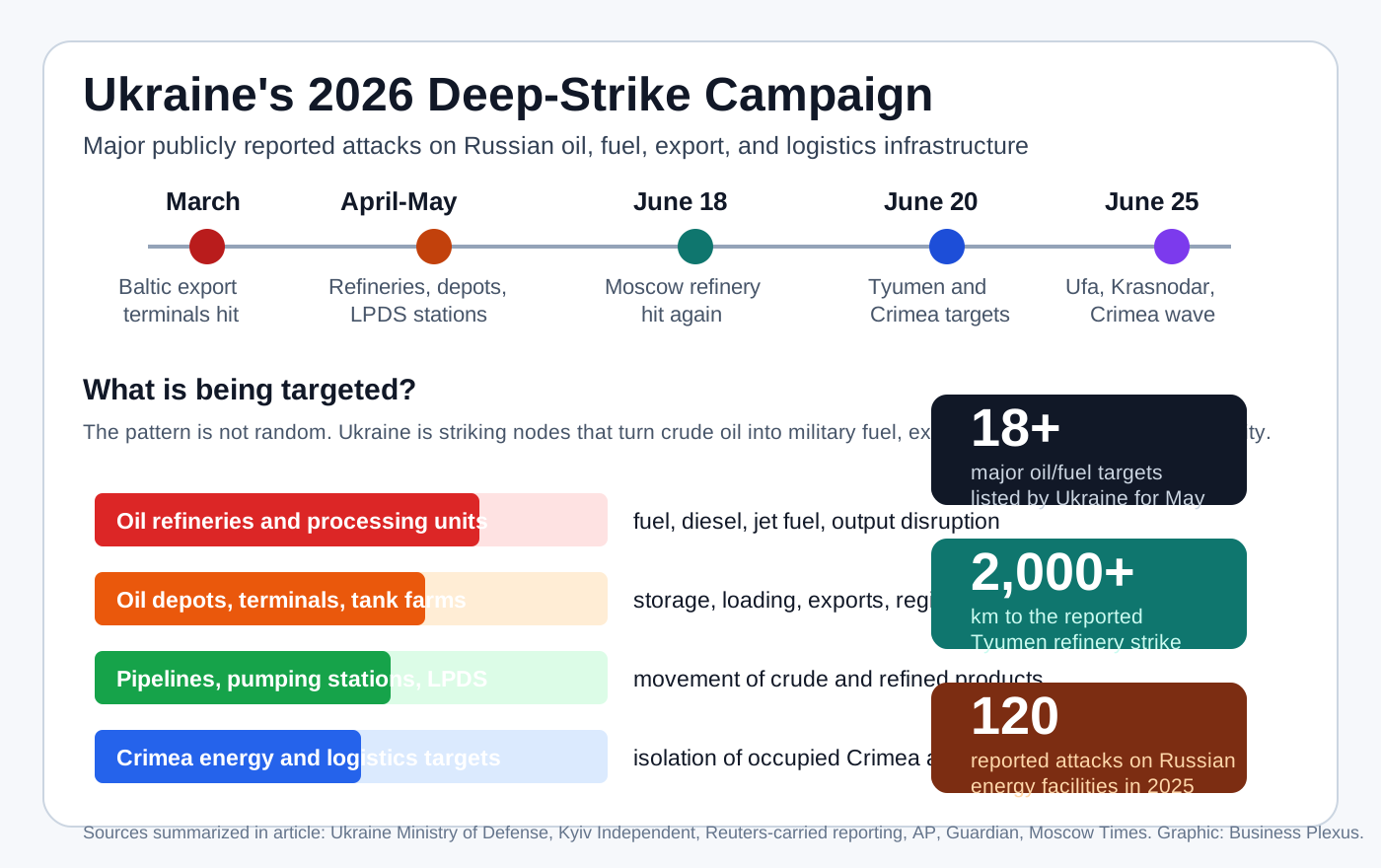
Business Plexus graphic based on publicly reported major strike clusters through July 6, 2026.
The strategic logic is straightforward: Ukraine is trying to make Russia pay twice. First, by destroying or disrupting fuel, refining, storage, export, and logistics infrastructure. Second, by forcing Moscow to spend air-defense resources protecting refineries, ports, bridges, depots, and industrial sites far from the front.
Those physical targets also connect to Russia's elite economy. Refineries and depots are not abstract pieces of machinery; they sit inside networks of state oil companies, private oil fortunes, logistics contractors, and Kremlin-linked power brokers. For that side of the story, see our related catalog of Russia's wartime power brokers and how they fit into the oil, metals, finance, and infrastructure system.
What changed after June 25
The new strikes matter because they show that Ukraine did not treat the June 25 Ufa/Krasnodar/Crimea wave as a one-off. Within days, Ukrainian drones were again reported over Krasnodar Krai, Bashkortostan, Nizhny Novgorod Oblast, the St. Petersburg/Leningrad region, Omsk, Yaroslavl, Kaluga, occupied Crimea, and the Sea of Azov.
The July 6 wave widened the map again. Omsk pushed the campaign roughly 2,500 kilometers from Ukraine's border, while Vysotsk, Kerch, and the Sea of Azov tanker attacks show that Ukraine is treating export terminals, fuel shipment routes, and occupied Crimea's supply chain as part of the same target set.
The Ukrainian Ministry of Defense's June summary said Ukraine struck 11 Russian oil refineries and 8 defense-industry facilities during the month, along with fuel logistics hubs, communications facilities, naval assets, and other targets. That official framing is important: Kyiv is presenting the campaign as a systematic effort to hit fuel, logistics, communications, and weapons production together.
The late-June and early-July follow-on strikes also reinforce the repair problem. Russia can repair individual sites, move fuel by other routes, and prioritize military supply. But repeated hits on the same refinery complexes, including Ufa and Kstovo, create a different kind of pressure. The question is no longer only whether a facility was damaged. It is whether Russia can keep enough units online while new repairs, export restrictions, regional shortages, and air-defense deployments pile up at the same time.
The May list is the key
The most useful single document for understanding the scale of the campaign is Ukraine's own May summary. The Ukrainian Ministry of Defense said that in May 2026 Ukrainian deep-strike operations reached more than ten Russian regions and that the longest-range strike reached 1,700 kilometers from the state border.
The same summary said at least 18 major Russian oil refining and fuel logistics facilities were halted or significantly disrupted in May, with combined design processing capacity above 110 million tonnes of crude oil per year. That does not mean every ton of capacity was permanently destroyed. It means Ukraine was striking a large share of the system's most valuable nodes, repeatedly enough that repair schedules and operational planning become a moving target.
The May list included refineries at Tuapse, Perm, Kirishi, Yaroslavl, Ryazan, Kstovo, Syzran, Volgograd, and Saratov; oil and product terminals around Novorossiysk and Taman; LPDS and pumping stations in Perm, Vladimir, Moscow Oblast, Yaroslavl, and Kirov; the Astrakhan gas processing plant; and regional oil depots in places such as Unecha, Taganrog, Feodosiia, and Armavir.
That is the difference between a raid and a campaign. One refinery fire is a headline. Eighteen oil and fuel logistics targets in a month is an attempt to impose a recurring cost on the Russian war economy.
Moscow was a turning point
The June attacks on Moscow's Kapotnya refinery stand out because they connected the war to the capital's own fuel supply. Reuters reporting carried by Defense News described the June 18 attack as hitting Moscow's refinery for the second time that week, with flames and smoke visible over the southeastern district where the plant is located.
Follow-up Reuters reporting, summarized by the Kyiv Independent and The Moscow Times, said the refinery was unlikely to resume production this year. Industry sources said repairs could take at least six months. The same reporting said one damaged unit accounted for 53 percent of capacity and a second modern unit accounted for the remaining 47 percent.
If those figures hold, the Moscow strike is not merely symbolic. It is a direct hit on a refinery that processed 11.6 million metric tons of crude in 2024 and produced millions of tons of gasoline and diesel. The broader effect is also psychological: if Moscow's own refinery needs additional protection, then every other refinery and depot in Russia has to ask the same question.
Tyumen changed the map
The reported strike on the Tyumen oil refinery in western Siberia pushed the map much farther east. The Guardian reported that Zelensky confirmed a Ukrainian drone attack on an oil refinery more than 2,000 kilometers from Ukraine and said new Ukrainian drones developed by Fire Point could travel more than 3,000 kilometers.
The Kyiv Independent reported that the Tyumen refinery processes about 7.5 million to 9 million metric tons of crude per year and that Ukraine framed the strike as part of its "long-range sanctions" campaign. Russian officials claimed air defenses repelled the attack and that debris fell, a familiar formulation after many Ukrainian strikes. But the bigger issue is the range demonstration: refineries once considered deep rear infrastructure are now within reach.
Crimea is a separate campaign
Ukraine's attacks on Crimea are related to the oil-infrastructure campaign, but they have a slightly different purpose. The goal is not only to burn fuel. It is to isolate the peninsula, degrade Russian air defense and radar coverage, disrupt transport, and make it harder to sustain troops in occupied southern Ukraine.
On June 25, the Kyiv Independent reported that Ukraine struck energy and oil infrastructure as well as military facilities across occupied Crimea. The reported target set included the Tavriya Thermal Power Plant in Simferopol, an oil depot in Dzhankoi, two gas compressor stations, two electrical substations, three coastal radar stations, and an anti-aircraft gun. Ukrainian commander Robert "Madyar" Brovdi said 38 sites were targeted.
That campaign also has visible effects. Russian-installed authorities in Crimea have reported strain on the grid, transportation disruptions, and fuel-sale restrictions. Ukraine's defense leadership has described the goal in plain language: turning Crimea "into an island" by cutting logistics and supply routes.
Why Ukraine can do this more often now
The first reason is range. Ukraine is no longer relying only on scarce Western long-range missiles for deep attacks. It has developed a domestic long-range drone industry, including fixed-wing one-way attack drones that can travel hundreds or thousands of kilometers. The Associated Press reported from inside Fire Point's production network in 2025 that its FP-1 drones could travel up to 1,600 kilometers and were used against oil refineries, arms depots, and other targets. By June 2026, Zelensky was publicly talking about drones capable of reaching 3,000 kilometers.
The same industrial logic may now be moving from drones into missiles. We examine that shift in a related article on Ukraine's emerging ballistic missile strategy and why manufacturability may matter more than peak performance.
The second reason is scale. Ukraine has turned drones into an industrial program, not just a battlefield improvisation. Business Insider reported that Zelensky said Ukraine was on track to produce 10 million drones in 2026, up from 4 million in 2025. Most of those are not refinery-strike drones, but the production culture matters. Ukraine now has a dense ecosystem of manufacturers, military users, procurement channels, software teams, volunteer funders, and feedback loops from the front.
The third reason is targeting discipline. Ukraine is not hitting random industrial buildings. The target list tends to cluster around fuel production, military logistics, ports, aviation fuel, pipelines, pumping stations, ammunition, radio electronics, and Crimea supply infrastructure. That suggests a campaign designed around systemic pressure rather than headline value alone.
The fourth reason is Russia's air-defense problem. Russia can defend Moscow, the Kerch Bridge, oil terminals, air bases, missile factories, refineries, border regions, occupied Crimea, and the front line, but it cannot defend all of them perfectly at the same time. Kyiv Independent reporting cited Zelensky as saying Russia had redeployed air defense systems to protect Moscow and the Kerch Bridge, weakening coverage elsewhere. That is exactly the dilemma Ukraine wants to create.
The economic pressure is already visible
The damage is not limited to burnt tanks. The Moscow Times, citing Kommersant and Bloomberg calculations, reported that Ukrainian strikes cost Russia's oil sector more than $13 billion in direct and indirect losses in 2025. The same report said Ukraine carried out 120 attacks on Russian energy facilities that year, including 81 against refineries.
By June 2026, Russian fuel-market stress was becoming harder to dismiss. Reuters-carried reporting said Russia was weighing additional export restrictions, including on diesel, as refinery damage and fuel shortages spread. The Moscow refinery outage alone adds pressure to a system already coping with regional gasoline restrictions, higher prices, and the need to shift supply by rail, truck, or imports.
The July 2 Kstovo strike sharpened that pressure. The Kyiv Independent, citing Reuters, reported that NORSI was the fifth Russian refinery to shut down since the beginning of June, following outages at Volgograd, Kuibyshev, Taneco, and Moscow. The same report said Putin had publicly acknowledged lines at gas stations and missing gasoline grades, while Russia relaxed fuel-quality standards to manage the shortage.
That does not mean Russia is out of fuel. Russia is a huge oil producer with spare routes, storage, emergency rules, and the ability to prioritize the military over civilian consumers. But the point of Ukraine's campaign is cumulative friction: less refining margin, more regional shortage risk, higher insurance costs, more repairs, more air-defense deployments, more export complications, and less certainty for Russian planners.
What to watch next
The next phase will be judged by repetition. A single successful strike is less important than whether Ukraine can keep returning to the same refinery, hitting replacement equipment, and forcing Russia to keep units offline. Watch for reports of crude distillation units, hydrotreaters, isomerization units, substations, tank farms, loading racks, and pipeline pumping stations. Those are often more important than dramatic video of a fire.
Also watch the geography. If strikes continue beyond the familiar belt of Belgorod, Rostov, Krasnodar, Crimea, and Moscow into places like Bashkortostan, Tyumen, Omsk, Kirov, Perm, Kaluga, Yaroslavl, and Leningrad Oblast, then Russia's rear area is no longer a rear area in the old sense. It becomes a defended industrial battlespace.
The central question is whether Ukraine can keep the cost curve moving faster than Russia can repair, harden, disperse, and defend. For now, the answer appears to be that Ukraine has found a real pressure point. It will not win the war by itself, but it is forcing Russia to defend its oil economy as part of the battlefield.
Sources and further reading: Ukraine Ministry of Defense's May deep-strike summary and June deep-strike summary; Kyiv Independent reporting on the July 6 Omsk, Yaroslavl, Vysotsk, Kaluga, Crimea, and Sea of Azov strike wave, June 25 Ufa and Krasnodar strikes, Crimea energy strikes, Tyumen and Crimea strikes, Moscow refinery outage, Kstovo/NORSI shutdown, and St. Petersburg oil infrastructure strike; Associated Press and Kyiv Post on the June 28 Slavyansk and Yaroslavl strikes; Associated Press and Euronews on the July 1 Ufa strike; Reuters reporting republished by Defense News; The Guardian on the Tyumen strike and 3,000 km drone claims; Associated Press on Fire Point's long-range drone production; and The Moscow Times on reported 2025 oil-sector losses.