Myanmar has become one of the most intense drone battlefields outside Ukraine. What began after the 2021 coup as improvised resistance use of commercial drones has become a national drone arms race involving the military junta, People’s Defence Force units, ethnic armed organizations, border supply chains, Chinese commercial technology, Russian military support, and local workshops.
The short version is this: resistance groups pioneered the mass use of drones in Myanmar and still account for the larger cumulative number of reported drone-strike events. But since 2024 the central military government has caught up quickly. The junta now has deeper supply lines, better electronic warfare, more money, state factories, Russian support, and access to Chinese commercial and military-adjacent technology. That shift is one reason analysts now say the resistance has lost part of its early drone advantage.
Who is using the most drones?
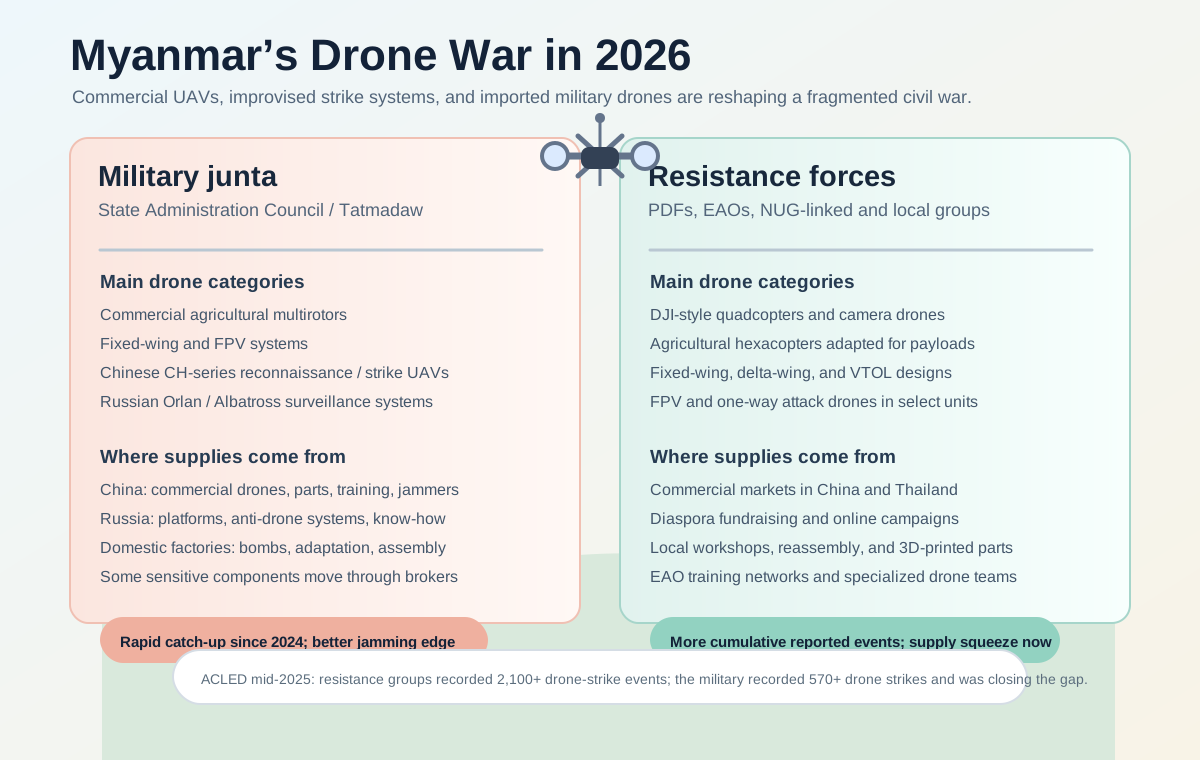
It depends on what is being counted. If the question is cumulative reported drone strike events since the resistance first began using drones in late 2021, the answer is the resistance side: PDFs, ethnic armed organizations, and specialized drone teams. ACLED recorded more than 2,100 drone-strike events by resistance groups across more than 600 locations by mid-2025.
If the question is who has the stronger trend line right now, the answer is increasingly the junta. ACLED recorded more than 570 military drone strikes by May 2025, and its reporting emphasized that the military was rapidly closing the gap. Al Jazeera, citing ACLED in March 2026, said Myanmar’s war had seen hundreds of drone attacks alongside thousands of air strikes since the coup. The important point is not one exact number. It is the direction: drones are no longer mainly a resistance tool.
The resistance side: commercial drones as an improvised air force
For the resistance, drones became the substitute for an air force. Many post-coup groups lacked artillery, aircraft, armored vehicles, and reliable ammunition supplies. Commercial UAVs offered a way to scout military positions, harass checkpoints, attack supply routes, and support larger offensives without needing a conventional military-industrial base.
The most common systems are multi-rotor drones, including quadcopters and hexacopters, plus agricultural drones adapted for heavier payloads. Fixed-wing drones, delta-wing designs, VTOL drones, and FPV-style systems are also used by better organized units. ACLED identifies Federal Wings and Cloud Wings, linked to the Karen National Union/Karen National Liberation Army area, as specialized drone forces, while Shar Htoo Waw has served as a knowledge and training hub for drone innovation.
Other users include local People’s Defence Force units aligned with the National Unity Government, the Chin resistance, Karenni forces, Kachin Independence Army-linked operations, the Arakan Army, and groups connected to the Three Brotherhood Alliance. Capabilities vary widely. Some units can plan long-range coordinated strikes. Others operate only a few commercial drones when parts, batteries, and funding are available.
Where resistance drones come from
The resistance supply chain is improvised and fragile. Drones and components have generally come from commercial markets rather than formal arms transfers. Sources include Chinese-made consumer drones, agricultural drones, parts bought through online platforms, smuggling routes through Thailand and China, local reassembly, diaspora fundraising, and small workshops inside Myanmar. Some components are repaired, reused, or adapted repeatedly because replacement parts are expensive and hard to move.
That supply chain has tightened. ACLED reported that China was asked to block dual-use exports and drone parts to resistance groups, while border restrictions, currency depreciation, inflation, and enforcement inside Myanmar pushed up costs. Agricultural drones that were reportedly available for about $3,000 in 2023 were estimated at more than $6,000 by 2025. That matters because resistance drone units are not only competing with the junta’s aircraft; they are competing with customs barriers, sanctions risk, jammers, batteries, spare parts, and money.
The junta side: from aircraft dominance to drone saturation
The military junta already had the airpower advantage: jets, helicopters, transport aircraft, and artillery coordination. Its weakness was ground manpower and the inability to hold every front at once. Drones help solve that problem. They can watch roads and bases, guide artillery, strike small targets, support isolated outposts, and make resistance advances more costly without always sending pilots or large ground units into danger.
Myanmar’s military had used drones for surveillance before the civil war, and it had acquired Chinese CH-series UAVs earlier. But the post-2024 shift is different. The junta began copying the resistance model: large numbers of cheaper commercial drones, especially agricultural drones, adapted for combat. Reuters reported in 2024 that the junta was building a Chinese drone fleet after learning from the rebels. LSE’s 2026 report says the military purchased an initial batch of roughly 2,000 to 3,000 agricultural drones from China in mid-2024, while adding fixed-wing and FPV drones and investing in military-grade systems with infrared and night capability.
ACLED’s annex lists a mix of systems accessible to the military: Chinese CH-3, CH-3A, and CH-4 fixed-wing drones; Chinese multi-rotor models such as DJI Mavic series and other small UAVs; Chinese VTOL systems; Russian Albatross-M5, Orlan-10E, and other surveillance systems; and improvised delta-wing drones inspired by one-way attack designs. Some listed systems are for reconnaissance, some for strikes, and some for both.
Where the junta gets its drones and parts
The junta’s supply chain is more state-like. China is the most important source for commercial drones, parts, training, manufacturing assistance, and anti-drone systems. Russia has become the regime’s major defence partner for aircraft, munitions, drones, anti-drone systems, and operational knowledge. Al Jazeera reported in March 2026 that Russian-made jets, helicopters, and drones were helping the military regain battlefield momentum.
There is also a gray-market layer. The Guardian reported in 2025 on Conflict Armament Research findings that advanced European anti-jamming technology had reached Myanmar military drones through a Chinese supply chain, ending near the China-Myanmar border. That does not mean every company in the chain intended to arm the junta, but it shows why modern drone warfare is difficult to control: sensitive navigation, anti-jamming, imaging, batteries, radios, and flight-control technology can move through ordinary commercial channels.
Why jamming changed the balance
The resistance’s early drone edge depended on cheap commercial systems being good enough. The junta’s counter was electronic warfare. ACLED reports that military jammers now appear at major bases and can disrupt many common resistance drones. When a drone loses connection, it may crash, return home, hover, or miss its target. That makes each attack riskier and more expensive for resistance groups.
Jamming also changes tactics. Better-equipped groups such as the Kachin Independence Army may be able to adapt, but smaller PDFs may lose drones faster than they can replace them. This is why drones are not just about the airframe. The winning side needs batteries, cameras, radios, navigation, trained operators, spare parts, anti-jam capability, and enough money to keep replacing what is lost.
What this means for the war
Drones have not decided the war by themselves. Myanmar is still a fragmented conflict shaped by geography, ethnic politics, conscription, air strikes, artillery, border trade, rare earths, Chinese pressure, Russian support, and the resistance’s difficulty unifying command. But drones have changed the cost of fighting. They make remote positions more vulnerable, complicate resupply, expose infantry movements, and allow small units to hit targets that once required artillery or aircraft.
For the defense industry, Myanmar shows how quickly a drone war can emerge from civilian supply chains. The most important platforms are not always expensive strategic UAVs. Often they are commercial drones, agricultural drones, improvised fixed-wing systems, and cheap sensors tied together by local adaptation. The side with the best supply chain, not just the best single drone model, gains the advantage.
The current direction favors the junta in technology and logistics, but not necessarily in political control. Resistance forces still operate across much of the country and have shown unusual creativity. The danger for civilians is that both sides are now fighting under a sky filled with more drones, more jammers, more air strikes, and more pressure to attack before the other side adapts.
Sources and notes: Drone-event counts, drone types, resistance groups, jamming, and military drone-strike data are drawn from ACLED’s July 2025 report on Myanmar drone warfare. The broader 2026 framing and China/Russia supply-chain analysis are informed by Matthew B. Arnold’s LSE IDEAS report, How Myanmar’s War Became the World’s Second Biggest Drone Fight. Current conflict context and Russian support are from Al Jazeera. Chinese commercial-drone procurement is supported by Reuters reporting republished by AsiaOne. European anti-jamming component diversion is from the Guardian’s report on Conflict Armament Research findings.